Many learners feel confused when they see “stinged” and “stung.” Both words seem to come from the verb “sting,” so it looks like both could be correct.
But in real English, only one of them is used in standard grammar. This confusion is very common, especially for students and ESL learners, because English verbs do not always follow simple rules.
This article will make everything clear in very simple English so you can understand it easily the first time.
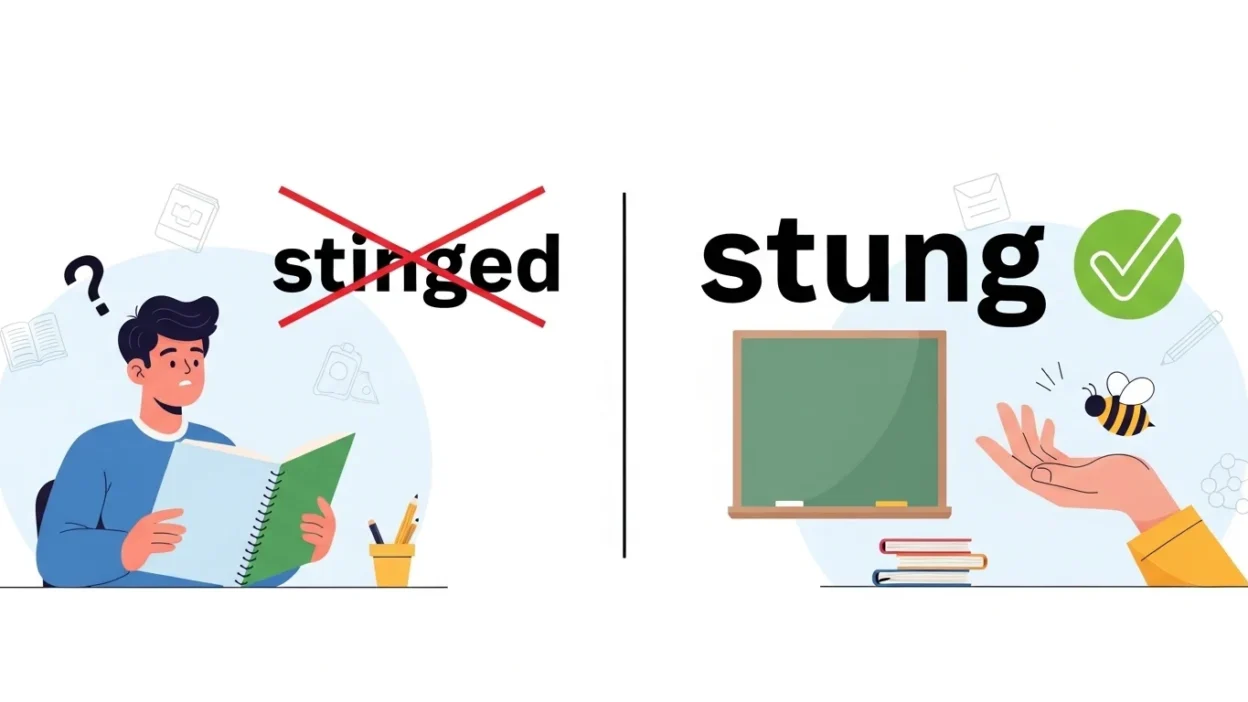
Quick Answer
- ✅ “Stung” is correct
- ❌ “Stinged” is not correct in standard English
- “Stung” is the past tense and past participle of “sting”
- Use “stung” when talking about something that already happened
Simple Origin and Background
The verb “sting” is an irregular verb. This means it does not follow the normal “-ed” rule.
Most English verbs work like this:
- walk → walked
- play → played
But some verbs change in a different way:
- sing → sang → sung
- ring → rang → rung
- sting → stung → stung
So instead of saying “stinged,” English uses “stung.”
“Stinged” may look correct because many verbs use “-ed,” but in this case, English follows an older pattern.
Clear Explanation of the Difference
What is “Stung”?
“Stung” is the correct form of the verb “sting.” It is used when:
- Something already happened in the past
- You are using present perfect tense
Examples:
- The bee stung me.
- She has been stung by a jellyfish.
- His words really stung.
What is “Stinged”?
“Stinged” is not a correct word in standard English.
Some learners create it by mistake because:
- They think all verbs follow the “-ed” rule
- It sounds logical
But in real usage, native speakers do not use “stinged.”
Comparison
| Word | Correct or Not | Meaning | Example |
| Stung | ✅ Correct | Past form of “sting” | The insect stung him. |
| Stinged | ❌ Incorrect | Not used in standard English | ❌ He was stinged by a bee. |
Which One to Use and When
Always use “stung.”
Use it in these situations:
Talking about the past
- The bee stung my hand.
Talking about experience
- I have been stung before.
Talking about emotional pain
- Her comment stung a little.
Never use “stinged” in any of these cases.
Common Mistakes People Make
Here are some mistakes learners often make:
Adding “-ed” to every verb
- ❌ He stinged me
- ✅ He stung me
Mixing past forms
- ❌ I have stinged my finger
- ✅ I have stung my finger
Confusing spelling
Some learners write:
- “stunged” (also incorrect)
Using logic instead of memory
English is not always logical. Some verbs must be memorized.
Everyday Real Life Examples
In Emails
- I got stung by a bee yesterday, so I may not come to work.
In News
- Several swimmers were stung by jellyfish.
On Social Media
- That comment really stung, but I’m okay now.
In Daily Conversation
- Watch out! I was stung there last week.
Emotional Use
“Sting” is not only about insects. It can also mean emotional pain:
- His words stung her feelings.
Learning Section for Students and Beginners
Here is an easy way to remember:
Think of similar verbs
- sing → sung
- ring → rung
- sting → stung
They follow the same pattern.
Practice sentences
Try saying these out loud:
- The bee stung me.
- I have been stung before.
- That joke stung a little.
Quick memory tip
If it sounds like “sung” or “rung,” then “stung” is correct.
FAQ Section
Is “stinged” ever correct?
No. It is not used in standard English.
Why do people say “stinged”?
Because they think all verbs use “-ed.” It is a common learning mistake.
What is the past tense of “sting”?
The past tense is “stung.”
Can “stung” be used for feelings?
Yes. It can describe emotional pain.
Example:
- Her words stung me.
What is the past participle of “sting”?
It is also “stung.”
Example:
- I have been stung before.
Is “stung” formal or informal?
It can be used in both formal and informal English.
How can I remember “stung”?
Think of similar words like:
- sung
- rung
They follow the same pattern.
Is “sting” a regular verb?
No. It is an irregular verb, so it does not use “-ed.”
Conclusion
The confusion between “stinged” and “stung” is very common, but the answer is simple:
- “Stung” is correct
- “Stinged” is incorrect
“Sting” is an irregular verb, so it does not follow the normal “-ed” rule. Once you remember this pattern, it becomes easy to use the correct form every time.
Keep practicing with real sentences, and soon “stung” will feel natural to you.

Daniel Matthew is a language enthusiast, writer, and contributor at Meanefy.com, where he explores the meanings, origins, and nuances of words and phrases. With a deep passion for language, Daniel aims to make complex concepts simple, engaging, and easy to understand for readers of all ages.