Many English learners feel confused when they see the words “seeked” and “sought.”
They both seem to come from the verb “seek,” so it feels natural to think they are both correct. But in real English, only one of them is correct.
This confusion happens because English has many irregular verbs. These verbs do not follow the usual “add -ed” rule for the past tense. If you don’t know which verbs are irregular, it’s easy to make mistakes.
Don’t worry this guide will make everything clear in very simple English.
Quick Answer
- “Sought” is correct
- “Seeked” is incorrect in standard English
- “Seek” is an irregular verb
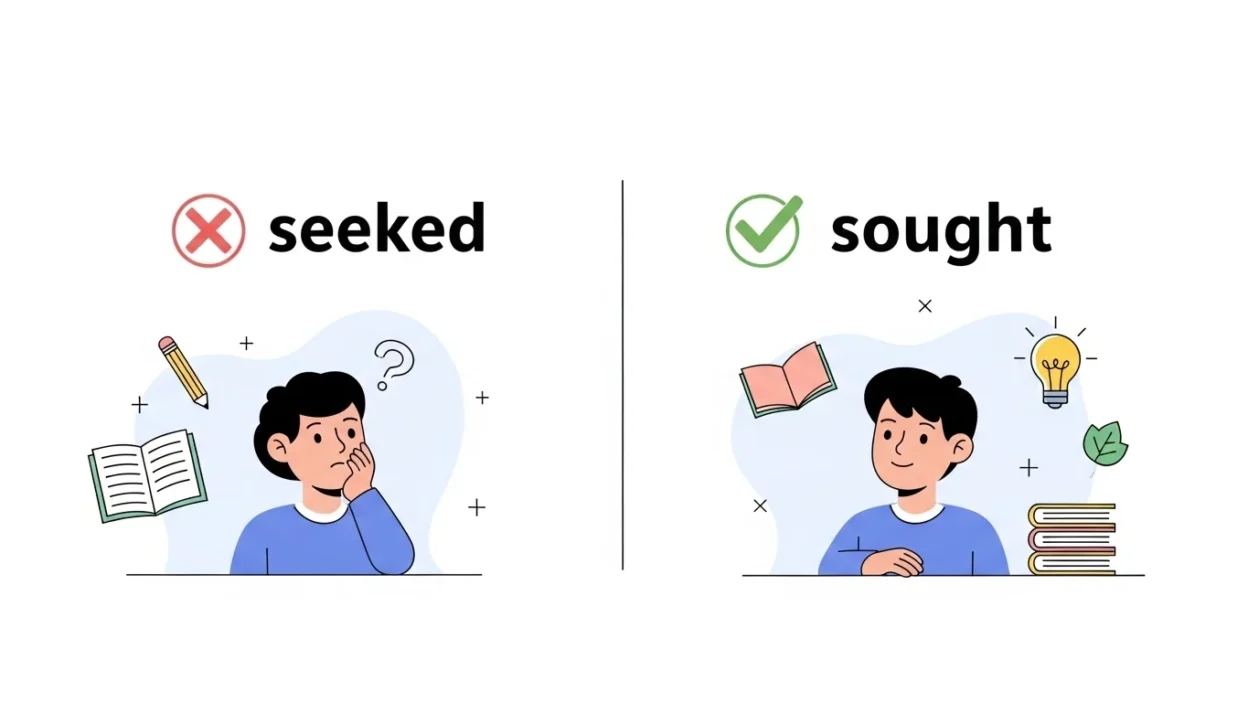
- Past tense of “seek” = sought
- Past participle of “seek” = sought
Example:
- Correct: I sought help.
- Incorrect: I seeked help.
Simple Background
The verb “seek” means:
- to try to find something
- to ask for something
- to look for help, advice, or information
English verbs have two main types:
- Regular verbs → add -ed (walk → walked)
- Irregular verbs → change in a different way (go → went)
“Seek” is an irregular verb, so it does not become “seeked.” Instead, it changes to sought.
This pattern comes from old English forms that are still used today.
Clear Explanation of the Difference
Let’s make it very simple:
“Seeked”
- Sounds logical
- Follows regular verb pattern
- But it is NOT correct in standard English
- Rarely used, and often seen as a mistake
“Sought”
- Correct past form of “seek”
- Used in speaking and writing
- Accepted everywhere (school, exams, formal writing)
Why the confusion?
Because learners think:
“Walk → walked, so seek → seeked”
But English does not always follow this rule.
Comparison
| Word | Correct? | Type | Use Case | Example |
| Seeked | No | Incorrect form | Not used in standard English | ❌ I seeked help |
| Sought | Yes | Irregular form | Past tense and past participle | ✅ I sought help |
Which One to Use and When
Always use “sought” when you talk about the past.
Use “sought” when:
- Talking about something in the past
- Writing essays or emails
- Speaking in daily life
- Taking exams
Examples:
- She sought advice from her teacher.
- They sought a better solution.
- He sought help online.
Never use “seeked” in:
- School writing
- Formal communication
- Professional situations
Common Mistakes People Make
Here are mistakes learners often make:
Using “seeked” instead of “sought”
❌ I seeked information online
✅ I sought information online
Mixing present and past forms
❌ Yesterday, I seek help
✅ Yesterday, I sought help
Using “sought” incorrectly in present tense
❌ I sought help every day (if talking about now)
✅ I seek help every day
Forgetting it is irregular
Many learners memorize rules but forget exceptions like this one.
Everyday Real Life Examples
In Emails
- I sought clarification before replying.
- She sought approval from her manager.
In News
- The company sought new investors.
- The government sought public support.
On Social Media
- I sought advice from my followers.
- He sought opinions before making a decision.
In Daily Conversation
- I sought help from a friend.
- We sought a better place to live.
In School or Study
- The student sought guidance from the teacher.
- They sought answers in the textbook.
Learning Section for Students and Beginners
Here is a simple way to remember:
Step 1: Learn the base verb
- Seek = to look for something
Step 2: Memorize the past form
- Seek → Sought
Step 3: Practice with simple sentences
- I seek help (present)
- I sought help (past)
Easy Memory Tip
Think of it like:
- Teach → taught
- Seek → sought
The “-ought” sound can help you remember.
Practice Sentences
Fill in the blank:
- Yesterday, I ______ help.
Answer: sought - She has ______ advice many times.
Answer: sought
FAQ Section
Is “seeked” ever correct?
No, “seeked” is not correct in standard English. Always use “sought.”
Why do people say “seeked”?
Because they follow the regular verb rule (add -ed). But “seek” is irregular.
What is the past tense of “seek”?
The past tense of “seek” is sought.
What is the past participle of “seek”?
It is also sought.
Example:
- I have sought help before.
Can I use “sought” in speaking?
Yes, it is correct in both speaking and writing.
Is “sought” formal or informal?
It works in both. You can use it in daily conversation and formal writing.
What does “seek” mean?
It means:
- to look for something
- to ask for something
Are there other verbs like this?
Yes, many irregular verbs exist. For example:
- Think → thought
- Bring → brought
Conclusion
The difference between “seeked” and “sought” is actually very simple:
- “Seeked” is incorrect
- “Sought” is correct
Even though “seeked” looks logical, English does not use it. The correct past form of “seek” is always sought.
If you remember just one thing, remember this:
Seek → Sought (never seeked)
With a little practice, this will feel natural. Keep using “sought” in your sentences, and soon you won’t feel confused at all.

Anthony Charles is the founder and lead content creator at Meanefy.com, a platform dedicated to exploring word meanings, language nuances, and everyday curiosities. With a passion for language and a keen eye for detail, Anthony aims to make complex words and concepts simple and accessible for readers around the world.