
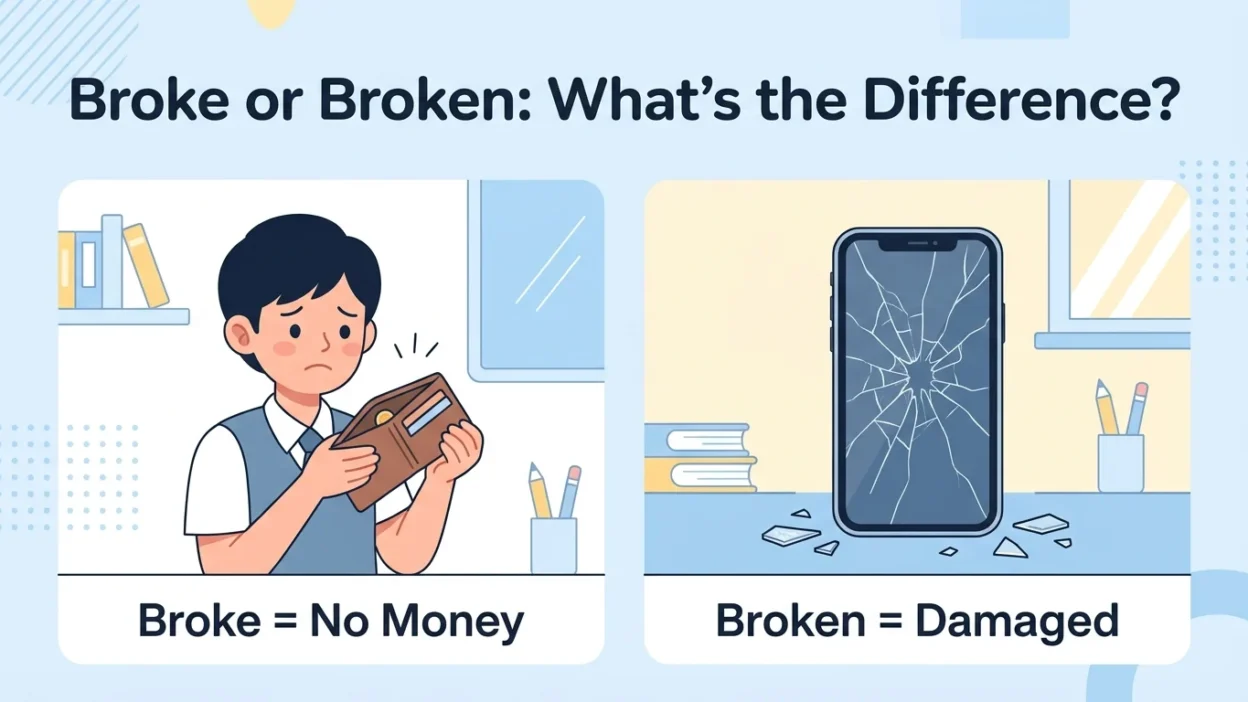
Many English learners get confused between broke and broken because both words come from the verb break. They look similar, sound similar, and are sometimes used in related situations.
For example:
- “My phone is broke.”
- “My phone is broken.”
One sentence is correct, and one is not. This is where many students feel unsure.
The good news is that the difference is actually very simple once you understand how each word works in a sentence. This guide will explain everything in easy English with clear examples from daily life.
Quick Answer
Here is the simple difference:
- Broke = usually the past tense of “break”
- Broken = the past participle of “break”
Simple examples:
- I broke my glass yesterday. ✅
- The glass is broken. ✅
Important tip:
- “Broke” can also mean having no money.
- “Broken” cannot mean “having no money.”
Example:
- I’m broke after shopping. ✅
- I’m broken after shopping. ❌
Simple Background of the Words
The base verb is:
- Break
Different forms of the verb are:
| Verb Form | Word |
| Base form | break |
| Past tense | broke |
| Past participle | broken |
This is called an irregular verb because the forms change completely.
Examples:
- I break things sometimes.
- Yesterday I broke a plate.
- The plate has broken.
- The plate is broken.
Understanding the Difference Clearly
What Does “Broke” Mean?
“Broke” is mainly the past tense of the verb “break.”
It tells us that something happened in the past.
Examples
- She broke her pencil.
- I broke my glasses.
- They broke the window.
In all these sentences, someone did the action in the past.
“Broke” Also Means No Money
This is another very common meaning.
Examples
- I’m broke until Friday.
- He spent all his salary and now he’s broke.
- We can’t eat outside because we’re broke.
Here, “broke” means having little or no money.
What Does “Broken” Mean?
“Broken” describes the condition of something.
It often means:
- damaged
- not working
- separated into pieces
Examples
- My laptop is broken.
- The chair was broken.
- Their relationship is broken.
“Broken” is usually used:
- after is/am/are
- after was/were
- after has/have/had
Examples
- The machine is broken.
- My watch was broken yesterday.
- He has broken the rule.
Easy Comparison
| Feature | Broke | Broken |
| Type of word | Past tense verb | Past participle/adjective |
| Main meaning | Did the action in the past | Something is damaged |
| Example | I broke the cup. | The cup is broken. |
| Used with “has/have” | No | Yes |
| Can mean “no money”? | Yes | No |
| Common in speaking | Very common | Very common |
| Correct sentence | She broke it. | It is broken. |
Which One Should You Use?
Use “Broke” When Someone Did the Action
Pattern:
Person + broke + object
Examples
- Tom broke the TV.
- I broke my phone.
- The child broke the toy.
Here, the action happened in the past.
Use “Broken” When Describing Condition
Pattern:
Object + is/was + broken
Examples
- The TV is broken.
- My phone was broken.
- The toy is broken now.
Here, we focus on the condition, not the action.
Use “Broken” After Have/Has/Had
Examples
- She has broken the glass.
- They had broken the rules.
- I have broken my promise.
Never use “broke” after “has,” “have,” or “had.”
Wrong:
- She has broke the glass. ❌
Correct:
- She has broken the glass. ✅
Common Mistakes People Make
Mistake: “My phone is broke”
This mistake is extremely common among learners.
Wrong:
- My phone is broke. ❌
Correct:
- My phone is broken. ✅
Why?
Because after “is,” we usually use “broken,” not “broke.”
Mistake: Using “broken” for Money Problems
Wrong:
- I am broken this month. ❌
Correct:
- I am broke this month. ✅
“Broken” does not mean “without money.”
Mistake: Using “broke” After “has” or “have”
Wrong:
- He has broke the chair. ❌
Correct:
- He has broken the chair. ✅
Mistake: Confusing Action and Condition
Compare these:
- Sarah broke the window.
→ Sarah did the action. - The window is broken.
→ The window is in damaged condition.
Both are correct, but the meaning focus is different.
Everyday Real Life Examples
Daily Conversation
Examples
- I dropped my phone and broke it.
- Sorry, the elevator is broken.
- We are broke after vacation.
- Someone broke the coffee machine.
In Emails
Examples
- My computer is broken, so I cannot join the meeting today.
- I accidentally broke the office printer.
On Social Media
Examples
- My heart is broken.
- I’m completely broke after online shopping.
- Who broke my headphones?
In News or Reports
Examples
- Strong winds broke several trees.
- The bridge was broken during the storm.
- The company is financially broke.
In School or Classroom Situations
Examples
- The student broke the ruler.
- The classroom fan is broken.
- I can’t buy lunch today because I’m broke.
Simple Learning Tips for Students and Beginners
Easy Memory Trick
Think like this:
Broke = Action
Someone did something.
- I broke the glass.
Broken = Result
What is the condition now?
- The glass is broken.
This simple trick helps many learners remember the difference quickly.
Another Easy Trick
If you see:
- is
- am
- are
- was
- were
- has
- have
- had
then “broken” is usually the correct choice.
Examples
- The car is broken.
- She has broken the rule.
Practice Sentences
Choose the correct word:
Example 1
I _____ my watch yesterday.
Answer:
- broke ✅
Example 2
My watch is _____.
Answer:
- broken ✅
Example 3
We are completely _____ after paying rent.
Answer:
- broke ✅
Mini Practice Quiz
Fill in the blanks
Questions
- Someone _____ the window.
- The window is _____.
- I’m _____ until payday.
- She has _____ her phone.
- They _____ the chair yesterday.
Answers
- broke
- broken
- broke
- broken
- broke
FAQ
Is “my phone is broke” correct?
No. The correct sentence is:
- My phone is broken. ✅
Can “broke” mean poor?
Yes. “Broke” often means having no money.
Example:
- I’m broke right now.
Is “broken” a verb or adjective?
It can work as both, but very often it acts like an adjective.
Example:
- The door is broken.
Which is correct: “has broke” or “has broken”?
“Has broken” is correct.
Example:
- She has broken the glass.
Can I say “I am broken”?
Yes, but the meaning is emotional or physical, not financial.
Example:
- After the loss, he felt broken.
This means emotionally hurt.
Why do learners confuse these words?
Because both words come from “break,” and many languages use only one form for both meanings.
Is “broke” always wrong after “is”?
Usually yes when talking about damaged things.
Wrong:
- The TV is broke. ❌
Correct:
- The TV is broken. ✅
But “I am broke” is correct because it means “I have no money.”
Can “broken” describe emotions?
Yes.
Examples:
- a broken heart
- a broken spirit
- a broken relationship
Here, it means emotionally damaged.
Conclusion
The difference between broke and broken becomes easy when you remember one simple idea:
- Broke usually talks about an action in the past.
- Broken usually describes a condition or result.
Examples:
- I broke the cup.
- The cup is broken.
Also remember:
- “Broke” can mean having no money.
- “Broken” cannot mean poor.
With practice and real life examples, these two words become much easier to understand. Many learners confuse them at first, but after learning the patterns, you can use both words naturally and correctly in daily English.

Daniel Matthew is a language enthusiast, writer, and contributor at Meanefy.com, where he explores the meanings, origins, and nuances of words and phrases. With a deep passion for language, Daniel aims to make complex concepts simple, engaging, and easy to understand for readers of all ages.