Many learners feel confused about “froze” and “frozen.” Both words come from the verb “freeze,” and both talk about cold or ice. Because they look similar and have similar meanings, it is easy to mix them up.
But don’t worry. This guide will explain everything in very simple English. By the end, you will clearly understand when to use froze and when to use frozen.
Quick Answer
Here is the simple difference:
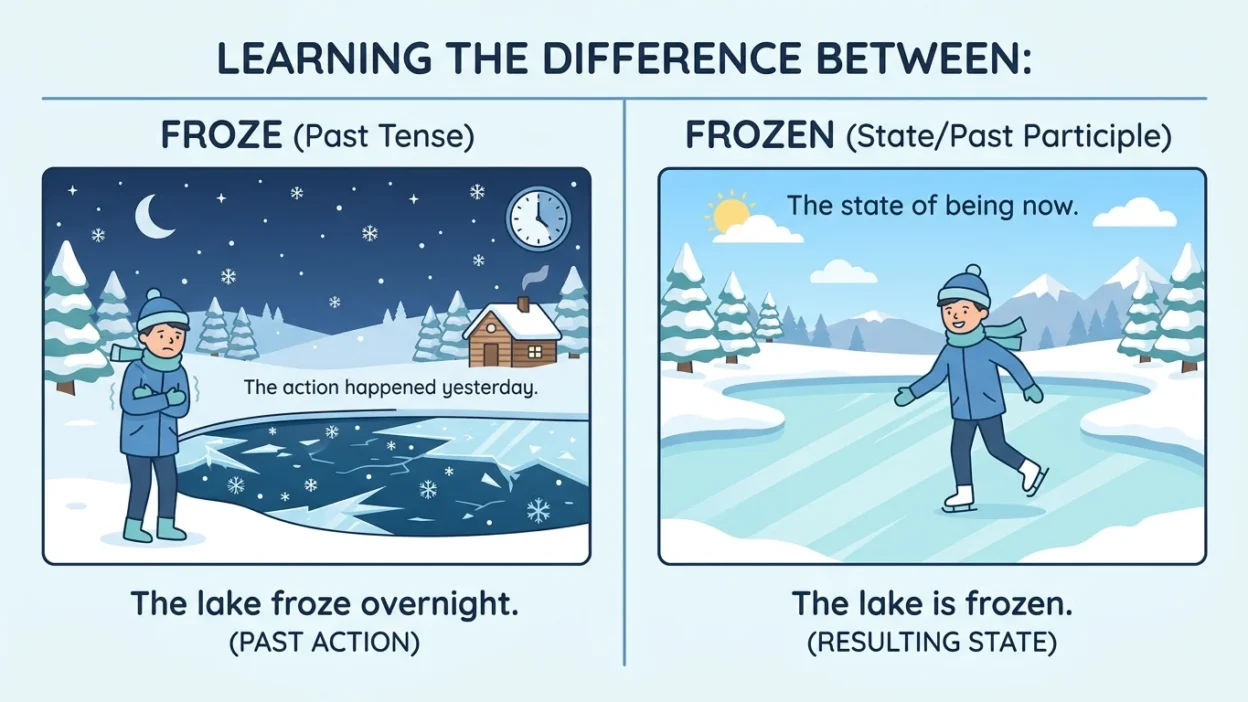
- Froze = past tense (something already happened)
- Frozen = past participle (used with “has,” “have,” or “had”)
Examples:
- I froze the water yesterday.
- The water has frozen.
Think of it like this:
- Froze = simple past
- Frozen = used with helping verbs
Simple Background of the Words
The base verb is freeze.
Here are its forms:
- Present: freeze
- Past: froze
- Past participle: frozen
English has many verbs like this. They change their form instead of adding ed.
For example:
- break → broke → broken
- choose → chose → chosen
So, froze and frozen are just different forms of the same verb.
Clear Explanation of the Difference
Let’s make it very easy.
Froze
Use froze when you talk about something that happened in the past.
- No helping verb is needed
- It shows a completed action in the past
Example:
- The lake froze last night.
- I froze the juice to make ice cubes.
Frozen
Use frozen with helping verbs like:
- has
- have
- had
- is / was (in passive voice)
Example:
- The lake has frozen.
- My hands have frozen in the cold.
- The food was frozen before cooking.
Simple Way to Remember
- If there is no helping verb, use froze
- If there is a helping verb, use frozen
Comparison
| Feature | Froze | Frozen |
| Type | Past tense | Past participle |
| Needs helping verb | No | Yes |
| Example | It froze last night | It has frozen |
| Usage | Simple past | Perfect or passive forms |
| Easy clue | No “has/have” | Has/have/had is present |
Which One to Use and When
Here is a simple guide:
Use “froze” when:
- You talk about a finished action in the past
- You do not use helping verbs
Examples:
- The pipes froze during winter.
- She froze the leftovers yesterday.
Use “frozen” when:
- You use has, have, or had
- You talk about a result or condition
- You use passive voice
Examples:
- The pipes have frozen.
- The food has been frozen.
- My phone screen is frozen.
Common Mistakes People Make
Here are mistakes learners often make:
Using “frozen” without a helping verb
❌ The lake frozen last night
✔️ The lake froze last night
Using “froze” with “has” or “have”
❌ The lake has froze
✔️ The lake has frozen
Mixing both forms
❌ I have froze the food
✔️ I have frozen the food
Forgetting passive use
❌ The chicken was froze
✔️ The chicken was frozen
Everyday Real Life Examples
Let’s see how people use these words in daily life.
In Emails
- I froze the documents by mistake (computer issue).
- The system has frozen, so I cannot continue.
In News
- The river froze after the temperature dropped.
- Several roads have frozen, causing accidents.
On Social Media
- My phone just froze again 😩
- My screen has completely frozen!
Daily Conversations
- I froze when I saw the dog.
- I have frozen the milk for later use.
Learning Section for Students and Beginners
Here are simple tips to help you learn faster:
Tip One: Look for helping verbs
If you see:
- has
- have
- had
→ Use frozen
Tip Two: Think about time
- Past action only → froze
- Result or condition → frozen
Tip Three: Practice with sentences
Try making your own sentences:
- Yesterday I ______ the water.
- The water has ______.
Answers:
- froze
- frozen
Tip Four: Speak out loud
Practice saying:
- I froze
- I have frozen
Hearing yourself helps you remember better.
FAQ Section
What is the main difference between froze and frozen?
Froze is past tense.
Frozen is used with helping verbs like “has” or “have.”
Can I say “has froze”?
No. This is incorrect.
You must say “has frozen.”
Is “froze” always in the past?
Yes. It only talks about something that already happened.
Can “frozen” be used alone?
Sometimes, yes, as an adjective:
- frozen food
- frozen lake
Which one is correct: “was froze” or “was frozen”?
Correct: was frozen
Incorrect: was froze
Why are there two forms?
English verbs often have three forms:
- base
- past
- past participle
This is normal in English.
Is “frozen” only about ice?
No. It can also mean:
- not moving
- stuck
Example:
- My computer is frozen
How can I remember the difference easily?
Just remember:
- No helper → froze
- With helper → frozen
Conclusion
The difference between froze and frozen is simple once you understand it.
- Froze is used for past actions
- Frozen is used with helping verbs or as an adjective
If you follow this rule, you will avoid mistakes easily.
Take your time, practice a few sentences, and soon this will feel natural. English becomes easier when you learn step by step.

Steven Mark is a writer, researcher, and contributor at Meanefy.com, a platform dedicated to exploring word meanings, language nuances, and everyday linguistic curiosities. With a passion for words and clear communication, Steven focuses on making language simple, engaging, and accessible to all readers.