Many learners of English feel unsure about the words “sped” and “speeded.” Both seem correct. Both come from the same verb: “to speed.” So which one should you use?
The confusion happens because English has two past forms for this verb. That is not very common, so it can feel tricky. The good news is that the difference is simple once you see how people use each word in real life.
This guide will explain everything in very easy English so you can understand it quickly and clearly.
Quick Answer
- “Sped” is the most common past form of “speed.”
- “Speeded” is also correct, but used in fewer situations.
- Use “sped” for most everyday sentences.
- Use “speeded” when talking about actions like “speeded up” in a more formal or careful tone.
Simple Background
The verb “speed” means to move fast or to make something faster.
In English, many verbs change form in the past tense. For example:
- go → went
- run → ran
These are called irregular verbs.
“Speed” is interesting because it has two past forms:
- sped (short form)
- speeded (regular form with “ ed”)
Over time, people started using “sped” more in daily speech. But “speeded” did not disappear. It stayed in use, especially in formal writing or certain phrases.
The Difference Between “Sped” and “Speeded”
Let’s keep it very simple:
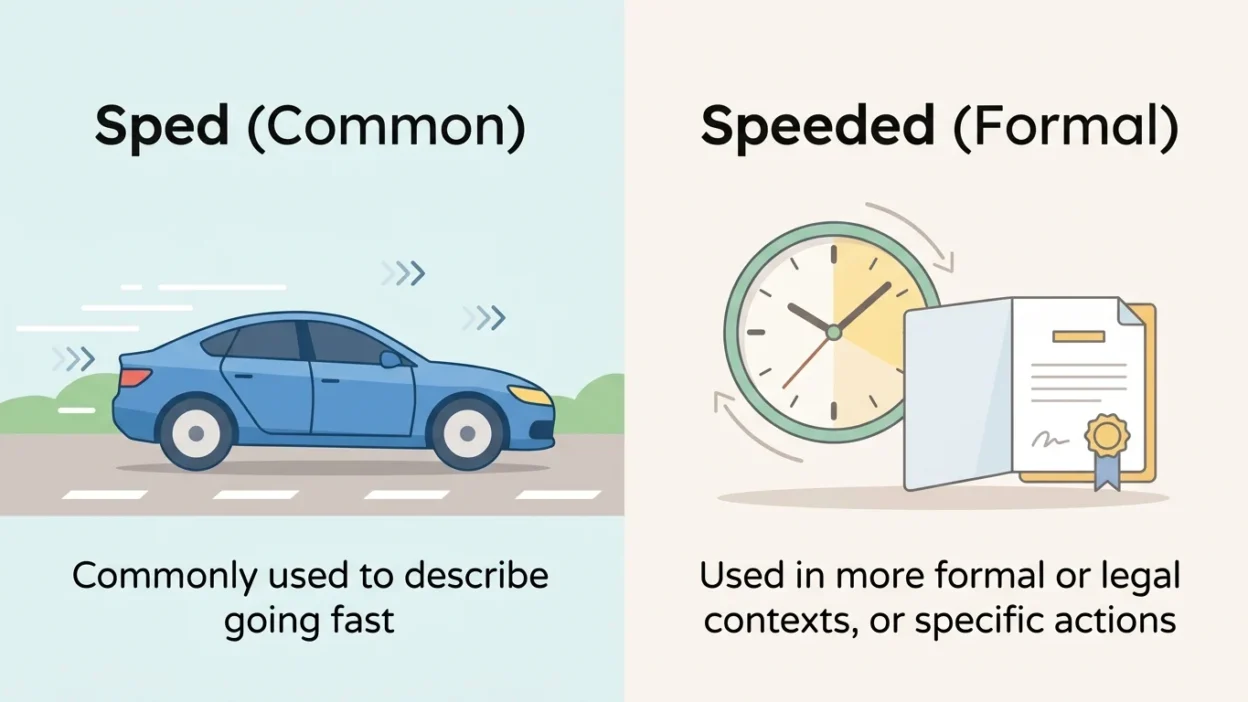
“Sped”
- Short and common
- Used in everyday English
- Sounds natural in conversation
Example:
- The car sped down the road.
“Speeded”
- Longer and less common
- Often used in formal writing
- Sometimes used when we say “speeded up”
Example:
- The process was speeded up to save time.
👉 In most cases, both words are correct. But one sounds more natural depending on the situation.
Comparison
| Feature | Sped | Speeded |
| Type | Irregular form | Regular form |
| Common use | Very common | Less common |
| Tone | Casual, everyday | Slightly formal |
| Length | Short | Longer |
| Example | She sped away quickly | The work was speeded up |
| Best for | Speaking, daily writing | Formal writing, specific phrases |
Which One Should You Use and When?
Use “sped” when:
- You are speaking in daily life
- You are writing simple sentences
- You want to sound natural and fluent
Examples:
- He sped past the school.
- The bike sped down the hill.
- She sped away after the meeting.
Use “speeded” when:
- You are writing something formal
- You are using phrases like “speeded up”
- You want to sound careful or clear
Examples:
- The project was speeded up due to pressure.
- The system was speeded up for better results.
👉 Tip: If you are not sure, use “sped.” It is almost always safe.
Common Mistakes People Make
Here are some mistakes learners often make:
Using “speeded” too much
Some learners think “speeded” is always correct because it follows the “ ed” rule. But in real English, “sped” is more common.
❌ Incorrect feeling:
- He speeded to the store. (sounds unnatural)
✔ Better:
- He sped to the store.
Mixing both forms in one sentence
❌ Wrong:
- He sped and speeded up quickly.
✔ Correct:
- He sped up quickly.
Avoiding “sped” because it looks strange
Some learners avoid “sped” because it looks unusual. But it is correct and widely used.
✔ Correct:
- The car sped away.
Overthinking the difference
Many learners worry too much about choosing the “perfect” word. In most cases, both are correct, and the meaning is clear.
Everyday Real Life Examples
Let’s see how people use these words in daily life.
In Emails
- We sped up the delivery process.
- The team speeded up the work to meet the deadline.
In News
- The car sped through the red light.
- Changes were speeded up after the meeting.
On Social Media
- He sped past me like a rocket!
- Things are getting speeded up now.
In Daily Conversation
- She sped off without saying goodbye.
- The teacher sped up the lesson.
👉 Notice: “sped up” is more common than “speeded up” in speech.
Learning Tips for Students and Beginners
Here are some easy ways to remember:
- Think: “Sped = simple and common”
- Use “sped” when speaking
- Learn the phrase “sped up”
- Remember: “speeded” is not wrong, just less common
Practice Tip
Try making your own sentences:
- The bus ______ past us. (Answer: sped)
- The work was ______ up. (Answer: sped or speeded)
Both answers can work in the second sentence.
FAQ: Simple Questions and Answers
Is “sped” a real word?
Yes, “sped” is a correct past form of “speed.”
Is “speeded” wrong?
No, it is also correct, but less common.
Which one is more common?
“Sped” is more common in everyday English.
Can I use “speeded up”?
Yes, it is correct, especially in formal writing.
What should beginners use?
Beginners should mostly use “sped.” It is easier and more natural.
Do native speakers use both?
Yes, but they use “sped” more often.
Is there a difference in meaning?
No big difference. The meaning is almost the same.
Can I use them in exams?
Yes, both are correct. But “sped” is usually safer.
Conclusion
The difference between “sped” and “speeded” is not as difficult as it seems.
- Both words are correct past forms of “speed.”
- “Sped” is short, common, and used in everyday English.
- “Speeded” is less common and often used in formal writing.
If you remember just one thing, remember this:
👉 Use “sped” in most situations.
With practice, you will feel more confident and natural when using these words. English has many small differences like this, but step by step, they become easy to understand.

Anthony Charles is the founder and lead content creator at Meanefy.com, a platform dedicated to exploring word meanings, language nuances, and everyday curiosities. With a passion for language and a keen eye for detail, Anthony aims to make complex words and concepts simple and accessible for readers around the world.