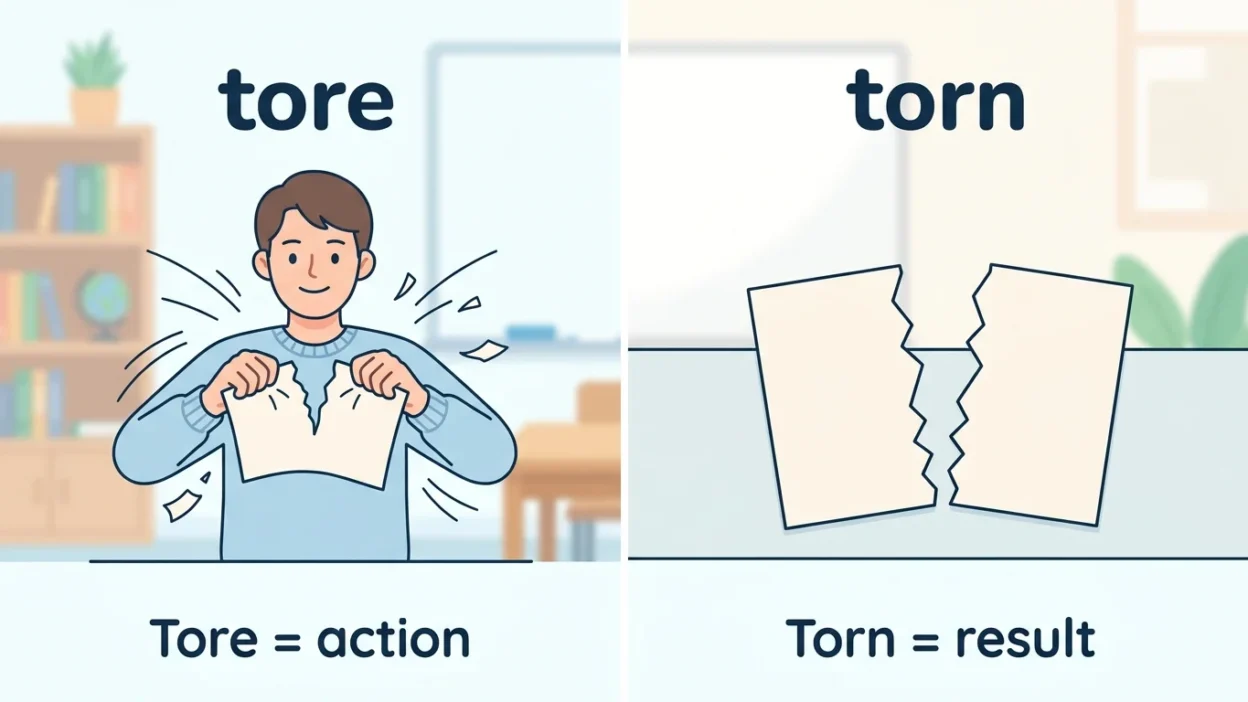
Many learners feel confused when they see the words “tore” and “torn.” They both come from the same verb “tear,” and they both talk about something being ripped or broken. So why do we have two forms? When should you use each one?
This confusion is very common, especially for students and ESL learners. The good news is that the difference is not hard. Once you understand one small rule, everything becomes clear.
Let’s break it down step by step in very simple English.
Quick Answer
Here is the short and easy answer:
- “Tore” is the past simple form of “tear”
- Use it when talking about something that happened in the past
- Example: I tore my shirt.
- “Torn” is the past participle form of “tear”
- Use it with helping verbs like has, have, had, is, was
- Example: My shirt is torn.
Simple Background
The base verb is “tear.”
It means:
- To pull something so it breaks
- To make a hole or split in something
Examples:
- Tear paper
- Tear clothes
- Tear a page from a book
Like many English verbs, “tear” changes form depending on time:
- Present: tear
- Past: tore
- Past participle: torn
This is why we have two different words: tore and torn.
Clear Explanation of the Difference
Let’s understand this in the simplest way.
What is “tore”?
“Tore” is used for past actions. It tells us that something happened before now.
- No helping verb is needed
- It stands alone in the sentence
Example:
- I tore the paper yesterday.
Here, the action is finished.
What is “torn”?
“Torn” is used with helping verbs. It does not usually stand alone.
Common helping verbs:
- has
- have
- had
- is
- was
- were
Example:
- The paper is torn.
- She has torn the letter.
“Torn” often describes a result (what something is like now).
Simple Way to Remember
- Tore = action in the past
- Torn = result or used with helper words
Comparison
| Feature | Tore | Torn |
| Type | Past simple | Past participle |
| Needs helper? | No | Yes |
| Focus | Action | Result or condition |
| Example | I tore my bag. | My bag is torn. |
| Time | Past | Past + connection to now |
Which One to Use and When
Use “tore” when:
- You talk about something that already happened
- You do not use helping verbs
Examples:
- He tore the page.
- I tore my jeans last week.
Use “torn” when:
- You use helping verbs
- You describe the condition of something
Examples:
- My jeans are torn.
- She has torn the paper.
- The book was torn.
Quick Tip
If you see words like:
- is
- was
- has
- have
Then “torn” is usually correct.
Common Mistakes People Make
Here are mistakes that learners often make:
Using “torn” without a helper
❌ I torn my shirt.
✔️ I tore my shirt.
Using “tore” with a helper
❌ My shirt is tore.
✔️ My shirt is torn.
Mixing the forms
❌ She has tore the paper.
✔️ She has torn the paper.
Forgetting the meaning
Some learners think both words are the same. They are not.
- “Tore” = action happened
- “Torn” = result or state
Everyday Real Life Examples
Let’s see how people use these words in daily life.
In Emails
- I accidentally tore the document. I will send a new one.
- The file you sent looks torn. Can you resend it?
In News
- The storm tore roofs from many houses.
- Several flags were torn during the strong winds.
On Social Media
- I just tore my favorite shirt 😢
- My shoes are completely torn now.
In Daily Conversation
- He tore the paper in anger.
- Her dress is torn at the bottom.
Learning Section for Students and Beginners
Here are some easy ways to practice:
Practice Sentence Change
Change “tore” to “torn”:
- I tore the paper.
→ The paper is torn. - She tore the bag.
→ The bag is torn.
Fill in the Blank
Choose the correct word:
- I ______ my notebook yesterday.
→ tore - My notebook is ______.
→ torn
Speak Out Loud
Say these sentences:
- I tore my shirt.
- My shirt is torn.
This helps your brain remember the difference.
Memory Trick
Think like this:
- “Tore” = short action
- “Torn” = long condition
FAQ Section
What is the main difference between tore and torn?
“Tore” is used for past actions. “Torn” is used with helping verbs and shows a result.
Can I say “I torn my shirt”?
No. That is incorrect. You should say: I tore my shirt.
Can I say “My shirt is tore”?
No. The correct form is: My shirt is torn.
Is “torn” always used with helping verbs?
Yes, most of the time. It usually comes with words like is, was, has, have.
Which one is more common in daily speech?
Both are common, but they are used in different ways. You need both to speak correctly.
Is this rule the same for all verbs?
No. Some verbs are regular (like “walk → walked”), but “tear” is an irregular verb.
Can “torn” describe something?
Yes. It often describes condition:
- A torn shirt
- A torn page
How can I remember this easily?
Remember:
- “Tore” = did something
- “Torn” = something is now damaged
Conclusion
The difference between “tore” and “torn” is simple once you understand it.
- Tore is for past actions
- Torn is for results and needs a helper verb
If you remember this one idea, you will not feel confused again.
Keep practicing with small sentences. Read, write, and speak them out loud. Over time, using “tore” and “torn” will feel natural and easy.
Learning English step by step is the best way and you’re already doing it right.

Steven Mark is a writer, researcher, and contributor at Meanefy.com, a platform dedicated to exploring word meanings, language nuances, and everyday linguistic curiosities. With a passion for words and clear communication, Steven focuses on making language simple, engaging, and accessible to all readers.