Many English learners and even native speakers get confused between hunny and honey because the two words sound exactly the same when spoken.
When people see both spellings online, in text messages, on social media, or in cartoons, they often wonder whether both are correct English words.
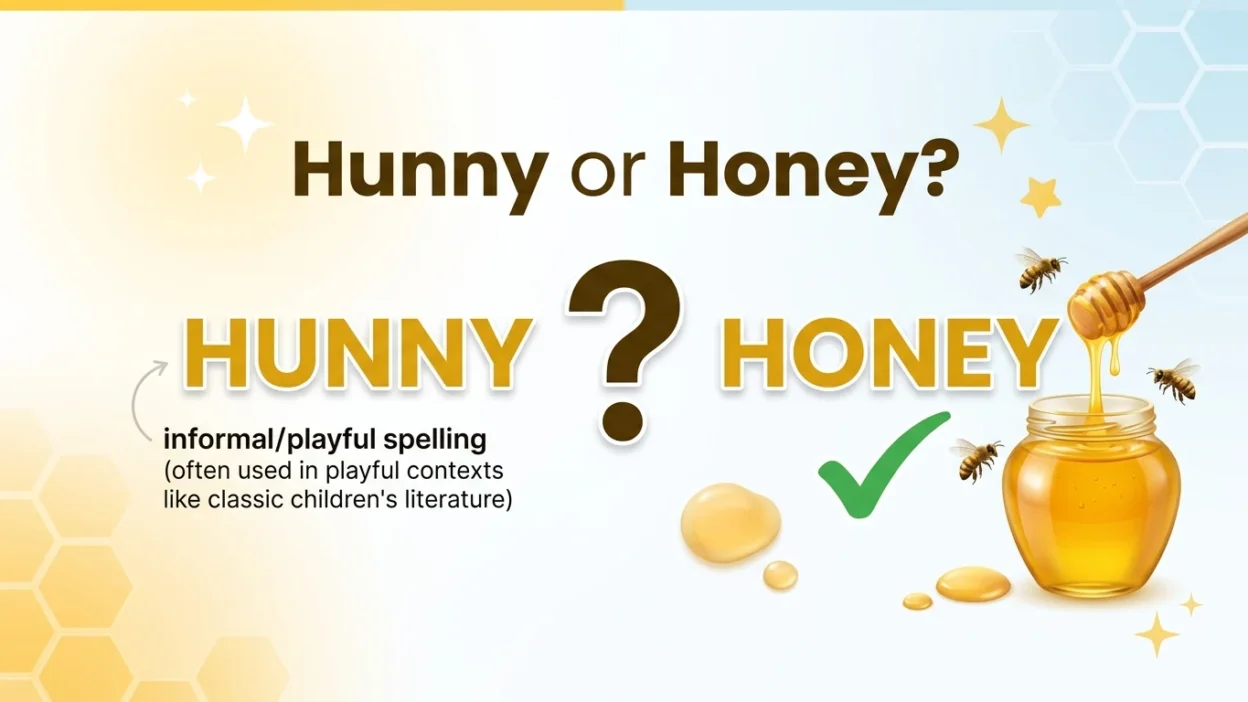
The simple truth is that honey is the standard English spelling, while hunny is mainly a special or playful spelling used in certain situations.
Understanding this difference will help you use the right word in writing, schoolwork, emails, and everyday communication.
Quick Answer
- Honey is the correct and standard English spelling.
- Honey refers to the sweet food made by bees.
- Honey can also be a term of affection for someone you care about.
- Hunny is a non standard spelling.
- Hunny is mostly used in playful writing, nicknames, texts, or fictional stories.
- In formal writing, school assignments, emails, and professional communication, use honey.
Origin and Background
Where Does the Word Honey Come From?
The word honey has been part of the English language for hundreds of years. It originally referred to the sweet substance made by bees from flower nectar.
Over time, people also began using honey as a loving nickname for family members, friends, husbands, wives, partners, and children.
Examples:
- Thank you, honey.
- Honey, can you help me?
- The bees make honey.
Where Did Hunny Come From?
The spelling hunny became popular mainly through children’s stories and playful writing.
People sometimes change spellings for fun, affection, or style. Because hunny sounds exactly like honey, some writers use it to create a cute or informal feeling.
Today, hunny is often seen in:
- Text messages
- Social media posts
- Nicknames
- Children’s content
- Informal conversations
However, it is not considered the standard spelling.
Difference Between Hunny and Honey
The biggest difference is not pronunciation. Both words are pronounced the same way.
The difference is mainly in correctness and usage.
Honey Is the Standard Word
Use honey when you mean:
- The food made by bees
- A sweet nickname for someone
- Formal and informal writing
Examples:
- I put honey in my tea.
- Good morning, honey.
- Honey has a sweet taste.
Hunny Is a Playful Alternative
Use hunny only when you want a cute, creative, or informal style.
Examples:
- Love you, hunny!
- Thanks, hunny.
- Welcome home, hunny.
These examples may look friendly and affectionate, but they are not standard English spelling.
Pronunciation Is the Same
Both words sound like:
Honey → HUH-nee
Hunny → HUH-nee
The pronunciation does not change.
Comparison Table
| Feature | Honey | Hunny |
| Standard English spelling | Yes | No |
| Found in dictionaries | Yes | Usually no |
| Refers to bee made sweet food | Yes | Usually no |
| Used in formal writing | Yes | No |
| Used in school assignments | Yes | No |
| Used in business emails | Yes | No |
| Used in text messages | Yes | Sometimes |
| Used as a cute nickname | Yes | Yes |
| Professional choice | Yes | No |
| Recommended for learners | Yes | No |
Which One to Use and When
Use Honey in Most Situations
For nearly all writing situations, choose honey.
This includes:
- School work
- Essays
- Reports
- Emails
- Articles
- News writing
- Professional communication
Examples:
- Honey is often used as a natural sweetener.
- Honey, how was your day?
- The recipe requires two tablespoons of honey.
Use Hunny Only in Informal Situations
You might use hunny when:
- Sending a playful text
- Writing a cute social media caption
- Creating a nickname
- Writing informal messages to close friends
Examples:
- Miss you, hunny!
- Happy birthday, hunny!
- Good night, hunny.
Even in these situations, many people still prefer the standard spelling honey.
Common Mistakes People Make
Thinking Hunny Is the Correct Spelling
Many learners believe hunny is another accepted spelling of honey.
This is incorrect.
For standard English writing, use honey.
Using Hunny in Formal Writing
Some people write:
- Dear Hunny,
- Hunny is good for health.
These sentences should use honey instead.
Correct versions:
- Dear Honey,
- Honey is good for health.
Confusing the Food With the Nickname
The same spelling honey can have two meanings.
Examples:
Food:
- I added honey to my tea.
Nickname:
- Honey, please come here.
The meaning depends on the context.
Assuming Different Pronunciations
Some learners think hunny and honey are pronounced differently.
They are pronounced the same way.
Everyday Real Life Examples
Emails
Correct:
- Hello Honey,
- Thank you for your help.
Less common and very informal:
- Hello Hunny,
- Thank you for your help.
For most emails, honey is the better choice.
News
News articles almost always use honey.
Example:
- Local farmers produced organic honey this year.
You would not normally see hunny in news writing.
Social Media
People sometimes use both spellings.
Examples:
- Love you, honey!
- Miss you, hunny!
Because social media is informal, creative spellings are more common.
Daily Conversations
When speaking, nobody can hear the spelling.
For example:
- Thanks, honey.
- Thanks, hunny.
Both sound exactly the same.
The difference only appears in writing.
Text Messages
Examples:
- Good morning, honey.
- Good morning, hunny.
Both may be understood, but honey remains the standard spelling.
Learning Section for Students and Beginners
Easy Rule to Remember
If you are unsure which spelling to use, choose honey.
This simple rule will be correct almost every time.
Think About the Situation
Ask yourself:
- Is this school writing?
- Is this an email?
- Is this professional communication?
- Is this an article or report?
If the answer is yes, use honey.
Remember the Bee Connection
The sweet food made by bees is always spelled honey.
Examples:
- Honey comes from bees.
- Honey tastes sweet.
- Honey is used in many recipes.
You should never write hunny when talking about the food.
Practice Sentences
Correct:
- Honey is my favorite natural sweetener.
- Honey, can you help me?
- The recipe includes honey.
Incorrect:
- Hunny is my favorite natural sweetener.
- The recipe includes hunny.
Frequently Asked Questions
Is hunny a real word?
It can be used as an informal or playful spelling, but it is not the standard English spelling.
Which spelling is correct, hunny or honey?
Honey is the correct standard spelling.
Can I use hunny in school assignments?
No. It is better to use honey in school writing.
Is hunny wrong?
It is not necessarily wrong in casual messages, but it is not the standard spelling.
Do honey and hunny sound different?
No. They are pronounced the same way.
Can honey be a nickname?
Yes. Many people use honey as a loving nickname.
Is honey only a food?
No. It can refer to the sweet food made by bees and also be used as a term of affection.
Which spelling should English learners use?
English learners should use honey because it is the accepted standard spelling.
Conclusion
The difference between hunny and honey is simple once you understand it. Honey is the standard English spelling and should be used in almost all situations, including schoolwork, emails, articles, and everyday writing. It refers both to the sweet food made by bees and to a loving nickname for someone.
Hunny is mainly a playful, informal spelling that appears in texts, social media posts, and creative writing. While people may use it for a cute effect, it is not the standard choice.
If you ever feel unsure, remember one easy rule: choose “honey.” It is the correct, safe, and widely accepted spelling in English.