Many English learners and even native speakers get confused between therefor and therefore because the two words look almost the same. The only visible difference is one extra letter: e.
Because they are so similar, people often think they have the same meaning. However, these words are different in both meaning and usage.
The good news is that the confusion is easy to fix. Once you understand what each word means and where it is used, you will know exactly which one to choose.
This guide explains everything in simple English so that students, ESL learners, and beginners can understand it easily.
Quick Answer
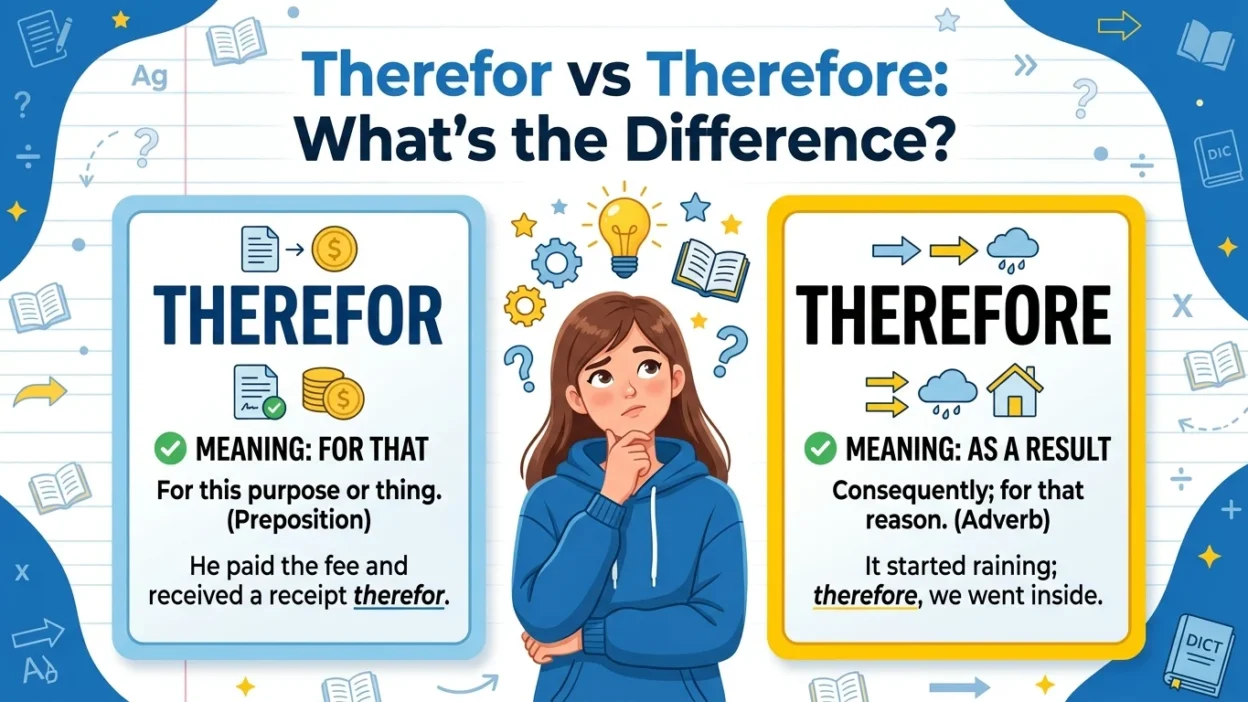
- Therefore is a common English word that means for that reason or as a result.
- Therefor is a rare word that means for that thing or for that purpose.
- In modern English, therefore is used much more often.
- Most of the time, when people write therefor, they actually mean therefore.
- If you are unsure, therefore is usually the correct choice.
Quick Examples
✅ I was tired; therefore, I went to bed early.
✅ The company built a new office and bought equipment therefor.
In everyday writing, you will probably use therefore far more often than therefor.
Origin and Background
Understanding where these words come from can help make their meanings clearer.
The Word “Therefore”
The word therefore comes from older English forms that combined:
- there
- for
Over time, it developed the meaning of:
- for that reason
- because of that
- as a result
Today, it is commonly used to connect a cause and its result.
The Word “Therefor”
The word therefor also comes from older English.
It originally meant:
- for that
- for that object
- for that purpose
Unlike therefore, it does not show a result or conclusion.
Because modern English rarely needs this meaning, therefor is uncommon today.
The Difference Between Therefor and Therefore
The easiest way to remember the difference is to focus on meaning.
Therefore = As a Result
Use therefore when something happens because of another thing.
Think of it as:
- for that reason
- consequently
- as a result
Example:
It was raining heavily. Therefore, the match was canceled.
The rain caused the cancellation.
Therefor = For That
Use therefor when you mean:
- for that
- for that purpose
- for that item
Example:
The workers prepared the materials and the tools therefor.
Here, therefor means “for that purpose.”
A Simple Memory Trick
- ThereFORE = think of a result that comes before the next action.
- ThereFOR = simply means for that.
If you can replace the word with “as a result,” use therefore.
If you can replace it with “for that,” use therefor.
Comparison Table
| Feature | Therefore | Therefor |
| Meaning | For that reason | For that |
| Usage | Very common | Rare |
| Shows cause and result | Yes | No |
| Used in everyday English | Yes | Rarely |
| Used in formal writing | Yes | Sometimes |
| Can mean “as a result” | Yes | No |
| Can mean “for that purpose” | No | Yes |
Which One to Use and When
Use Therefore When Showing a Result
This is the choice you will use most often.
Examples:
- She studied hard; therefore, she passed the exam.
- The road was closed; therefore, we took another route.
- Prices increased; therefore, sales dropped.
In all these sentences, the second event happens because of the first event.
Use Therefor When Meaning “For That”
This use is uncommon in modern English.
Examples:
- The law provided a penalty therefor.
- The company purchased equipment and paid therefor.
- A new system was created and funds were approved therefor.
These examples are usually found in legal, official, or very formal writing.
Everyday Rule
For students and general writers:
- You will use therefore most of the time.
- You will rarely need therefor.
Common Mistakes People Make
Using Therefor Instead of Therefore
Incorrect:
I forgot my umbrella; therefor, I got wet.
Correct:
I forgot my umbrella; therefore, I got wet.
The sentence shows a result, so therefore is correct.
Thinking They Are Different Spellings of the Same Word
Many people assume that therefor is simply a misspelling of therefore.
This is not true.
Both words exist, but they have different meanings.
Using Therefor in Normal Conversation
Incorrect:
I was hungry; therefor, I ordered food.
Correct:
I was hungry; therefore, I ordered food.
Again, the sentence describes a result.
Forgetting the Meaning Test
Before choosing a word, ask yourself:
Can I replace it with:
- as a result → use therefore
- for that → use therefor
This simple test solves most mistakes.
Everyday Real Life Examples
Emails
Correct:
The meeting was moved to Friday; therefore, please update your calendar.
Correct:
Additional software was required, and payment therefor was approved.
News
Correct:
The storm damaged several roads. Therefore, travel delays are expected.
Correct:
The government announced a new program and allocated funding therefor.
Social Media
Correct:
My phone battery died; therefore, I missed your message.
Correct:
A new community project was proposed and support therefor quickly followed.
Daily Conversations
Correct:
I finished my work early; therefore, I went home.
Correct:
The team bought new uniforms and paid therefor.
In daily conversation, the first type is much more common.
Learning Section for Students and Beginners
A Very Easy Way to Remember
Think about what you want to say.
If you mean:
because of that
or
as a result
use therefore.
Example:
I practiced every day; therefore, I improved.
If you mean:
for that
use therefor.
Example:
A solution was found and funding therefor was approved.
Practice Exercise
Choose the correct word.
Sentence One
The weather was bad; ________, the event was canceled.
Answer:
Therefore
Sentence Two
The committee approved the project and provided money ________.
Answer:
Therefor
Sentence Three
She missed the bus; ________, she arrived late.
Answer:
Therefore
Sentence Four
The equipment was purchased and payment was made ________.
Answer:
Therefor
Quick Reminder
- Result → therefore
- For that → therefor
FAQ
Is therefor a real word?
Yes. It is a real English word, but it is rare in modern usage.
Is therefore a real word?
Yes. It is a common English word used to show a result or conclusion.
Which word is used more often?
Therefore is used far more often than therefor.
Can I use therefor instead of therefore?
No. They have different meanings and cannot normally replace each other.
What does therefore mean?
It means:
- for that reason
- as a result
- because of that
What does therefor mean?
It means:
- for that
- for that purpose
- for that thing
Is therefor old fashioned?
In many situations, yes. It is mostly seen in legal, official, or formal writing.
How can I remember the difference?
Ask yourself:
- Does it mean as a result? → Therefore
- Does it mean for that? → Therefor
Conclusion
The difference between therefor and therefore is actually very simple once you know their meanings.
Therefore means for that reason or as a result. It is common in everyday English and is the word most people need.
Therefor means for that or for that purpose. It is a real word, but it is much less common and usually appears in formal or legal writing.
When you are unsure, check the meaning:
- As a result → therefore
- For that → therefor
Remembering this simple rule will help you choose the correct word every time.

Anthony Charles is the founder and lead content creator at Meanefy.com, a platform dedicated to exploring word meanings, language nuances, and everyday curiosities. With a passion for language and a keen eye for detail, Anthony aims to make complex words and concepts simple and accessible for readers around the world.