Many learners feel confused when they see “struck” and “stricken.” Both come from the same verb “strike,” so they look related. But they are not always used in the same way. Sometimes both can be correct, and sometimes only one sounds natural.
This makes it hard for students, ESL learners, and even native speakers. The good news is that the difference is actually simple once you understand how each word is used in real life.
Let’s break it down step by step in very easy English.
Quick Answer
- Struck is the past tense and also a common past participle of “strike.”
- Stricken is a past participle, but it is used in special situations, often with feelings or bad events.
- Use struck for most normal actions.
- Use stricken when talking about serious problems, emotions, or disasters.
Simple origin and background
Both words come from the verb “strike.”
“Strike” can mean many things:
- To hit something
- To suddenly affect someone
- To remove something
- To discover something
Over time, English kept two past forms:
- Struck (more common and general)
- Stricken (more emotional or formal)
This is why both words exist today.
Clear explanation of the difference
What does “struck” mean?
“Struck” is the most common form. It is used when something happens physically or directly.
Examples:
- The ball struck the window.
- Lightning struck the tree.
- An idea struck me.
It is simple and used in everyday language.
What does “stricken” mean?
“Stricken” is used when something strongly affects a person or place, often in a negative way.
It is often used with:
- Illness
- Fear
- Shock
- Disaster
Examples:
- He was stricken with fear.
- The town was stricken by disease.
- She stood there, stricken with shock.
It sounds more emotional and serious.
Comparison
| Feature | Struck | Stricken |
| Type | Past tense & past participle | Past participle |
| Usage | General, everyday use | Formal or emotional situations |
| Meaning | Hit or affected | Deeply affected (usually negative) |
| Common with | Objects, actions, ideas | Illness, fear, disasters |
| Tone | Neutral | Serious, dramatic |
Which one to use and when
Use struck when:
- You are talking about a physical action
- You want simple and natural English
- You are speaking in daily conversation
Examples:
- The car struck a pole.
- A thought struck me.
Use stricken when:
- You want to show strong emotion
- You are talking about something serious
- You are writing in a formal or dramatic style
Examples:
- He was stricken with grief.
- The village was stricken by famine.
Common mistakes people make
Using “stricken” for simple actions
❌ The ball was stricken the wall
✔ The ball struck the wall
“Stricken” is not used for simple physical actions.
Using “struck” for deep emotions
❌ She was struck with fear (not wrong, but less natural)
✔ She was stricken with fear
“Stricken” sounds better for strong emotions.
Thinking both are always the same
Some learners think they can always replace one with the other. This is not true.
- Sometimes both are possible
- But often one sounds more natural
Everyday Real Life Examples
In emails
- “I was struck by your idea. It is very interesting.”
- “We are deeply stricken by the sad news.”
In news
- “A storm struck the city last night.”
- “The region is stricken by drought.”
On social media
- “That quote really struck me.”
- “I feel stricken with sadness after watching that video.”
In daily conversation
- “The clock struck twelve.”
- “He looked stricken when he heard the result.”
Learning tips for students and beginners
Here are some simple tips to remember:
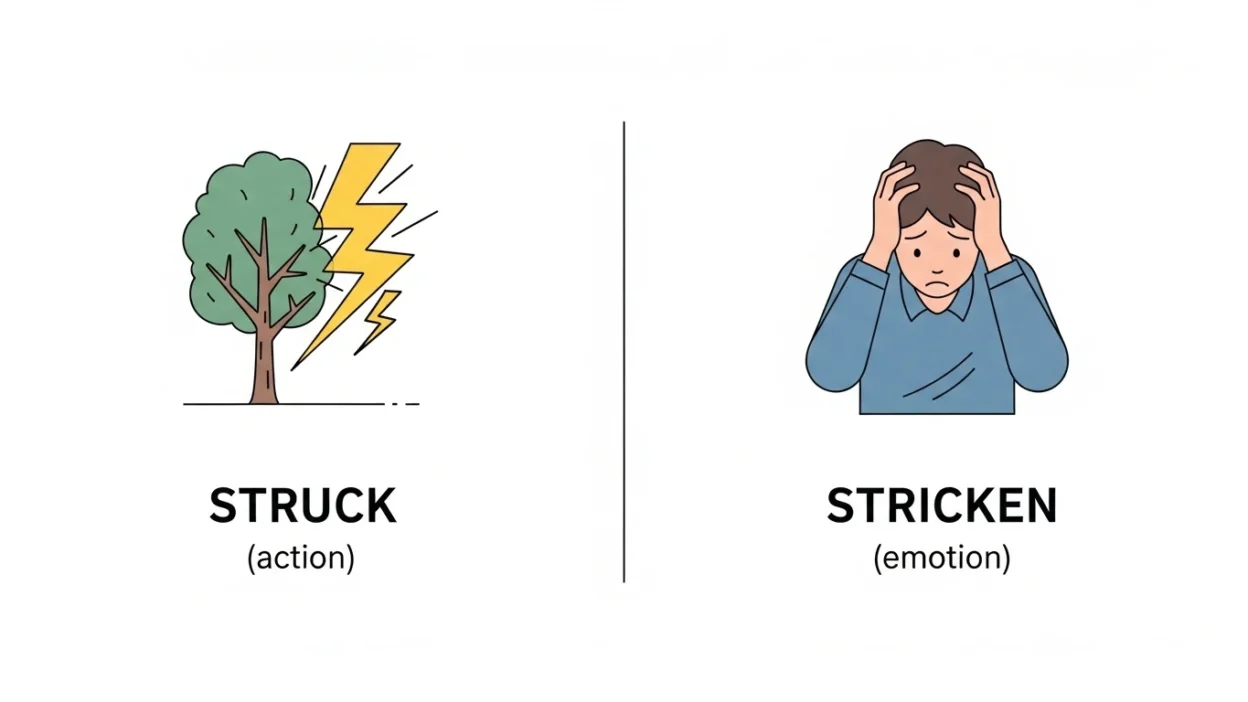
- Think of struck = action
- Think of stricken = emotion or suffering
Easy trick:
- If it is about hitting or happening → struck
- If it is about feeling or suffering → stricken
Practice sentences:
- The lightning ______ the building. → struck
- She was ______ with fear. → stricken
Try to make your own examples. This helps you remember faster.
FAQ section
What is the main difference between struck and stricken?
“Struck” is used for general actions. “Stricken” is used for strong emotions or serious situations.
Can I use struck and stricken in the same way?
Not always. Sometimes both work, but usually one sounds more natural depending on the situation.
Is “stricken” more formal?
Yes. “Stricken” often sounds more formal or emotional.
Which one is more common?
“Struck” is more common in everyday English.
Can I say “struck with fear”?
Yes, but “stricken with fear” sounds more natural and expressive.
Is “stricken” always negative?
Almost always. It is usually used for bad or serious situations.
Can “struck” be used for ideas?
Yes. For example: “An idea struck me.”
How can I remember the difference easily?
Remember:
- Struck = simple action
- Stricken = strong feeling or suffering
Conclusion
The difference between struck and stricken is not as hard as it seems.
- Use struck for normal actions and everyday situations
- Use stricken for strong emotions, illness, or serious events
If you focus on this simple idea, you will choose the correct word easily.
With a little practice, this confusion will disappear, and you will feel more confident using both words in your speaking and writing.

Daniel Matthew is a language enthusiast, writer, and contributor at Meanefy.com, where he explores the meanings, origins, and nuances of words and phrases. With a deep passion for language, Daniel aims to make complex concepts simple, engaging, and easy to understand for readers of all ages.