Many people hear the phrase “funny or die” online, in videos, jokes, or social media posts and feel confused about what it really means. Some think it is just a normal English expression. Others think it is the name of a comedy project or entertainment brand. Both ideas are connected, which is why learners often mix them up.
The good news is that the meaning is actually simple once you understand the background. This guide explains everything in very easy English so students, ESL learners, and beginners can understand it clearly.
Quick Answer
Here is the short and simple answer:
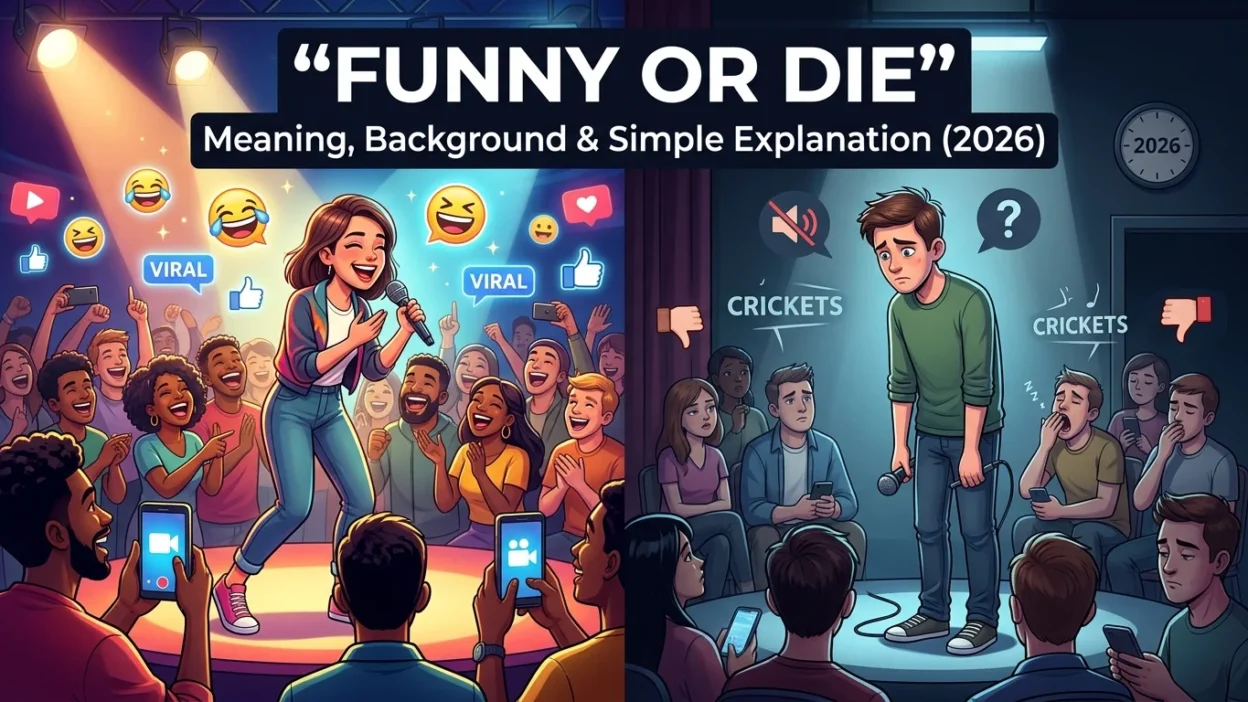
- “Funny or die” means something must be very funny or it will fail.
- It is often used in comedy and entertainment.
- The phrase became famous because of a comedy company called Funny Or Die.
- People also use it in everyday speech to talk about pressure to be entertaining.
- It is usually connected with jokes, comedy videos, and online humor.
Example:
“In stand up comedy, it’s funny or die.”
This means:
If the audience does not laugh, the comedian may fail.
The Simple Background of “Funny or Die”
The phrase became widely known because of Funny Or Die, a comedy entertainment company started in the United States.
The company became popular for:
- comedy videos
- internet sketches
- celebrity humor
- parody content
- short funny clips
Many famous actors and comedians appeared in their videos. Because of this, the phrase spread across the internet and became part of popular culture.
But the words themselves also have a general meaning:
- funny = making people laugh
- die = fail badly or disappear
So the phrase suggests:
“Be funny, or people will stop paying attention.”
Of course, this is not about real death. It is only a dramatic way to describe success or failure in comedy.
What Does “Funny or Die” Really Mean?
The phrase has two connected meanings.
1. Literal Entertainment Meaning
In comedy, audiences expect laughter. If a joke is not funny, the performance may fail.
Example:
- A comedian tells weak jokes.
- Nobody laughs.
- The show becomes unsuccessful.
People may describe this situation as:
“It’s funny or die.”
2. Popular Culture Meaning
Today, people also use the phrase more casually. It can describe any situation where someone feels pressure to entertain others.
Examples:
- social media creators
- YouTubers
- meme pages
- comedians
- actors
- streamers
People use the phrase to say:
“You must keep people interested.”
Clear Explanation of the Idea
The phrase is dramatic on purpose. English often uses strong expressions for emotional effect.
Here, “die” does not mean real physical death.
Instead, it means:
- fail
- lose attention
- lose popularity
- become unimportant
So the full idea is:
| Part | Meaning |
| Funny | Successful, entertaining |
| Die | Fail, lose audience |
This creates pressure:
“You must succeed or fail completely.”
That strong contrast makes the phrase memorable.
Comparison
Here is an easy comparison to understand the different uses.
| Use | Meaning | Example |
| Comedy phrase | Be funny or fail | “Stand up is funny or die.” |
| Company name | Comedy entertainment brand | “They watched a Funny or Die video.” |
| Everyday expression | Need to entertain people | “Social media feels funny or die sometimes.” |
| Dramatic slang | Strong pressure to succeed | “The show was funny or die.” |
Which One Should You Use and When?
Use It When Talking About Comedy
This is the most common use.
Examples:
- comedy shows
- jokes
- humorous videos
- internet sketches
Sentence:
“Comedy can feel like funny or die.”
Use It Casually With Friends
Some people use it jokingly in daily life.
Example:
“Our class presentation was funny or die.”
This means:
The presentation needed to be interesting and entertaining.
Do Not Use It in Formal Writing
The phrase is informal and dramatic. It is usually not good for:
- school essays
- business reports
- formal emails
- academic writing
Instead, use:
- “high pressure”
- “must succeed”
- “very competitive”
Common Mistakes People Make
Mistake 1: Thinking It Means Real Danger
Some learners think the phrase is serious.
Wrong idea:
“If you are not funny, something bad happens physically.”
Correct idea:
It only means failure or losing attention.
Mistake 2: Using It in Serious Situations
The phrase is playful and connected to humor.
Avoid sentences like:
“The hospital was funny or die.”
That sounds strange and inappropriate.
Mistake 3: Confusing the Company With the Expression
Some people think every use refers to the company.
But many speakers simply use it as an expression.
Example:
“TikTok creators live in a funny or die world.”
This sentence talks about online entertainment pressure, not the company.
Mistake 4: Using It in Very Formal English
The phrase is conversational and modern.
It sounds natural in:
- social media
- casual speaking
- entertainment discussions
It sounds less natural in:
- official documents
- formal presentations
- professional reports
Everyday Real Life Examples
In Social Media
“Content creators sometimes feel like it’s funny or die.”
Meaning:
They must constantly entertain viewers.
In a Group Chat
“Our meme page is basically funny or die now.”
Meaning:
The page must stay funny to remain popular.
In a Comedy Show
“Stand up comedy can be funny or die.”
Meaning:
A comedian succeeds only if people laugh.
In School
“The teacher wanted our presentation to be funny or die.”
Meaning:
The teacher wanted students to keep the audience interested.
In Entertainment News
“Late night television often feels funny or die.”
Meaning:
Hosts must continue making audiences laugh.
In Daily Conversation
“Internet culture today feels funny or die.”
Meaning:
People compete for attention using humor.
Short Learning Section for Students and Beginners
Here are simple learning tips to remember the phrase easily.
Easy Memory Trick
Think like this:
- funny = success
- die = failure
So:
“Be entertaining or fail.”
Grammar Tip
“Funny or die” is usually used as:
- a phrase
- a title
- a description
Examples:
- “Comedy is funny or die.”
- “That channel feels funny or die.”
- “They watched Funny or Die videos.”
Speaking Tip
Native speakers usually say it in:
- casual conversation
- entertainment discussions
- humorous situations
It is not common in formal classroom English.
Vocabulary Around the Phrase
Helpful related words:
| Word | Simple Meaning |
| Comedy | Funny entertainment |
| Joke | Something said to make people laugh |
| Parody | Funny copy of something |
| Audience | People watching |
| Viral | Popular online very quickly |
| Sketch | Short comedy performance |
FAQ Section
1. Is “Funny or Die” a company?
Yes. Funny Or Die is a comedy entertainment company known for humorous online videos.
2. Does “die” mean real death in the phrase?
No. It only means failure or losing attention.
3. Is the phrase formal or informal?
It is informal and mostly used in casual conversation.
4. Can students use this phrase?
Yes, especially when talking about entertainment, humor, or social media culture.
5. Why is the phrase popular online?
It became famous through comedy videos and internet culture.
6. Is it okay to use in business emails?
Usually no. It sounds too casual and dramatic.
7. What is the main idea behind the phrase?
The main idea is:
“You must entertain people successfully.”
8. Do native English speakers still use it?
Yes, especially when discussing comedy, online creators, and entertainment pressure.
Conclusion
The phrase “funny or die” is much easier to understand once you know both meanings. It is connected to comedy culture and also became famous because of Funny Or Die.
In simple English, the phrase means:
“Be entertaining or fail.”
It does not describe real danger. Instead, it uses dramatic language to explain the pressure of making people laugh and keeping attention.
Today, people use it when talking about:
- comedians
- internet humor
- social media creators
- online entertainment
- popular culture
Once you remember that “funny” means success and “die” means failure, the phrase becomes very easy to understand and use naturally in conversation.

Daniel Matthew is a language enthusiast, writer, and contributor at Meanefy.com, where he explores the meanings, origins, and nuances of words and phrases. With a deep passion for language, Daniel aims to make complex concepts simple, engaging, and easy to understand for readers of all ages.