Many learners feel confused about “came” and “come.” They look similar, and both are forms of the verb “come.” Because of this, people often mix them up in speaking and writing.
But don’t worry. The difference is actually simple. Once you understand how time works in English verbs, everything becomes clear. This guide will explain it step by step in very easy English.
Quick Answer
Here is the short and clear answer:
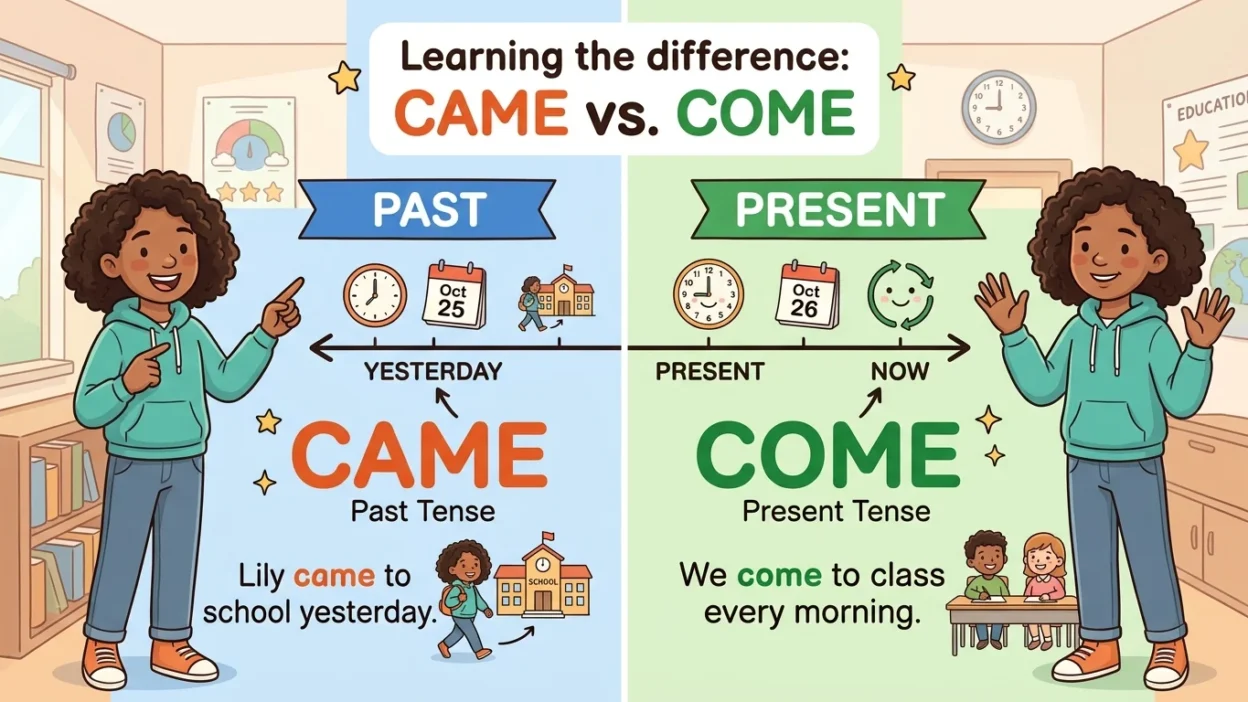
- “Come” = present tense (happening now or usually)
- “Came” = past tense (already happened)
- “Come” is also used with helping verbs (have, has, had)
Examples:
- I come to school every day. ✅
- I came to school yesterday. ✅
- I have come to school early today. ✅
Simple Background
The word “come” is a very common verb in English. It means to move toward a place or person.
English verbs often change their form to show time:
- Present (now)
- Past (before now)
- Past participle (used with helping verbs)
For the verb “come”, the forms are:
- Base form: come
- Past form: came
- Past participle: come
Yes, it looks strange because “come” is used twice. That is why many learners get confused.
Clear Explanation of the Difference
Let’s make it very simple.
“Come” (Present)
We use “come” when:
- Something happens now
- Something happens regularly
- We talk about general truth
Examples:
- I come home at 5 PM.
- They come to visit us every weekend.
- Please come here.
“Came” (Past)
We use “came” when:
- The action already happened
- It is finished
Examples:
- I came home late yesterday.
- She came to the party last night.
- They came early in the morning.
“Come” (with Helping Verbs)
We also use “come” with:
- have / has / had
Examples:
- I have come to help you.
- She has come from London.
- They had come before we arrived.
Comparison
| Form | Time | How to Use | Example |
| Come | Present | Now or regular action | I come here every day. |
| Came | Past | Finished action | I came here yesterday. |
| Come | With helpers | After have/has/had | I have come to see you. |
Which One to Use and When
Here is a simple way to choose:
Use “come” when:
- You talk about now
- You talk about daily habits
- You use helping verbs (have, has, had)
Example:
- I come to class daily.
- She has come already.
Use “came” when:
- You talk about the past
- The action is finished
Example:
- I came late yesterday.
Easy Trick
Ask yourself:
- Is it past? → use came
- Is it now or regular? → use come
- Is there have/has/had? → use come
Common Mistakes People Make
Here are mistakes many learners make:
Using “come” for the past
❌ I come yesterday.
✅ I came yesterday.
Using “came” with “have”
❌ I have came early.
✅ I have come early.
Mixing tenses
❌ She come last night.
✅ She came last night.
Forgetting helping verbs
❌ I come already.
✅ I have come already.
Everyday Real Life Examples
Let’s see how people use these words in daily life.
In Emails
- I came to your office yesterday, but you were not there.
- I have come to discuss the project.
In Conversations
- When did you come here?
- I came here last week.
On Social Media
- I just came back from vacation!
- I have come a long way in my journey.
In News or Reports
- The president came to the city yesterday.
- Many people have come to support the event.
Daily Use Sentences
- Please come inside.
- He came late today.
- They have come to help us.
Learning Section for Students and Beginners
Here are some easy tips to remember:
Practice with Time Words
Time words help you choose the correct form:
- Yesterday → came
- Last night → came
- Today → come or have come
- Every day → come
Make Simple Sentences
Practice like this:
- I come to school.
- I came to school yesterday.
- I have come to school early.
Speak Daily
Try to use these words when speaking:
- Come here
- I came late
- I have come
The more you use them, the easier they become.
FAQ Section
What is the main difference between “came” and “come”?
“Came” is past tense. “Come” is present tense or used with helping verbs.
Can I say “I come yesterday”?
No. It is wrong. You should say:
I came yesterday.
Can I say “I have came”?
No. It is wrong. You should say:
I have come.
Is “come” ever used for the past?
Yes, but only with helping verbs like “have,” “has,” or “had.”
Example:
I have come.
Why is “come” used twice?
English has irregular verbs. “Come” is one of them, so it repeats in base and past participle form.
Which one is easier to remember?
Think about time:
- Past → came
- Present or with have → come
Is “came” ever used with “has” or “have”?
No. Never use “came” with helping verbs.
How can I practice this better?
Make daily sentences and speak them out loud. Practice with time words like yesterday, today, and last week.
Conclusion
The difference between “came” and “come” is simple when you understand time.
- Use “came” for the past
- Use “come” for the present
- Use “come” with helping verbs
That’s it.
With a little practice, you will stop making mistakes and start using them naturally. Keep practicing with real life sentences, and soon this confusion will completely disappear.

Steven Mark is a writer, researcher, and contributor at Meanefy.com, a platform dedicated to exploring word meanings, language nuances, and everyday linguistic curiosities. With a passion for words and clear communication, Steven focuses on making language simple, engaging, and accessible to all readers.