Many learners feel confused about “spoke” and “spoken.” Both words come from the verb “speak,” and both are used in past forms. Because they look similar, people often mix them up.
The good news is: the difference is actually simple. Once you understand one small rule, you will not be confused again.
This guide will explain everything in very easy English so you can understand it quickly and use both words correctly in daily life.
Quick Answer
Here is the simple difference:
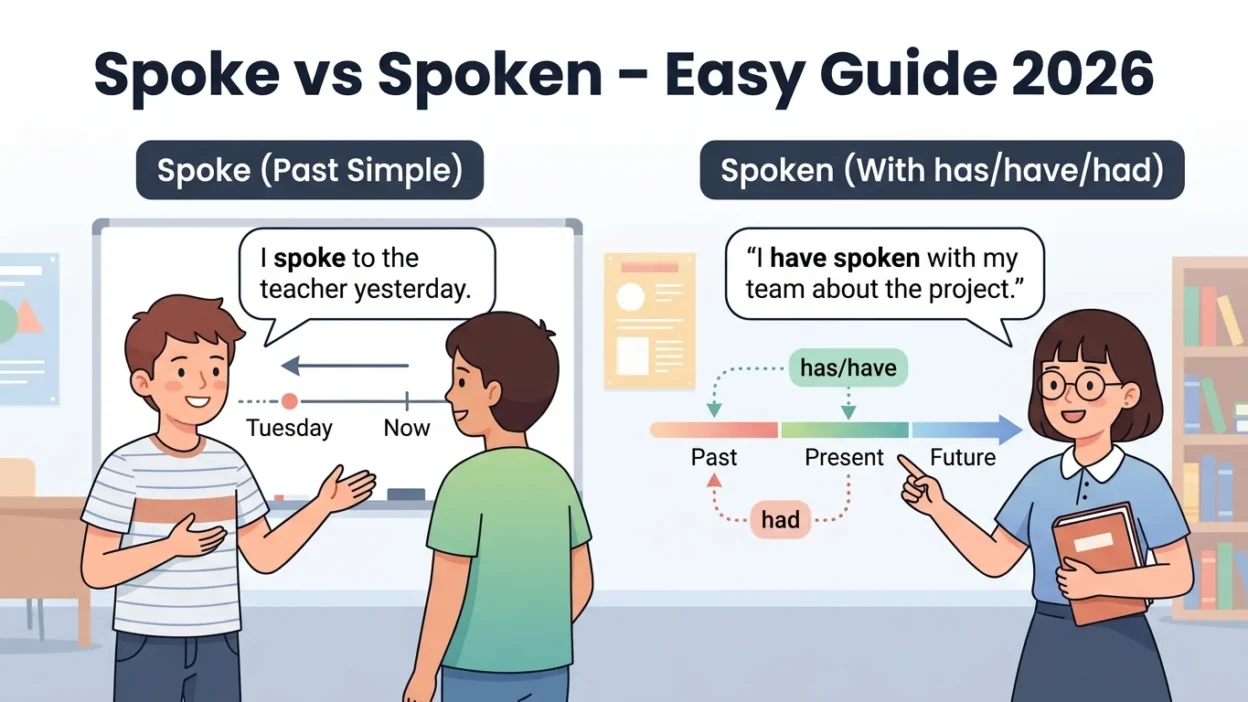
- Spoke = past simple (used alone)
- Example: I spoke to her yesterday.
- Spoken = past participle (used with helping verbs)
- Example: I have spoken to her already.
👉 Easy rule to remember:
- Use spoke → when talking about a finished past action
- Use spoken → with words like has, have, had, was, were
Simple Background
The base verb is speak.
English verbs often change form like this:
- Present: speak
- Past: spoke
- Past participle: spoken
This type of verb is called an irregular verb, which means it does not follow a simple “-ed” rule.
Example:
- speak → spoke → spoken
So, both words come from the same verb, but they are used in different ways.
Clear Explanation of the Difference
Let’s understand this step by step.
What is “Spoke”?
Spoke is the past simple form of “speak.”
We use it when:
- The action happened in the past
- The time is clear or finished
- No helping verb is used
Examples:
- I spoke to my teacher.
- She spoke very fast.
- We spoke about the problem yesterday.
👉 Think of “spoke” as a complete action in the past.
What is “Spoken”?
Spoken is the past participle form.
We use it:
- With helping verbs like has, have, had, was, were
- In perfect tenses
- In passive voice
Examples:
- I have spoken to him.
- She has spoken the truth.
- English is spoken all over the world.
👉 “Spoken” cannot be used alone. It always needs a helper.
Comparison
| Feature | Spoke | Spoken |
| Verb form | Past simple | Past participle |
| Used alone? | Yes | No |
| Needs helper verb | No | Yes |
| Time reference | Finished past | Often connected to present/past |
| Example | I spoke to her. | I have spoken to her. |
Which One to Use and When
Use this simple guide:
Use “Spoke” when:
- You are talking about the past
- The sentence is simple
- No helping verb is there
Examples:
- I spoke to him last night.
- They spoke about the meeting.
- She spoke politely.
Use “Spoken” when:
- There is a helping verb
- You are using has, have, had
- You are using passive voice
Examples:
- I have spoken to him already.
- She has spoken very clearly.
- English is spoken in many countries.
Common Mistakes People Make
Let’s look at mistakes learners often make.
Mistake 1: Using “spoken” alone
❌ I spoken to him yesterday.
✔ I spoke to him yesterday.
👉 Remember: “spoken” needs a helper.
Mistake 2: Using “spoke” with helping verbs
❌ I have spoke to her.
✔ I have spoken to her.
👉 After “have/has/had,” always use “spoken.”
Mistake 3: Mixing tenses
❌ She has spoke yesterday.
✔ She spoke yesterday.
✔ She has spoken already.
👉 Do not mix time words like “yesterday” with “has spoken.”
Mistake 4: Forgetting passive voice
❌ English is spoke here.
✔ English is spoken here.
👉 Passive voice needs “spoken.”
Everyday Real Life Examples
Here are simple examples from daily life.
In Conversations
- I spoke to my friend last night.
- Have you spoken to your boss?
- She has spoken about this before.
In Emails
- I spoke with the manager yesterday.
- I have spoken to the team already.
- The issue has been spoken about.
On Social Media
- I spoke about this in my last post.
- Many people have spoken about this topic.
- This language is widely spoken.
In News
- The president spoke at the event.
- Experts have spoken about climate change.
- English is spoken in many countries.
Learning Tips for Students and Beginners
Here are easy tips to help you remember:
Tip 1: Use a simple rule
- No helper → spoke
- Helper present → spoken
Tip 2: Practice with patterns
Say these aloud:
- I spoke…
- I have spoken…
- She spoke…
- She has spoken…
This helps your brain learn faster.
Tip 3: Look for helping verbs
Words like:
- has
- have
- had
- is
- was
If you see them → use spoken
Tip 4: Make your own sentences
Try:
- I spoke to my friend today.
- I have spoken to my teacher.
Practice daily to build confidence.
FAQ Section
What is the main difference between spoke and spoken?
“Spoke” is past simple and used alone. “Spoken” is past participle and used with helping verbs.
Can I use spoken without a helping verb?
No. “Spoken” always needs a helper like has, have, had, is, was.
Is “I have spoke” correct?
No. The correct sentence is:
✔ I have spoken.
When should I use spoke?
Use “spoke” when talking about a finished past action without a helper.
Example:
I spoke to him yesterday.
When should I use spoken?
Use “spoken” with helping verbs.
Example:
I have spoken to him.
Is “spoken” used in passive voice?
Yes.
Example:
English is spoken worldwide.
Why do these words look so different?
Because “speak” is an irregular verb, so its forms change differently.
Which one is more common?
Both are common. It depends on the sentence structure.
Conclusion
Understanding spoke and spoken is easier than it looks.
Just remember one simple idea:
- Spoke = past action (used alone)
- Spoken = used with helping verbs
Once you notice this pattern, your sentences will become correct and natural.
Keep practicing with simple examples, and soon you will use both words without thinking.

Daniel Matthew is a language enthusiast, writer, and contributor at Meanefy.com, where he explores the meanings, origins, and nuances of words and phrases. With a deep passion for language, Daniel aims to make complex concepts simple, engaging, and easy to understand for readers of all ages.