Many English learners get confused between “sank” and “sunk.” Both words come from the verb “sink,” and both talk about something going down into water, mud, or even failure. Because they look similar, people often use the wrong one in speaking and writing.
The good news is that the difference is actually simple once you understand how English verb forms work.
In this guide, you will learn:
- What “sank” means
- What “sunk” means
- When to use each word
- Common mistakes to avoid
- Easy real life examples
By the end, the confusion will be completely gone.
Quick Answer
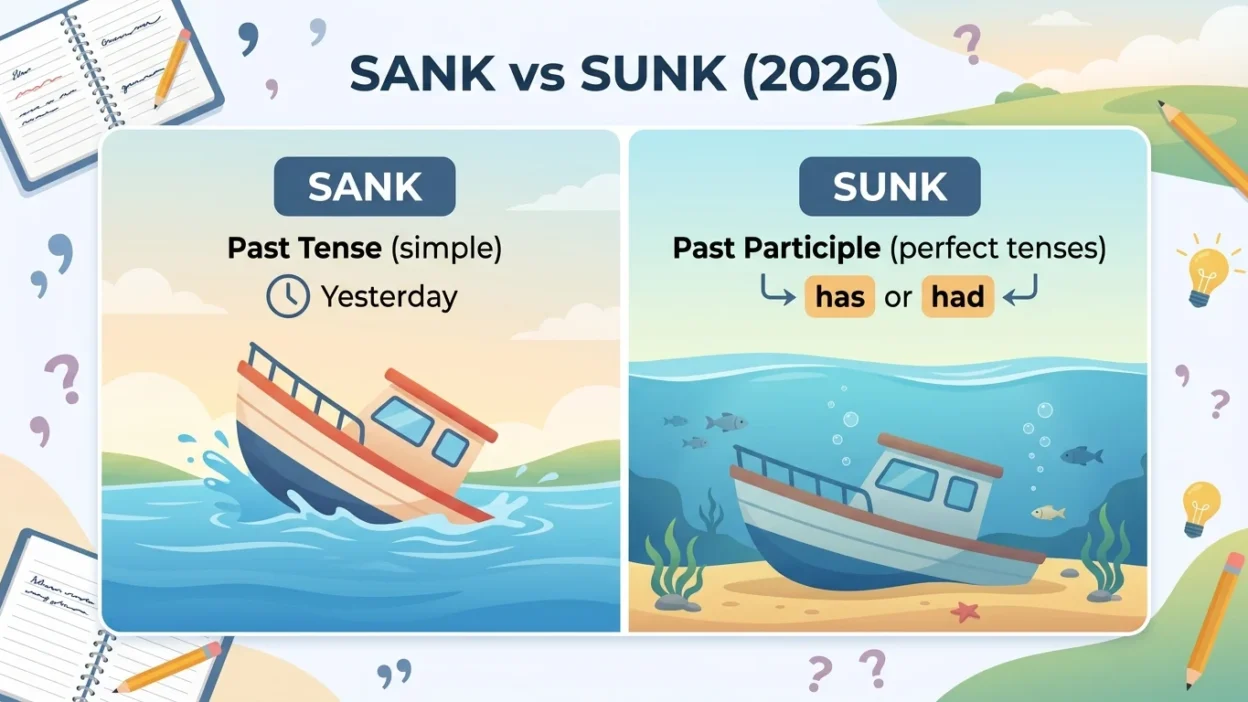
- Sank = simple past tense of “sink”
- Sunk = past participle of “sink”
- Use sank without helping verbs
- Use sunk with helping verbs like:
- has
- have
- had
- was
- were
Simple Examples
- The boat sank yesterday. ✅
- The boat has sunk. ✅
- The boat has sank. ❌
Simple Background of the Word
The main verb is sink.
English verbs often change form depending on time.
Here are the forms:
| Verb Form | Word |
| Base verb | sink |
| Past tense | sank |
| Past participle | sunk |
This pattern is similar to:
| Base Verb | Past | Past Participle |
| drink | drank | drunk |
| sing | sang | sung |
| ring | rang | rung |
So:
- sink → sank → sunk
This is why the two words are connected.
Difference Between Sank and Sunk
The biggest difference is grammar.
“Sank” = Past Tense
Use sank when talking about something that happened in the past.
It usually works alone without a helping verb.
Examples
- The ship sank during the storm.
- My phone sank into the snow.
- The stone sank quickly.
In all these sentences, the action already happened.
“Sunk” = Past Participle
Use sunk with helping verbs.
Common helping verbs are:
- has
- have
- had
- was
- were
Examples
- The ship has sunk.
- Their hopes had sunk.
- The treasure was sunk long ago.
Notice that “sunk” does not usually stand alone as the main past verb.
Easy Comparison
| Feature | Sank | Sunk |
| Verb type | Past tense | Past participle |
| Used alone? | Yes | Usually no |
| Needs helping verb? | No | Yes |
| Example | The boat sank. | The boat has sunk. |
| Common use | Simple past actions | Perfect tenses and passive voice |
Which One Should You Use?
Use “Sank” When:
- Talking about a completed action in the past
- No helping verb is used
Examples
- The canoe sank in the river.
- The economy sank last year.
- She sank into her chair.
Think of it this way:
“Sank” tells what happened.
Use “Sunk” When:
- Using helping verbs
- Talking about something already completed before another time
- Using passive voice
Examples
- The canoe has sunk.
- The company had sunk into debt.
- The ship was sunk by enemy fire.
Think of it this way:
“Sunk” works with another verb.
Understanding Through Real Situations
In Daily Conversation
- My keys sank in the lake. ✅
- My keys have sunk to the bottom. ✅
In News Reports
- The fishing boat sank near the coast.
- Officials said the boat had sunk before rescue teams arrived.
On Social Media
- My mood sank after reading the comments.
- My confidence has completely sunk today.
In Emails
- Sales sank during winter.
- Profits have sunk since January.
Common Mistakes People Make
Using “Sunk” Without a Helping Verb
❌ The ship sunk yesterday.
✅ The ship sank yesterday.
Why?
Because “yesterday” shows simple past tense, so use “sank.”
Using “Sank” After “Has” or “Have”
❌ The ship has sank.
✅ The ship has sunk.
After “has,” always use the past participle form.
Forgetting the Verb Pattern
Some learners remember only one form and use it everywhere.
Correct pattern:
- sink
- sank
- sunk
Mixing It with Similar Verbs
English has many verbs like this:
| Base | Past | Past Participle |
| begin | began | begun |
| swim | swam | swum |
| ring | rang | rung |
The same grammar idea applies.
Easy Trick to Remember
A simple memory trick can help.
Remember This Sentence:
Yesterday it sank.
It has sunk already.
- “Yesterday” → use sank
- “Has” → use sunk
This small pattern helps many students.
Real Life Examples
Water and Boats
- The old boat sank after the storm.
- Several ships have sunk in this area.
Emotions
People also use these words for feelings.
- My heart sank when I heard the news.
- Her confidence has sunk lately.
“Heart sank” means someone suddenly felt sad or worried.
Business and Money
- The market sank this week.
- Their company has sunk into debt.
Objects Going Down
- The ball sank into the mud.
- The coin has sunk to the bottom of the fountain.
Short Learning Section for Students and Beginners
Here is a very easy way to practice.
Step One: Learn the Forms
Say them aloud:
- sink
- sank
- sunk
Repeat several times.
Step Two: Match the Grammar
| Sentence Starter | Correct Word |
| Yesterday the ship ___ | sank |
| The ship has ___ | sunk |
| The stone suddenly ___ | sank |
| The treasure had ___ | sunk |
Step Three: Make Your Own Sentences
Try writing:
- one sentence with “sank”
- one sentence with “sunk”
Example:
- My phone sank in the water.
- My phone has sunk to the bottom.
Practice helps the difference become natural.
Simple Grammar Explanation
English has something called a past participle.
This form is often used with helping verbs.
Examples
- has eaten
- have gone
- had seen
In the same way:
- has sunk
- had sunk
- have sunk
That is why “sunk” usually follows another verb.
Meanwhile, “sank” is simply the normal past tense.
FAQ
Is “sunk” a real word?
Yes. “Sunk” is the past participle form of “sink.”
Example:
- The ship has sunk.
Is it correct to say “the ship sunk”?
In modern standard English, “the ship sank” is usually preferred for simple past tense.
Why do people confuse sank and sunk?
Because both words come from the same verb and both describe something going downward.
Can “sunk” be used as an adjective?
Yes.
Examples:
- a sunk ship
- sunk costs
Here, “sunk” describes something.
Which is more common in speaking?
Both are common, but they are used in different grammar situations.
- sank = simple past
- sunk = with helping verbs
What is the easiest way to remember the difference?
Use this rule:
- No helping verb → sank
- Helping verb → sunk
Can I say “has sank”?
No. That is incorrect.
- has sunk
Do native English speakers make this mistake?
Yes, sometimes in casual speech. But in correct grammar, “sank” and “sunk” have different uses.
Conclusion
The difference between sank and sunk becomes easy once you learn the verb forms.
Remember:
- Sank is the simple past tense
- Sunk is the past participle
Easy Rule
- The boat sank yesterday.
- The boat has sunk already.
That’s the main difference.
If you practice with short daily sentences, you will quickly start using both words correctly and naturally.

Daniel Matthew is a language enthusiast, writer, and contributor at Meanefy.com, where he explores the meanings, origins, and nuances of words and phrases. With a deep passion for language, Daniel aims to make complex concepts simple, engaging, and easy to understand for readers of all ages.