Many English learners, students, and even native speakers often get confused between “learnt” and “learned.”
They look very similar and both are past tense forms of the verb “learn.” But when should you use one over the other?
In this article, we will explain everything in very simple English, so you can understand it on the first read.
Why People Get Confused
The confusion happens because:
- Both learnt and learned are correct past tense forms of learn.
- Different countries prefer different forms.
- Some people think one is more “correct” than the other.
- English has many rules that are exceptions, so it can feel tricky.
Don’t worry! After reading this guide, you will know exactly which one to use and when.
Quick Answer
Here’s the simple version in bullets:
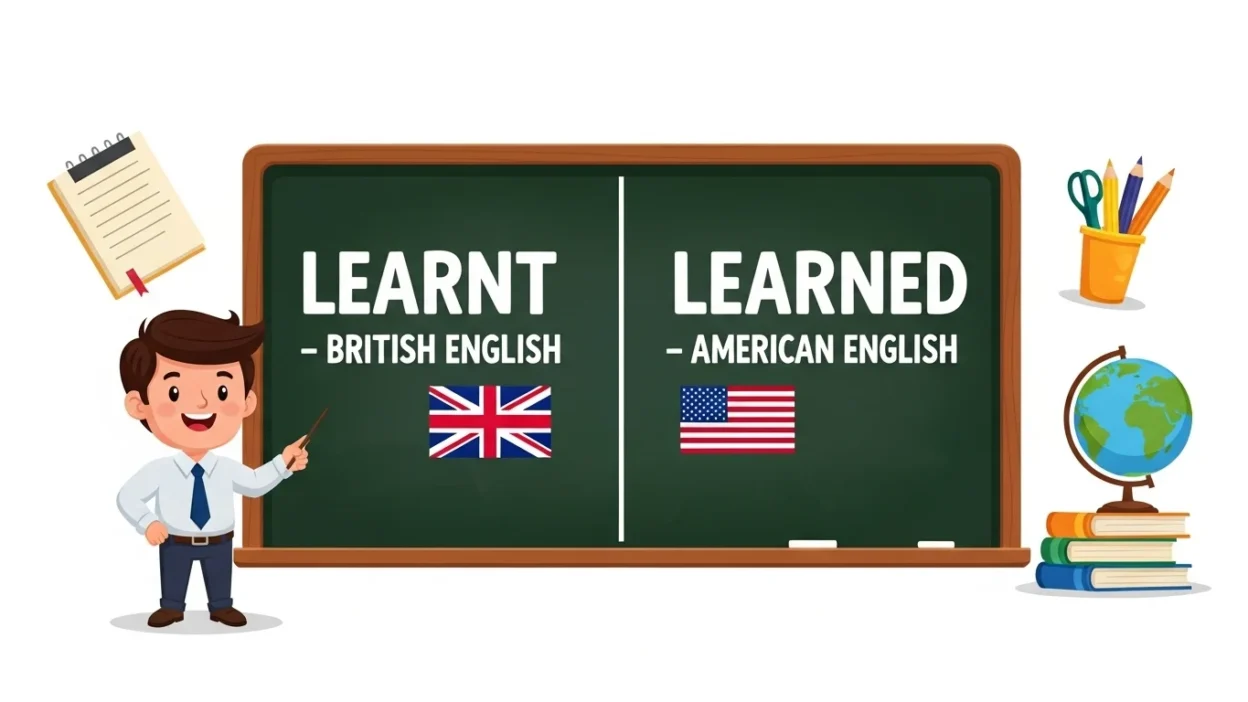
- Learned – commonly used in American English for past tense and past participle.
- Learnt – commonly used in British English for past tense and past participle.
- Both words mean the same thing.
- You can use either one, but it depends on your English style or region.
- Example:
- American English: I learned English last year.
- British English: I learnt English last year.
Origin of “Learnt” and “Learned”
Understanding the background helps:
- English verbs can have two past tense forms: regular and irregular.
- “Learn” is originally a Germanic word.
- In Old English, the past tense was leornode.
- Over time, English developed two common forms:
- Learned → follows the standard -ed ending like most verbs.
- Learnt → an irregular form, mainly used in British English.
So, both forms are historically correct, but usage depends on the region.
Difference Between Learnt and Learned
Here’s the clear rule:
- Learned
- Used more in American English.
- Can be used for past tense or past participle.
- Sounds natural in formal writing in the U.S.
- Learnt
- Used more in British English.
- Can also be used for past tense or past participle.
- More common in informal writing or everyday conversation in the U.K.
Important: The meaning does not change. Both show that someone already gained knowledge or skill.
Learnt vs Learned – Comparison Table
| Feature | Learned | Learnt |
| Region | Mainly American English | Mainly British English |
| Use | Past tense & past participle | Past tense & past participle |
| Formal writing | Yes, especially in the U.S. | Less common in formal writing |
| Informal conversation | Yes, everyday use | Yes, common in the U.K. |
| Example sentence | I learned how to cook. | I learnt how to cook. |
Which One to Use and When
- If you are writing in American English:
- Use learned in emails, essays, and reports.
- Example: I learned a lot from that book.
- If you are writing in British English:
- You can use learnt or learned.
- Learnt is more common in casual speech.
- Example: She learnt French when she was young.
- If you are unsure:
- Use learned – it is accepted everywhere.
Common Mistakes People Make
- Using learnt in formal American writing.
- ❌ Wrong: I learnt a lot from the meeting.
- ✅ Correct (American English): I learned a lot from the meeting.
- Confusing learned as an adjective with the verb.
- Learned can also mean well-educated.
- Example: He is a learned man. (Here, it’s not past tense!)
- Thinking learnt is wrong – it’s not wrong in British English.
- Mixing past tense with future tense:
- ❌ I will learnt English tomorrow.
- ✅ I will learn English tomorrow.
Everyday Real Life Examples
Here are some real-life examples showing both forms:
Emails
- American English: I learned about the new project yesterday.
- British English: I learnt about the new project yesterday.
Social Media
- I finally learned how to bake sourdough!
- I learnt how to ride a bike when I was six.
News or Articles
- American English: Researchers learned that exercise improves memory.
- British English: Researchers learnt that exercise improves memory.
Daily Use
- I learned a new word today.
- She learnt the song very quickly.
Short Learning Section for Students and Beginners
Here’s an easy way to remember:
- Think “-ed” = American, “-t” = British.”
- Both mean “already studied or practiced something.”
- Try this simple exercise:
Exercise: Fill in the blank with learned or learnt:
- I ___ how to swim last summer.
- She ___ to drive when she was 18.
- They ___ about the history of their city.
Answer (American English): learned, learned, learned
Answer (British English): learnt, learnt, learnt
Practice these sentences and it will become easy!
FAQ
1. Are “learnt” and “learned” correct?
Yes, both are correct. Use depends on British or American English.
2. Which one is more common in the U.S.?
Learned is more common in American English.
3. Can “learned” be an adjective?
Yes, learned can describe someone well-educated.
4. Is “learnt” used in American English?
It is rare in the U.S. and usually avoided in formal writing.
5. Can I use “learnt” in casual conversation in the U.K.?
Yes, it’s very common.
6. Does the meaning change between “learnt” and “learned”?
No, they both mean the same thing.
7. Can I use “learned” in British English?
Yes, it is also correct, especially in formal writing.
8. Which one should ESL learners choose?
If unsure, use learned – it works everywhere.
Conclusion
The words learnt and learned can be confusing at first, but the rule is simple:
- Learned = American English
- Learnt = British English
Both are correct, and the meaning is the same. Use learned if you are not sure or writing for an international audience. Practice with daily sentences, and soon you will never make a mistake again.

Anthony Charles is the founder and lead content creator at Meanefy.com, a platform dedicated to exploring word meanings, language nuances, and everyday curiosities. With a passion for language and a keen eye for detail, Anthony aims to make complex words and concepts simple and accessible for readers around the world.