Many English learners get confused when they see the words “labeled” and “labelled.” They look different, but they seem to mean the same thing. Some people think one is correct and the other is wrong. Others are not sure which one to use in writing.
The truth is simple: both words are correct. The difference is only about English spelling style, not meaning. In this article, you will clearly understand when and why each form is used.
Quick Answer: Labeled vs Labelled
Here is the simple explanation:
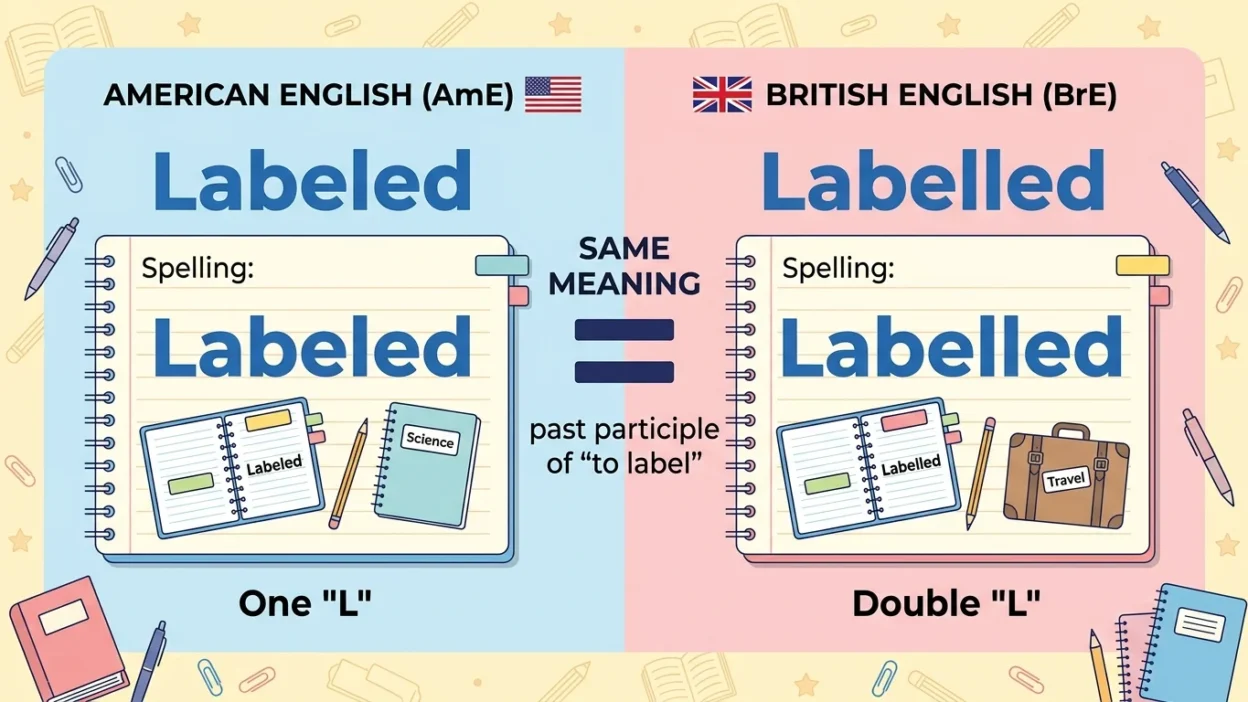
- Labeled → American English spelling
- Labelled → British English spelling
- Both mean: to attach a label or name to something
Key points:
- They have the same meaning
- They are used in different countries
- You should choose based on your English style (US or UK)
- Both are grammatically correct
Simple Origin and Background
The difference between these two words comes from the way English evolved in different regions.
British English (UK and many Commonwealth countries)
In British English, people often double some letters in verbs when adding endings like -ed or -ing.
So:
- label → labelled
- travel → travelled
- cancel → cancelled
This pattern is common in UK spelling rules.
American English (USA)
American English usually keeps spelling simpler and removes extra letters.
So:
- label → labeled
- travel → traveled
- cancel → canceled
This makes American spelling shorter and easier for many learners.
Clear Explanation of the Difference
Even though the spelling is different, the meaning is exactly the same.
Meaning of “label/labeled/labelled”
To label something means:
- To put a name tag on it
- To identify it
- To describe or mark it
Example meaning:
- You label a box “Books”
- A teacher labels a map
- A store labels prices
The only difference:
- “Labeled” = American writing style
- “Labelled” = British writing style
Nothing else changes:
- No change in grammar
- No change in pronunciation
- No change in meaning
Comparison
| Feature | Labeled | Labelled |
| English type | American English | British English |
| Meaning | Same | Same |
| Spelling style | Simpler | Double “l” |
| Used in | USA, Canada (mostly), online global content | UK, Australia, India, Pakistan (often British style) |
| Example | The box was labeled “Fragile” | The box was labelled “Fragile” |
Which One to Use and When
Choosing between labeled and labelled depends on your purpose.
Use “Labeled” when:
- You are writing for American readers
- You are using US English in school or exams
- Your teacher or book follows American English
- You are writing for international tech or global platforms that prefer US spelling
Use “Labelled” when:
- You are writing in British English
- Your school follows UK English rules
- You are in countries like the UK, Australia, or sometimes South Asia (depending on curriculum)
- You are using British textbooks or exams
Simple rule:
👉 Pick one style and stay consistent in your writing.
Common Mistakes People Make
Many learners make small but important mistakes with these words.
1. Mixing both spellings in one text
Wrong:
- The bottles were labeled and labelled correctly.
Correct:
- The bottles were labeled correctly. (US style)
OR - The bottles were labelled correctly. (UK style)
2. Thinking one is wrong
Both are correct. There is no “wrong” version.
3. Switching styles in the same paragraph
This makes writing look inconsistent and unprofessional.
4. Confusing meaning with spelling
Some learners think:
- “labelled” means something different from “labeled”
But this is not true. Meaning is exactly the same.
Everyday Real Life Examples
Emails
- US style: “The files are labeled by date.”
- UK style: “The files are labelled by date.”
News or Reports
- “The boxes were labeled for delivery.”
- “The boxes were labelled for delivery.”
Both describe the same situation.
Social Media Posts
- “I labeled my storage boxes today!”
- “I labelled my storage boxes today!”
Same meaning, different spelling style.
Daily Life Situations
- A student labels notebooks by subject
- A teacher labels a diagram in class
- A shop labels products with prices
- A doctor labels samples in a lab
In all these cases, both spellings can be used depending on English style.
Short Learning Section for Students and Beginners
Think of it like this:
English has two major writing styles:
- American English (simpler spelling)
- British English (traditional spelling)
Memory trick:
- Single “l” = American (Labeled)
- Double “l” = British (Labelled)
Easy reminder sentence:
👉 “Americans use one ‘l’, British use two ‘l’s.”
What really matters:
- Meaning stays the same
- Only spelling changes
- Choose one style and stay consistent
FAQ: Labeled vs Labelled
1. Is “labeled” correct English?
Yes. It is correct in American English.
2. Is “labelled” wrong?
No. It is correct in British English.
3. Do both words mean the same thing?
Yes, they have exactly the same meaning.
4. Which one should I use in school?
It depends on your school’s English system (US or UK).
5. Why are there two spellings?
Because English developed differently in the USA and UK.
6. Does pronunciation change?
No, both are pronounced the same way.
7. Can I mix both in writing?
It is better not to mix them. Choose one style.
8. Is one more modern than the other?
No. Both are modern and widely used today.
Conclusion
The difference between labeled and labelled is very simple. They mean the same thing, and both are correct. The only difference is spelling style: American English uses labeled, while British English uses labelled.
There is no need to feel confused or stressed about choosing the right one. Just decide which English style you are following and use it consistently. Once you understand this small rule, you can write more confidently and clearly in English.

Daniel Matthew is a language enthusiast, writer, and contributor at Meanefy.com, where he explores the meanings, origins, and nuances of words and phrases. With a deep passion for language, Daniel aims to make complex concepts simple, engaging, and easy to understand for readers of all ages.