Learning English can be tricky, and some words confuse almost everyone. Two of the most confusing words are “lie” and “lay.”
Even native speakers often mix them up. This guide will help you understand the difference clearly, so you never get confused again.
Why People Get Confused
“Lie” and “lay” sound similar and are related to putting something down or resting. But their meanings, forms, and grammar are different.
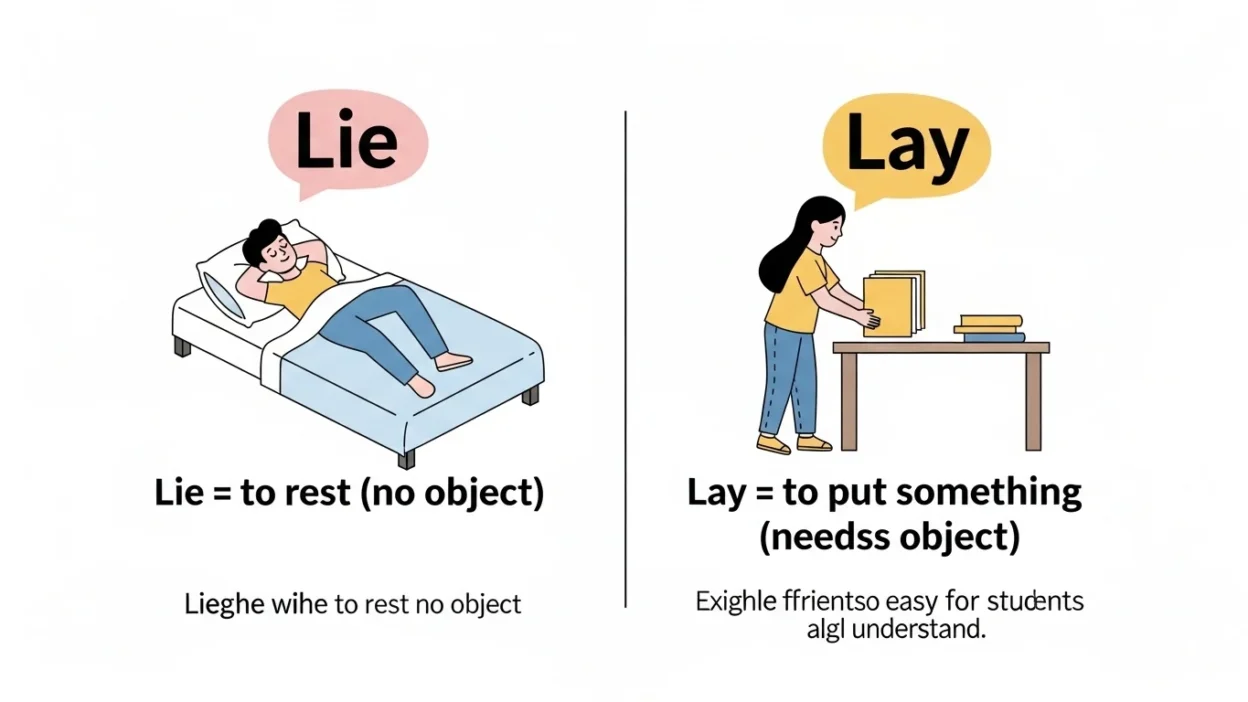
- Lie usually means to rest or recline by yourself.
- Lay usually means to put something down for someone or something else.
The confusion happens because their past tenses are different, and English doesn’t always follow strict rules.
Quick Answer
Here’s a simple way to remember:
- Lie → You lie down yourself.
- Present: lie
- Past: lay
- Past Participle: lain
- Lay → You lay something down.
- Present: lay
- Past: laid
- Past Participle: laid
Tip: If there is an object (something being placed), use lay. If not, use lie.
Where “Lie” and “Lay” Come From
- Lie comes from Old English licgan, meaning “to recline.”
- Lay comes from Old English lecgan, meaning “to put or place.”
So, historically, one is about your own action, and the other is about doing something to an object.
Clear Explanation of the Difference
1. Lie (to rest yourself)
- No object is needed.
- Examples:
- I lie on the bed every night.
- Yesterday, she lay on the sofa for two hours.
- He has lain in that position all morning.
2. Lay (to put something down)
- Always takes an object. You are laying something down.
- Examples:
- I lay the book on the table.
- Yesterday, she laid her keys on the counter.
- He has laid the plates on the table.
Quick trick:
- Ask yourself: “Am I doing it myself, or am I putting something down?”
- Yourself → lie
- Something else → lay
Comparison Table
| Feature | Lie (to recline) | Lay (to put something) |
| Object needed? | No | Yes |
| Present | lie | lay |
| Past | lay | laid |
| Past participle | lain | laid |
| Example | I lie on the bed. | I lay the book on the bed. |
Which One to Use and When
- Use lie when talking about yourself or someone reclining.
- Use lay when placing an object somewhere.
Easy trick: If you can add a thing after the verb, it’s probably lay.
- Example: “I ___ the pen on the desk.” → Must be lay, because pen is the object.
- Example: “I ___ down on the bed.” → Must be lie, no object.
Common Mistakes People Make
- Saying “I laid down” instead of “I lay down.”
- Confusing lay and lie in the past tense.
- Using lie with an object: ❌ “I lie the book on the table.” ✅ Correct: “I lay the book on the table.”
- Forgetting the past participle: ❌ “I have lay in bed all day.” ✅ Correct: “I have lain in bed all day.”
Everyday Real Life Examples
Emails
- Lie: “I plan to lie down for a short break.”
- Lay: “I laid the documents on your desk this morning.”
News
- “The cat lies in the sun all afternoon.”
- “Volunteers laid flowers at the memorial.”
Social Media
- “Just want to lie in bed all day.”
- “I laid my phone on the table by accident.”
Daily Use
- “Please lay your shoes by the door.”
- “I need to lie down for a few minutes.”
Learning Section for Students and Beginners
- Remember the object rule:
- No object → lie
- Object → lay
- Practice the tenses:
- Lie → lie, lay, lain
- Lay → lay, laid, laid
- Try small sentences:
- Lie: “I ___ down.” → Present: lie, Past: lay, Past Participle: lain
- Lay: “I ___ the cup on the table.” → Present: lay, Past: laid, Past Participle: laid
- Visualize:
- Lie → You resting.
- Lay → You putting something down.
FAQ
1. Can I say “I laid down yesterday”?
- ❌ No. Correct: “I lay down yesterday.”
2. Can I say “I lie the book on the table”?
- ❌ No. Correct: “I lay the book on the table.”
3. What is the past tense of lie?
- Past tense of lie is lay.
4. What is the past tense of lay?
- Past tense of lay is laid.
5. Can “lie” be used for objects?
- ❌ No, “lie” is only for yourself or someone reclining.
6. Can “lay” be used without an object?
- ❌ No, “lay” always needs an object.
7. Is “lain” the same as “laid”?
- No. Lain is past participle of lie, laid is past participle of lay.
8. How can I remember easily?
- Lie = rest yourself
- Lay = put something
Conclusion
Understanding lie and lay is easier if you remember two simple rules:
- Lie → you rest yourself, no object.
- Lay → you put something down, needs an object.
Practice using them in short sentences. Think about whether there is an object or not. Over time, it will become natural.
Once you master these, you can write and speak English more confidently without confusing these tricky words.

Daniel Matthew is a language enthusiast, writer, and contributor at Meanefy.com, where he explores the meanings, origins, and nuances of words and phrases. With a deep passion for language, Daniel aims to make complex concepts simple, engaging, and easy to understand for readers of all ages.