Many learners feel confused when they see the words “lieing” and “lying.” They look very similar, and both seem like they come from the verb “lie.” Because of this, people often use the wrong spelling without knowing it.
The good news is that the answer is actually very simple. Once you understand one small spelling rule, you will never be confused again.
This guide will explain everything in very easy English so you can understand it quickly and remember it for a long time.
Quick Answer
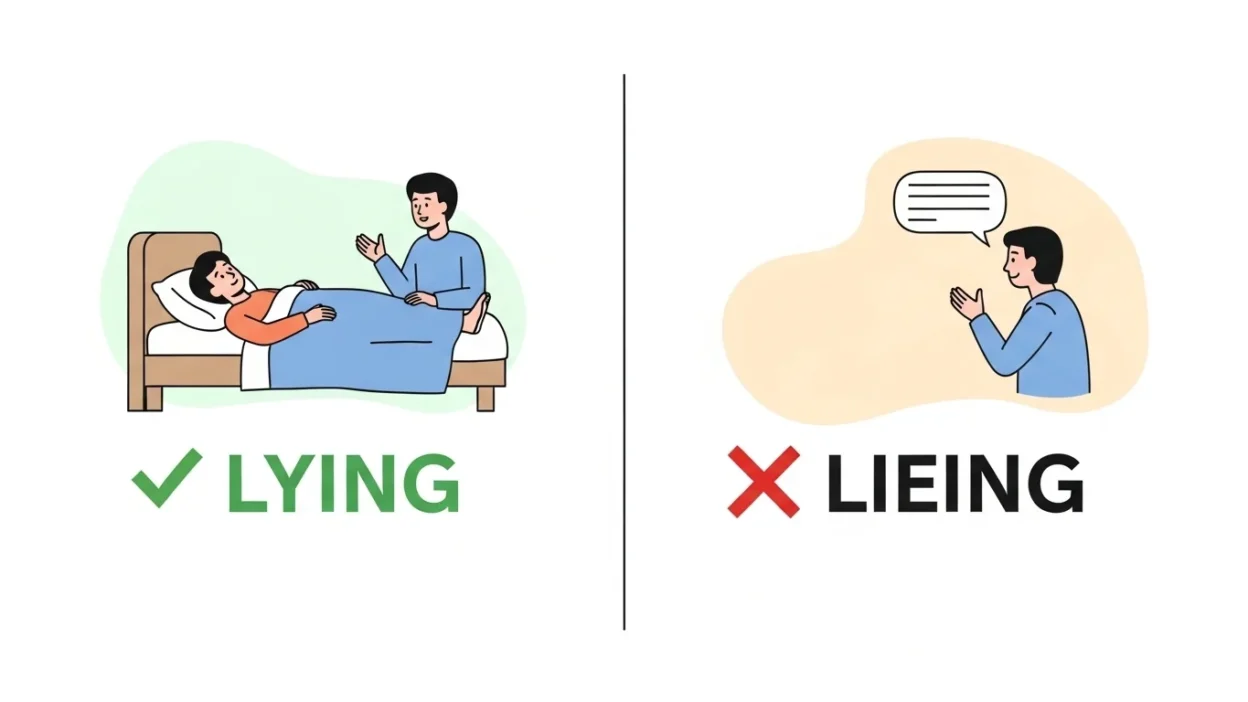
- ✅ “Lying” is correct
- ❌ “Lieing” is incorrect
- Use “lying” when talking about:
- Not telling the truth
- Resting or being in a flat position
Simple Background
The confusion comes from how English changes verbs when we add -ing.
The base word is “lie.” But when we add -ing, something special happens.
Normally, we just add -ing:
- run → running
- sit → sitting
But some words change their spelling before adding -ing.
This is why “lie” becomes “lying” and not “lieing.”
Clear Explanation of the Difference
Let’s make it very clear:
What is “lying”?
“Lying” is the present form of the verb “lie.”
It has two meanings:
- Not telling the truth
- Example: He is lying to his teacher.
- Being in a flat position
- Example: She is lying on the bed.
What about “lieing”?
- “Lieing” is not a real word in standard English
- It is a spelling mistake
- You should never use it
Comparison
| Word | Correct or Not | Meaning | Example |
| lying | ✅ Correct | Not telling the truth / resting | He is lying on the sofa. |
| lieing | ❌ Incorrect | No meaning | This spelling is wrong. |
Which One to Use and When
Always choose “lying.”
Use it in these situations:
When someone is not telling the truth
- She is lying about her age.
- They are lying to their parents.
When someone is resting or flat
- He is lying on the floor.
- The cat is lying in the sun.
Simple tip to remember
Think of this:
“Drop the e, then add -ing.”
- lie → lying
- not lieing ❌
Common Mistakes People Make
Here are some common mistakes and how to fix them:
Writing “lieing”
- ❌ She is lieing.
- ✅ She is lying.
Forgetting the spelling rule
Some learners think:
- lie + ing = lieing ❌
But correct rule:
- Remove e, add -ing
- lie → lying ✅
Mixing meanings
People sometimes get confused between:
- lie (not telling truth)
- lie (resting position)
But both use lying in the -ing form.
Everyday Real Life Examples
Here are examples you might see in daily life:
In emails
- “I think someone is lying in this report.”
- “He is lying about the meeting time.”
In news
- “The witness was lying in court.”
- “The injured man was lying on the road.”
On social media
- “Stop lying!”
- “I’m just lying on my bed and relaxing.”
In daily conversations
- “Why are you lying?”
- “The dog is lying under the table.”
Simple Learning Section for Students
Here is a quick way to learn and remember:
Easy rule
- If a verb ends with -ie, change it to -y before adding -ing
Example:
- lie → lying
Practice sentences
Fill in the blank:
- He is ______ on the couch.
- She is ______ to her friend.
Correct answer:
- lying
Memory trick
Think:
“No ‘e’ before -ing!”
FAQ
Is “lieing” ever correct?
No. “Lieing” is always wrong in standard English.
Why does “lie” become “lying”?
Because English spelling rules say:
- Change -ie to -y before adding -ing
Does “lying” always mean not telling the truth?
No. It has two meanings:
- Not telling the truth
- Resting in a flat position
How can I remember the correct spelling?
Just remember:
- Drop e, add -ing
- lie → lying
Is this mistake common?
Yes. Many learners and even native speakers sometimes write “lieing” by mistake.
Can I use “lying” in formal writing?
Yes. “Lying” is correct in both formal and informal English.
Are there other words like this?
Yes, for example:
- die → dying
- tie → tying
What is the easiest way to avoid mistakes?
Practice writing and remember the simple rule:
- ie → y + ing
Conclusion
The confusion between “lieing” and “lying” is very common, but the solution is simple.
- “Lying” is the correct spelling
- “Lieing” is always incorrect
Once you learn the small rule of changing -ie to -y, everything becomes clear. With a little practice, you will use the correct word naturally in speaking and writing.
Keep it simple, remember the rule, and you will never be confused again.