Many learners feel confused about “a” and “an.” At first, it looks easy, but small mistakes happen again and again. You may wonder: Should I say “a apple” or “an apple”? Or “a hour” or “an hour”?
The good news is this: once you understand one simple rule, the confusion goes away. This guide will explain everything in very easy English so you can use “a” and “an” correctly every time.
Quick Answer
Here is the rule in the simplest way:
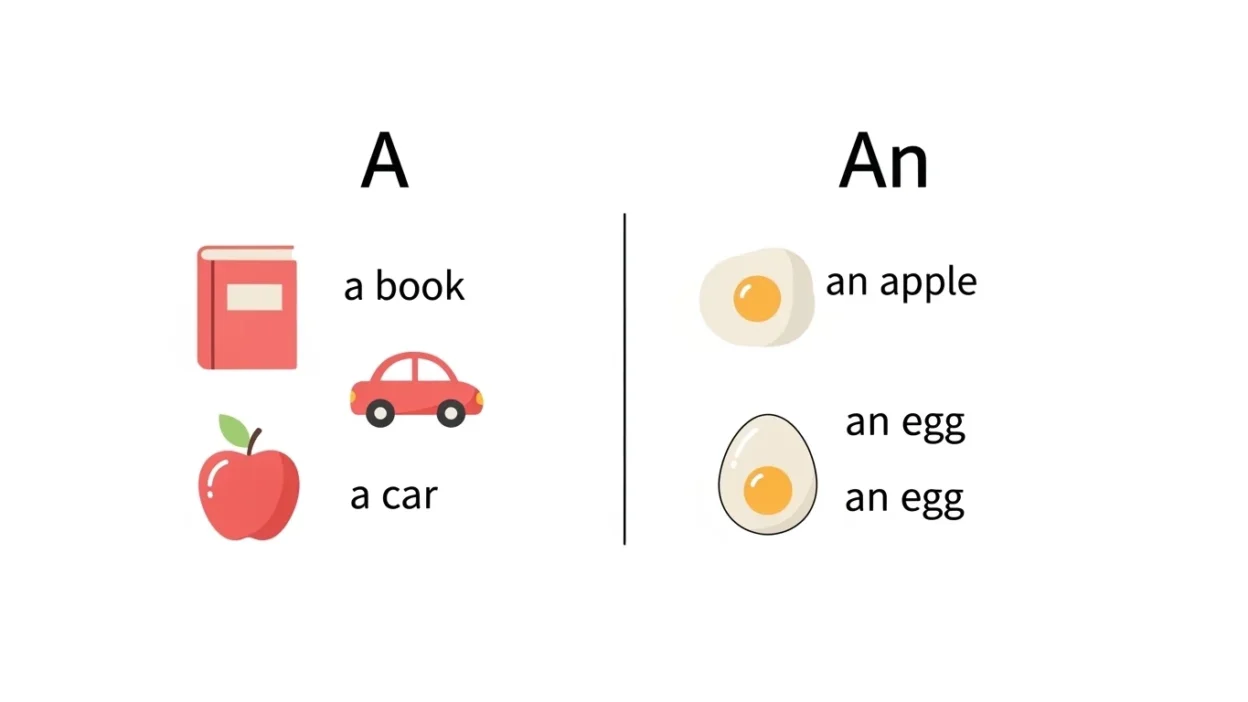
- Use a before words that start with a consonant sound
- a book
- a car
- a teacher
- Use an before words that start with a vowel sound
- an apple
- an egg
- an idea
👉 Important: It is about sound, not just the first letter.
Simple Background
In English, “a” and “an” are called articles. They are small words, but they are very important.
We use them when we talk about one thing, but not a specific thing.
For example:
- I saw a dog (any dog, not a specific one)
- She bought an orange (one orange, not a special one)
Long ago, English speakers used only “an.” Over time, it became easier to say “a” before certain sounds. This is why we now have two forms: a and an.
The Main Difference
The difference is very simple:
- “A” is used before a consonant sound
- “An” is used before a vowel sound
What is a vowel sound?
Vowel sounds are:
- a (apple)
- e (egg)
- i (ice)
- o (orange)
- u (umbrella)
What is a consonant sound?
All other sounds:
- b, c, d, f, g, etc.
Easy Comparison
| Use “a” | Use “an” |
| Before consonant sounds | Before vowel sounds |
| a book | an apple |
| a car | an orange |
| a teacher | an idea |
| a dog | an egg |
| a university (starts with “yoo” sound) | an hour (silent “h”) |
Which One to Use and When
Use “a” when the word starts with a consonant sound
Examples:
- a pen
- a house
- a girl
- a university (sounds like “yoo”)
- a European country
👉 Even if the word starts with a vowel letter, use “a” if the sound is not a vowel.
Example:
- a university (not an university)
Use “an” when the word starts with a vowel sound
Examples:
- an apple
- an umbrella
- an old man
- an hour (the “h” is silent)
- an honest person
👉 Even if the word starts with a consonant letter, use “an” if the sound is a vowel.
Example:
- an hour (not a hour)
Common Mistakes People Make
Mistake: Looking only at the letter
❌ a apple
✔️ an apple
👉 Always listen to the sound, not just the letter.
Mistake: Forgetting silent letters
❌ a hour
✔️ an hour
👉 The “h” is silent, so it sounds like “our.”
Mistake: Confusing “u” words
❌ an university
✔️ a university
👉 “University” starts with a “yoo” sound, not a vowel sound.
Mistake: Using “an” for all vowel letters
❌ an European city
✔️ a European city
👉 “European” starts with “yoo” sound.
Everyday Real Life Examples
In Emails
- I have a question about your class.
- Can you send me an update?
- She is a new student.
In News
- A man saved a child.
- An accident happened on the road.
- A company launched a product.
On Social Media
- I bought a phone today!
- This is an amazing movie!
- He is a great friend.
In Daily Conversation
- I need a glass of water.
- She ate an apple.
- He is a doctor.
Simple Learning Section for Students
Here is a quick way to practice:
Step 1: Say the word out loud
Listen to the first sound.
Step 2: Ask yourself
- Does it sound like a vowel? → use an
- Does it sound like a consonant? → use a
Practice Examples
Try these:
- ___ apple → an apple
- ___ dog → a dog
- ___ hour → an hour
- ___ university → a university
Tip to Remember
👉 Think: Sound first, not letter.
FAQ (Frequently Asked Questions)
What is the difference between “a” and “an”?
“A” is used before consonant sounds. “An” is used before vowel sounds.
Is it based on spelling or sound?
It is based on sound, not spelling.
Why do we say “an hour”?
Because the “h” is silent. It sounds like it starts with a vowel.
Why do we say “a university”?
Because it starts with a “yoo” sound, which is a consonant sound.
Can I use “an” before all vowel letters?
No. Only use “an” if the sound is a vowel.
Do I need “a” or “an” before plural words?
No.
❌ a apples
✔️ apples
Do we use “a” and “an” with uncountable nouns?
No.
❌ a water
✔️ water
Is it important to use them correctly?
Yes. It makes your English sound clear and natural.
Conclusion
Understanding “a” and “an” is easier than it looks. The key idea is simple:
👉 Focus on the sound, not the letter.
- Use a before consonant sounds
- Use an before vowel sounds
With a little practice, you will start using them naturally without thinking. Keep listening, speaking, and reading and soon, this small rule will feel very easy.

Daniel Matthew is a language enthusiast, writer, and contributor at Meanefy.com, where he explores the meanings, origins, and nuances of words and phrases. With a deep passion for language, Daniel aims to make complex concepts simple, engaging, and easy to understand for readers of all ages.