Many people feel confused about “lead” and “led.” They look very similar, and even their pronunciation can be tricky.
Some people say “lead” like leed, while others say it like led. This makes things even more confusing, especially for students and English learners.
But don’t worry. Once you understand a few simple rules, the difference becomes very easy.
This guide will explain everything in a calm and simple way so you can understand it on your first read.
Quick Answer
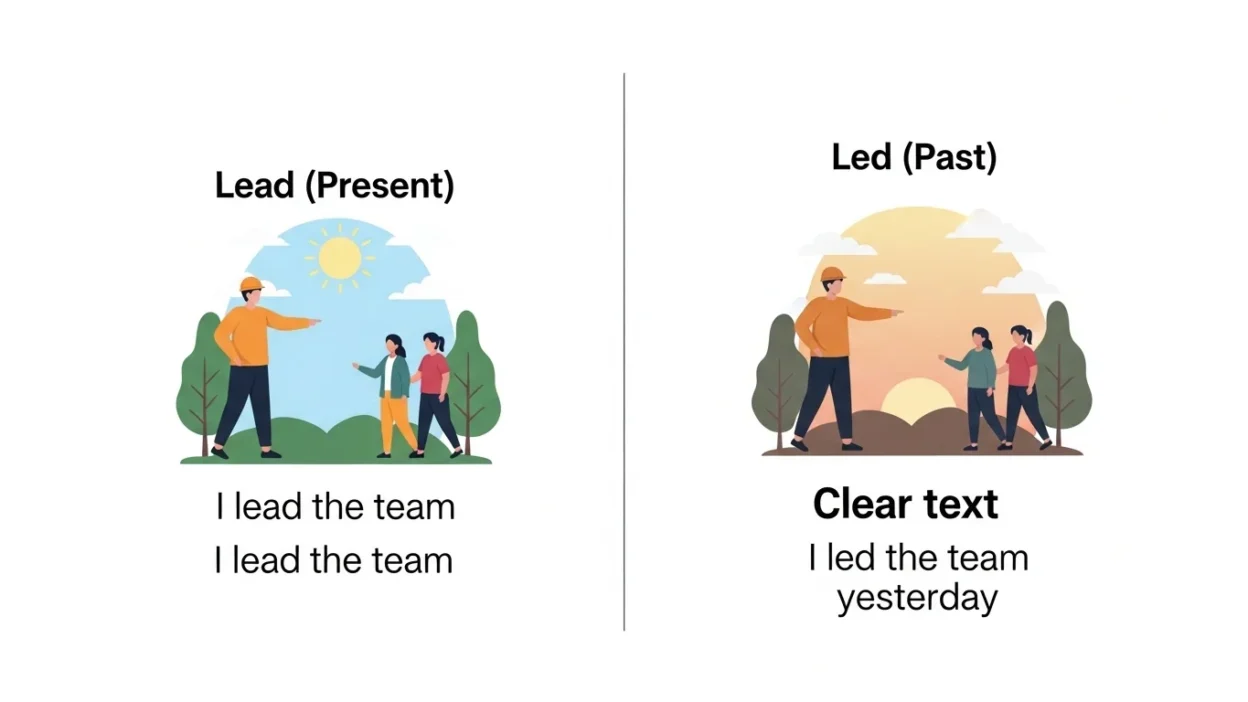
- Lead (leed) → Present tense (now)
- Example: I lead the team.
- Led (led) → Past tense (before)
- Example: I led the team yesterday.
- Lead (led) → Also a noun (a metal)
- Example: The pipe is made of lead.
Simple Background
The word “lead” comes from old English words that meant to guide or show the way. Over time, English changed, but this word stayed.
The past form of “lead” became “led.” This change helps us show time clearly.
Also, English has another word spelled “lead”, which is a type of metal. This is why spelling can feel confusing, even though the meanings are different.
The Difference Between Lead and Led
Let’s break it down in the simplest way.
Lead (Present)
- Used for now or regular actions
- Means to guide, show the way, or be in charge
- Pronounced like “leed”
Examples:
- I lead my group in class.
- She leads the team every week.
- They lead the project.
Led (Past)
- Used for the past
- Means you already guided or showed the way
- Pronounced like “led”
Examples:
- I led the group yesterday.
- She led the team last year.
- They led the meeting last week.
Lead (Metal)
- A thing, not an action
- A heavy metal
- Pronounced like “led”
Example:
- This pipe is made of lead.
Comparison
| Word | Time | Meaning | Pronunciation | Example |
| Lead | Present | To guide or be in charge | Leed | I lead the class |
| Led | Past | Guided or was in charge | Led | I led the class yesterday |
| Lead | Noun | A type of metal | Led | The box has lead inside |
Which One to Use and When
Use lead when:
- You are talking about now
- You are talking about something that happens regularly
- Example:
- I lead the team every day.
Use led when:
- You are talking about the past
- Something already happened
- Example:
- I led the team last week.
Easy tip:
- If your sentence has words like yesterday, last night, last year → use led
- If your sentence is about now or always → use lead
Common Mistakes People Make
Here are mistakes many learners make:
Using “lead” for the past
❌ I lead the team yesterday.
✔ I led the team yesterday.
Confusing pronunciation
- “Lead” (present) sounds like leed
- “Led” (past) sounds like led
Forgetting the metal meaning
Some people think “lead” is always a verb, but it can also be a noun (a metal).
Writing “led” as “lead”
❌ He lead the group last year.
✔ He led the group last year.
Everyday Real Life Examples
Emails
- I led the meeting yesterday.
- I will lead the next meeting.
News
- She led the country through a difficult time.
- He leads the company now.
Social Media
- I led my team to success last night!
- I lead a small group online.
Daily Conversation
- Who will lead the group today?
- Who led the group yesterday?
Simple Learning Section
If you are a student or beginner, follow these easy steps:
Step One: Learn the time
- Present = lead
- Past = led
Step Two: Practice with sentences
- I lead my class.
- I led my class yesterday.
Step Three: Say it out loud
- Lead = leed
- Led = led
Speaking helps you remember faster.
Step Four: Use it daily
Try to use both words in your daily English practice.
FAQ Section
What is the main difference between lead and led?
“Lead” is present tense, and “led” is past tense.
How do I know which one to use?
Check the time in your sentence:
- Now → lead
- Past → led
Is “lead” ever past tense?
No. The past tense of “lead” is always “led.”
Why do “lead” and “led” sound the same sometimes?
Because “lead” (the metal) is pronounced like “led,” but the verb “lead” (present) sounds like “leed.”
Can “lead” be a noun?
Yes. It can be a metal.
Is “led” ever used as a noun?
No. “Led” is only a verb (past tense).
Which one is more common in daily use?
Both are common. You use:
- “Lead” for present actions
- “Led” for past actions
How can I remember the difference easily?
Think:
- Lead = Now
- Led = Before
Conclusion
The difference between lead and led is simple once you understand it clearly.
- Lead is for the present (now)
- Led is for the past (before)
Just remember the time of your sentence, and you will choose the correct word easily.
With a little practice, this confusion will completely disappear, and you will feel more confident using English every day.

Steven Mark is a writer, researcher, and contributor at Meanefy.com, a platform dedicated to exploring word meanings, language nuances, and everyday linguistic curiosities. With a passion for words and clear communication, Steven focuses on making language simple, engaging, and accessible to all readers.