Many English learners and even native speakers mix up the words “principal” and “principle.” They look almost the same, sound very similar, and are often used in different situations. Because of this, it is very easy to make mistakes.
The confusion usually happens because:
- Both words are spelled almost the same
- They sound nearly identical when spoken
- They belong to different meanings (one is a person, one is an idea)
- People often learn them at the same time without clear explanation
This article will make everything simple so you never confuse them again.
Quick Answer: Simple Difference
Here is the easiest way to understand both words:
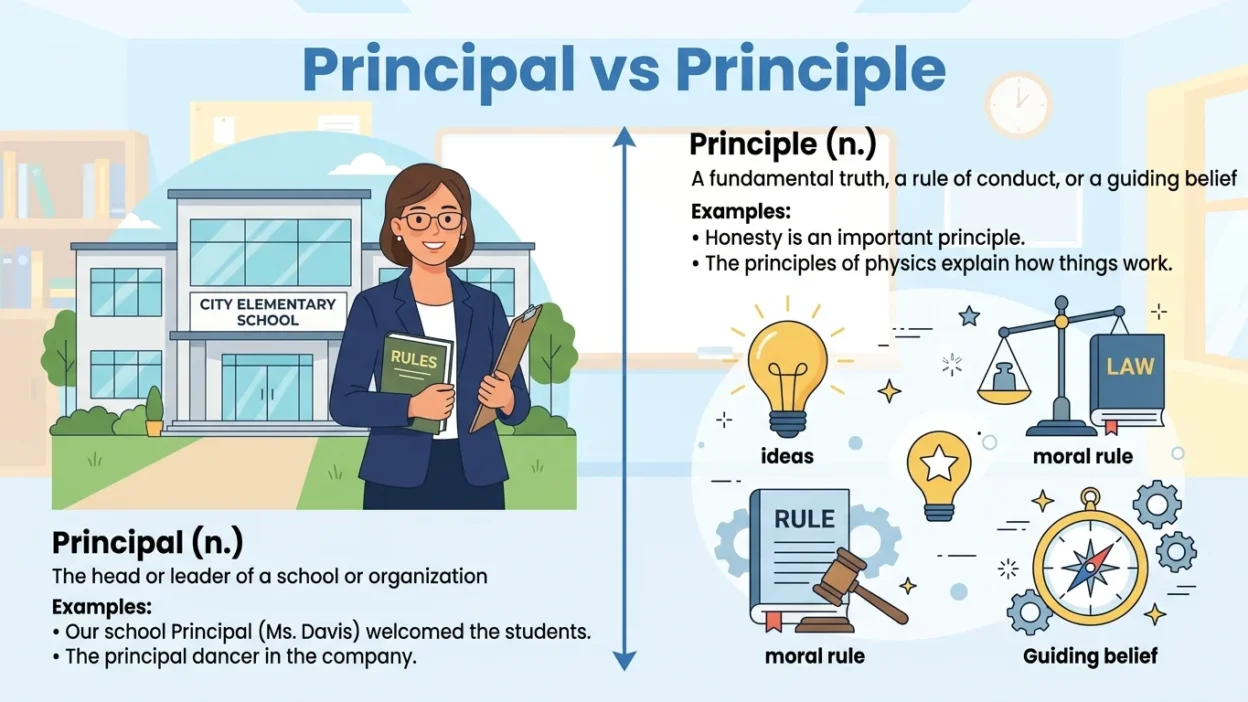
- Principal = a person in charge OR the most important thing
- Principle = a rule, belief, or idea
Simple memory trick:
- Principal = “pal” (person)
- Principle = rule or idea
That’s it. If you remember this, you are already ahead.
Simple Origin or Background Explanation
Both words come from Latin, and they were once part of the same root idea: “first” or “main.” Over time, English changed them into two different meanings.
- Principal stayed connected to “a person in charge” or “main position”
- Principle became connected to “rules” or “basic truths”
Even though they share history, modern English uses them in very different ways.
Clear Explanation of the Difference
Let’s break it down in a very simple way.
1. Principal
“Principal” is used in two main ways:
A. A person in authority
- The head of a school is called the principal
- This is the most common meaning for students
Example:
- The principal announced the school holiday.
B. The most important thing
- It can also mean “main” or “most important”
Example:
- The principal reason for success is hard work.
So, “principal” is about a person or something important.
2. Principle
“Principle” always refers to an idea or rule.
It is something you believe in or follow.
Example uses:
- Honesty is a good principle.
- He follows the principle of kindness.
- Scientific principles explain how things work.
So, “principle” is about rules, values, or beliefs.
Comparison (Easy to Understand)
| Feature | Principal | Principle |
| Meaning | A person or main thing | A rule or idea |
| Part of speech | Noun (sometimes adjective) | Noun |
| Usage | School head, important person | Beliefs, rules, laws |
| Easy trick | Think “pal” = person | Think “rule/idea” |
| Example | The principal is kind | Be honest is a principle |
Which One to Use and When
Choosing the correct word becomes easy when you ask yourself one question:
Ask this:
- Am I talking about a person or main thing? → Use principal
- Am I talking about a rule or belief? → Use principle
Quick guide:
Use “principal” when:
- Talking about school authority
- Talking about the main reason or main part
- Referring to someone in charge
Examples:
- The principal is speaking today.
- The principal cause of the problem is rain.
Use “principle” when:
- Talking about morals or values
- Talking about rules or laws
- Talking about general truths
Examples:
- She lives by strong principles.
- Physics is based on scientific principles.
Common Mistakes People Make
Many learners confuse these words. Here are the most common mistakes:
1. Using “principle” for a school head
Wrong:
- The principle of the school is strict.
Correct:
- The principal of the school is strict.
2. Using “principal” for rules
Wrong:
- He follows strong principals.
Correct:
- He follows strong principles.
3. Mixing spelling because they sound same
Since they are pronounced almost the same, people often write the wrong one in exams or messages.
4. Not checking meaning before writing
Many learners just guess the spelling instead of checking meaning.
Everyday Real Life Examples
Let’s see how both words are used in daily life.
School life examples
- The principal gave a speech in assembly.
- The school follows strict principles of discipline.
Social media examples
- “Respect is my main principle in life.”
- “Our principal announced new rules today.”
News or general use
- The principal investor supported the project.
- The company works on strong business principles.
Daily conversation examples
- I don’t break my principles.
- The principal reason for delay is traffic.
Short Learning Section for Students and Beginners
Here is a very simple way to remember forever:
Think like this:
- Principal = “pal” = person
- Principle = “rule” = idea
Easy practice:
Try filling in the blanks:
- The school ______ is kind.
- Honesty is a good ______.
- The ______ reason is rain.
- She follows strong ______.
Answers:
- principal
- principle
- principal
- principles
If you got all correct, you understand the difference well.
FAQ (Frequently Asked Questions)
1. Are principal and principle pronounced the same?
Yes, they sound almost the same, which is why people confuse them.
2. What is the easiest way to remember the difference?
Remember:
- principal = person
- principle = rule or idea
3. Can principal mean something other than a person?
Yes, it can also mean “main” or “most important.”
4. Is principle always about rules?
Yes, principle always refers to rules, beliefs, or basic truths.
5. Why do people confuse these words so often?
Because they look and sound very similar but have different meanings.
6. Is it a serious mistake in exams?
Yes, in writing exams, using the wrong one can change your meaning.
7. Can I use a trick to remember them?
Yes:
- principal has “pal” → think “school pal (person)”
- principle ends with “le” → think “rule”
8. Are these words used in daily English?
Yes, both are very common in school, news, and daily conversation.
Conclusion
The difference between principal and principle is simple once you understand it clearly.
- Principal = a person in charge or something main
- Principle = a rule, belief, or idea
Even though they look and sound similar, their meanings are completely different. If you remember the simple tricks and examples in this article, you will never confuse them again.
Just remember: one is a person, the other is a rule.

Daniel Matthew is a language enthusiast, writer, and contributor at Meanefy.com, where he explores the meanings, origins, and nuances of words and phrases. With a deep passion for language, Daniel aims to make complex concepts simple, engaging, and easy to understand for readers of all ages.