
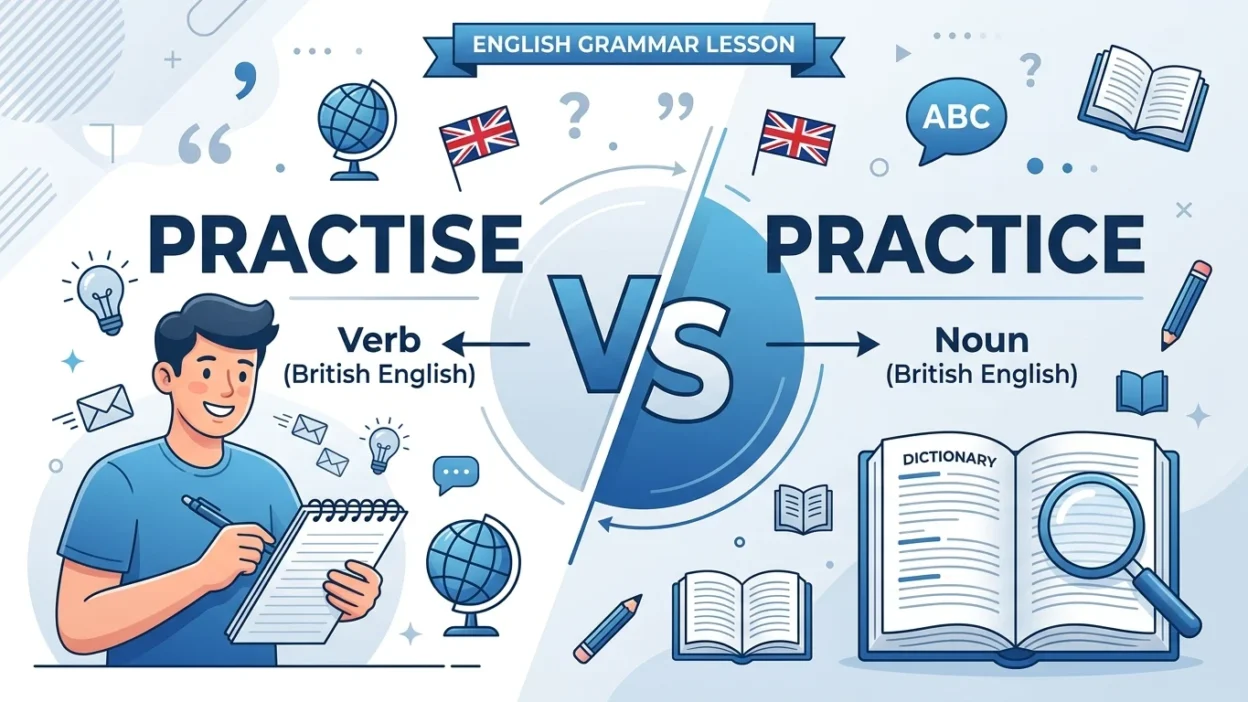
Many English learners become confused by practise and practice because the two words look almost the same and have the same meaning related to learning, training, or improving a skill.
The confusion becomes even bigger because some countries use the words differently. In one place, both forms may seem correct, while in another place, only one form is preferred.
The good news is that the difference is actually very simple once you understand one easy rule.
This guide will explain everything in clear and easy English so you can use these words correctly every time.
Quick Answer
- Practice is usually a noun.
- Practise is usually a verb in British English.
- In American English, practice is used as both the noun and the verb.
- If you are writing for a British audience:
- Practice = noun
- Practise = verb
- If you are writing for an American audience:
- Practice = noun and verb
Quick Examples
Noun (thing or activity):
- Daily practice improves your English.
- Piano practice starts at 5 PM.
Verb (action):
- I practise English every day. (British English)
- I practice English every day. (American English)
Origin and Background
Both words come from the same historical root.
Over time, British English developed a pattern where some words ended with -ice when used as nouns and -ise when used as verbs.
Examples include:
| Noun | Verb |
| advice | advise |
| device | devise |
| practice | practise |
Because of this pattern, British English kept two spellings.
American English later simplified the spelling and mostly chose practice for both noun and verb uses.
That is why you may see different spellings depending on where the writer is from.
The Difference Between Practise and Practice
The easiest way to remember the difference is to look at the job the word is doing in the sentence.
When Practice Is a Noun
A noun is a person, place, thing, or activity.
Practice is a noun when it refers to:
- Training
- Repeated activity
- A habit
- A professional business
Examples:
- Good writing comes from regular practice.
- Basketball practice begins after school.
- She opened a medical practice.
- Practice makes progress.
In all these sentences, practice is a thing or activity.
When Practise Is a Verb
A verb is an action word.
Practise means to do something repeatedly to improve.
Examples:
- I practise speaking English every evening.
- They practise football after class.
- She practises the piano every day.
- We need to practise for the presentation.
In these examples, someone is performing an action.
Easy Memory Trick
Think about the letter S in practise.
The letter S can remind you of something you do.
So:
- Practise = action = verb
- Practice = thing/activity = noun
This trick works mainly for British English.
Practice and Practise Comparison Table
| Feature | Practice | Practise |
| Part of speech | Noun | Verb |
| Meaning | Training, habit, activity | To perform repeatedly |
| British English | Yes | Yes |
| American English | Yes | Usually not used |
| Example | English practice helps. | I practise English daily. |
| Refers to | A thing or activity | An action |
Which One to Use and When
The correct choice depends on both grammar and the type of English you are using.
If You Use British English
Use practice as a noun.
Examples:
- More practice will help.
- Football practice starts soon.
- Writing practice is important.
Use practise as a verb.
Examples:
- Practise your spelling.
- I practise every morning.
- She practises piano lessons daily.
If You Use American English
Use practice for both noun and verb forms.
Examples:
- Practice makes improvement.
- I practice English every day.
- They practice basketball after school.
If You Are Not Sure
Many learners choose American spelling because it is simpler.
However, if your school, company, or exam follows British English, remember:
- Practice = noun
- Practise = verb
Common Mistakes People Make
Many mistakes happen because people know the meaning but forget the grammar.
Using Practice as a Verb in British English
Incorrect:
- I practice my pronunciation every day.
Correct:
- I practise my pronunciation every day.
Using Practise as a Noun
Incorrect:
- Daily practise helps students improve.
Correct:
- Daily practice helps students improve.
Mixing British and American Styles
Incorrect:
- I practise English every day, and more practiceing helps.
Correct:
- I practise English every day, and more practice helps.
Or in American English:
- I practice English every day, and more practice helps.
Forgetting the Audience
A document written in British English should normally keep British spelling throughout.
A document written in American English should normally keep American spelling throughout.
Consistency makes writing look professional and clear.
Everyday Real Life Examples
In Emails
British English:
- Please practise the presentation before tomorrow.
American English:
- Please practice the presentation before tomorrow.
Noun example:
- Extra practice will improve your confidence.
In News Articles
- The team completed another practice session.
- Players practise daily before major matches.
- Regular practice helped the athlete improve.
On Social Media
- I need more practice with photography.
- Time to practise my guitar skills.
- Practice really does make improvement.
In School and College
- Math practice is important.
- Students should practise writing essays.
- Practice tests can help before exams.
At Work
- New employees practise customer service skills.
- Regular practice helps workers become more efficient.
- The company encourages practice and learning.
In Daily Conversations
- You need more practice.
- I practise English with friends.
- Practice helps people learn faster.
Learning Tips for Students and Beginners
Learning the difference becomes easy when you focus on grammar first.
Ask Yourself a Question
If the word means a thing or activity, use practice.
Example:
- More practice is needed.
Ask:
“What is needed?”
Answer:
Practice.
Since it is a thing, it is a noun.
Look for an Action
If the word means doing something repeatedly, use practise in British English.
Example:
- I practise every day.
Ask:
“What am I doing?”
Answer:
Practising.
Since it is an action, it is a verb.
Create Your Own Sentences
Try writing pairs like these:
- Practice improves speaking.
- I practise speaking.
- Practice helps musicians.
- Musicians practise daily.
Writing your own examples helps you remember much faster.
Frequently Asked Questions
Is practise correct?
Yes. Practise is correct in British English when it is used as a verb.
Example:
- I practise English every day.
Is practice correct?
Yes. Practice is correct as a noun in both British and American English. It is also the normal verb spelling in American English.
Why do Americans use practice for everything?
American English simplified the spelling and generally uses practice as both the noun and verb form.
Which spelling should students learn?
Students should learn both forms so they can understand British and American English.
Is “practice makes perfect” correct?
Yes. In this sentence, practice is a noun, so the spelling is correct.
Is “I practise every day” correct?
Yes, in British English.
In American English, it would normally be:
- I practice every day.
Can I use practice as a verb in British English?
Traditional British English prefers practise as the verb.
How can I remember the difference?
Remember this simple rule:
- Practice = noun
- Practise = verb
This works for British English and removes most confusion.
Conclusion
The difference between practise and practice is much easier than many people think.
In British English:
- Practice is a noun.
- Practise is a verb.
In American English:
- Practice is used for both nouns and verbs.
Whenever you are unsure, ask yourself whether the word is naming an activity or describing an action. If it is an activity, use practice. If it is an action, use practise in British English.
Once you remember this simple rule, choosing between practise and practice becomes easy and natural.

Anthony Charles is the founder and lead content creator at Meanefy.com, a platform dedicated to exploring word meanings, language nuances, and everyday curiosities. With a passion for language and a keen eye for detail, Anthony aims to make complex words and concepts simple and accessible for readers around the world.