Many English learners and even native speakers get confused by purposely and purposefully because both words are connected to the idea of having a purpose.
When you read books, articles, emails, or social media posts, you may see both words used in similar situations. Because of this, it can seem like they mean exactly the same thing.
The good news is that the difference is not difficult. Once you understand the basic idea behind each word, choosing the correct one becomes much easier.
This guide explains everything in simple English so you can use both words correctly and confidently.
Quick Answer
- Purposely means on purpose or intentionally.
- Purposefully usually means with determination, confidence, or a clear sense of purpose.
- In some situations, purposefully can also mean intentionally, but this use is less common.
- If you mean not by accident, use purposely.
- If you mean in a determined or meaningful way, use purposefully.
Quick Examples
- She purposely broke the vase. ✔️
- She purposefully walked toward the stage. ✔️
- He purposely ignored my message. ✔️
- The leader purposefully explained the plan. ✔️
Simple Origin or Background Explanation
Both words come from the noun purpose, which means a reason for doing something.
Over time, English developed two adverbs from the same root word:
- Purposely
- Purposefully
Because they come from the same word, their meanings overlap a little.
However, English speakers gradually started using them in slightly different ways:
- Purposely became strongly connected with the idea of doing something intentionally.
- Purposefully became more connected with acting in a focused, determined, or meaningful way.
That is why both words still exist today.
Clear Explanation of the Difference
The easiest way to remember the difference is to focus on the message you want to give.
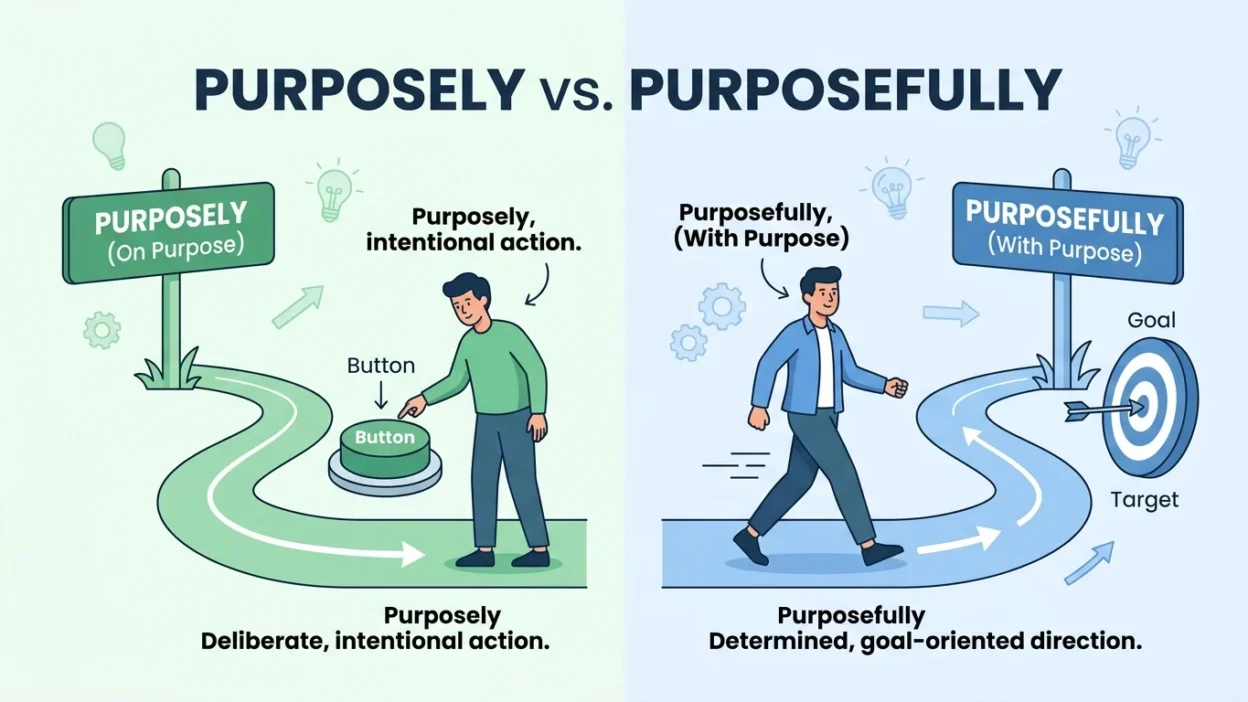
Purposely = On Purpose
Use purposely when you want to show that an action was intentional.
The person meant to do it.
Examples:
- She purposely arrived early.
- He purposely left the door open.
- They purposely avoided the topic.
- I purposely turned off my phone.
In all these examples, the action was not accidental.
Purposefully = With Purpose or Determination
Use purposefully when you want to show that someone is acting with confidence, focus, or a clear goal.
Examples:
- She purposefully walked into the meeting room.
- The athlete purposefully moved toward the finish line.
- He purposefully organized his study schedule.
- The manager purposefully guided the discussion.
Here, the focus is not simply on intention. It is on determination and direction.
A Simple Way to Think About It
Ask yourself this question:
Do I mean “on purpose” or “with purpose”?
- On purpose → purposely
- With purpose → purposefully
This trick helps in most situations.
Comparison Table
| Feature | Purposely | Purposefully |
| Main meaning | On purpose | With purpose or determination |
| Focus | Intention | Direction and confidence |
| Opposite | Accidentally | Aimlessly |
| Common in everyday speech | Very common | Less common |
| Used when something is not accidental | Yes | Sometimes |
| Used to show determination | Rarely | Yes |
| Example | She purposely ignored him. | She purposefully walked toward him. |
Which One to Use and When
Use Purposely When You Mean “Intentionally”
Choose purposely if your goal is to show that an action was deliberate.
Examples:
- I purposely chose the blue shirt.
- She purposely sat near the window.
- They purposely changed the schedule.
- He purposely stayed quiet.
You can often replace purposely with intentionally.
Example:
- He purposely missed the meeting.
- He intentionally missed the meeting.
Both sentences have nearly the same meaning.
Use Purposefully When You Mean “With Determination”
Choose purposefully when someone acts with confidence, focus, or a clear goal.
Examples:
- The student purposefully worked toward graduation.
- She purposefully entered the room.
- The team purposefully followed its plan.
- He purposefully built his career.
The emphasis is on direction and purpose, not simply intention.
When Both May Work
Sometimes both words are possible.
Example:
- She purposely walked away.
- She purposefully walked away.
The first sentence means she did it intentionally.
The second sentence suggests she walked away with confidence or a specific goal.
The meaning changes slightly.
Common Mistakes People Make
Using Purposefully for Every Situation
Many learners think purposefully should always be used because it sounds longer or more formal.
Example:
- He purposefully broke the glass.
This is understandable, but purposely is usually more natural:
- He purposely broke the glass.
Forgetting the Meaning of Determination
Some people use purposely when they want to describe focused action.
Example:
- She purposely walked toward the audience.
This is not wrong, but if you want to emphasize confidence and direction, purposefully may be better.
Thinking the Words Are Always Interchangeable
The words overlap, but they are not always identical.
Compare:
- He purposely remained silent.
- He purposefully remained silent.
The first focuses on intention.
The second suggests thoughtful or meaningful silence.
Using Them When “Accidentally” Is Better
Sometimes an action simply happens by mistake.
Incorrect:
- I purposely dropped my keys.
Correct if it was an accident:
- I accidentally dropped my keys.
Always make sure the word matches the situation.
Everyday Real Life Examples
Emails
- I purposely attached the report again so everyone could see it.
- She purposefully organized the email into clear sections.
- We purposely scheduled the meeting for Monday.
News
- Officials purposely closed the road for safety reasons.
- The company purposefully changed its business strategy.
- The speaker purposefully addressed public concerns.
Social Media
- I purposely stayed offline today.
- She purposefully shared positive messages.
- They purposely avoided discussing the rumor.
Daily Conversations
- I purposely parked near the entrance.
- He purposely arrived early.
- She purposefully planned her day.
- The children purposely hid the toy.
Short Learning Section for Students and Beginners
Here is an easy study guide.
Remember This Formula
Purposely = Intentionally
Examples:
- I purposely called you.
- She purposely chose that answer.
- They purposely arrived late.
Purposefully = With Purpose
Examples:
- She purposefully prepared for the exam.
- He purposefully followed his goals.
- They purposefully worked together.
Quick Memory Trick
Think about these phrases:
- On purpose = purposely
- With purpose = purposefully
Many students find this trick helpful because it is simple and easy to remember.
Mini Practice
Choose the correct word.
- He ______ ignored the warning.
- She walked ______ toward the stage.
- I ______ left the note on your desk.
- The team worked ______ toward success.
Answers:
- purposely
- purposefully
- purposely
- purposefully
FAQ
Is purposely the same as intentionally?
Yes. In most situations, purposely and intentionally have very similar meanings.
Is purposefully a real word?
Yes. It is a correct English word that means acting with purpose, focus, or determination.
Which word is more common?
Purposely is generally more common in everyday conversation and writing.
Can purposefully mean intentionally?
Yes. In some contexts, purposefully can mean intentionally, but many writers prefer purposely when talking about deliberate actions.
Which word should students use most often?
Students usually need purposely more often because it clearly means “on purpose.
What is the opposite of purposely?
The opposite is usually accidentally.
Example:
- I purposely opened the file.
- I accidentally opened the file.
What is the opposite of purposefully?
The opposite is often aimlessly.
Example:
- She purposefully walked toward the office.
- She wandered aimlessly around town.
Can I replace every purposely with purposefully?
Not always. The meaning may change slightly because purposefully often adds the idea of determination or direction.
Conclusion
The difference between purposely and purposefully is simpler than many people think.
Purposely means on purpose or intentionally. Use it when you want to show that something was not an accident.
Purposefully means with purpose, focus, or determination. Use it when you want to emphasize a clear goal or confident action.
A simple rule to remember is:
- On purpose = purposely
- With purpose = purposefully
Once you remember that rule, choosing the correct word becomes much easier in everyday speaking and writing.

Anthony Charles is the founder and lead content creator at Meanefy.com, a platform dedicated to exploring word meanings, language nuances, and everyday curiosities. With a passion for language and a keen eye for detail, Anthony aims to make complex words and concepts simple and accessible for readers around the world.