Many English learners and even native speakers get confused about requester and requestor because both words seem to mean the same thing.
You may see requester in emails, customer service messages, online forms, and everyday writing. At the same time, you might notice requestor in business documents, legal papers, or technical systems.
This naturally raises a question:
Which spelling is correct: requester or requestor?
The good news is that both words are correct. However, one is much more common in everyday English than the other. Understanding the difference is simple once you know how these words are used.
Quick Answer
- Requester and requestor have the same meaning.
- Both words describe a person who makes a request.
- Requester is the more common spelling in modern English.
- Requestor is often found in legal, technical, government, or business contexts.
- If you are unsure which one to use, choose requester.
- Most teachers, editors, and style guides prefer requester for general writing.
Simple Origin and Background
Both words come from the verb request, which means to ask for something politely or formally.
English often creates nouns by adding endings such as:
- -er
- -or
For example:
| Verb | Person |
| teach | teacher |
| work | worker |
| act | actor |
| inspect | inspector |
Over time, English developed different endings for people who perform an action.
When the verb is request, two forms appeared:
- requester
- requestor
Since both follow English word building patterns, both became accepted spellings.
However, everyday English gradually began using requester more often, making it the preferred choice in most situations.
The Difference Explained Clearly
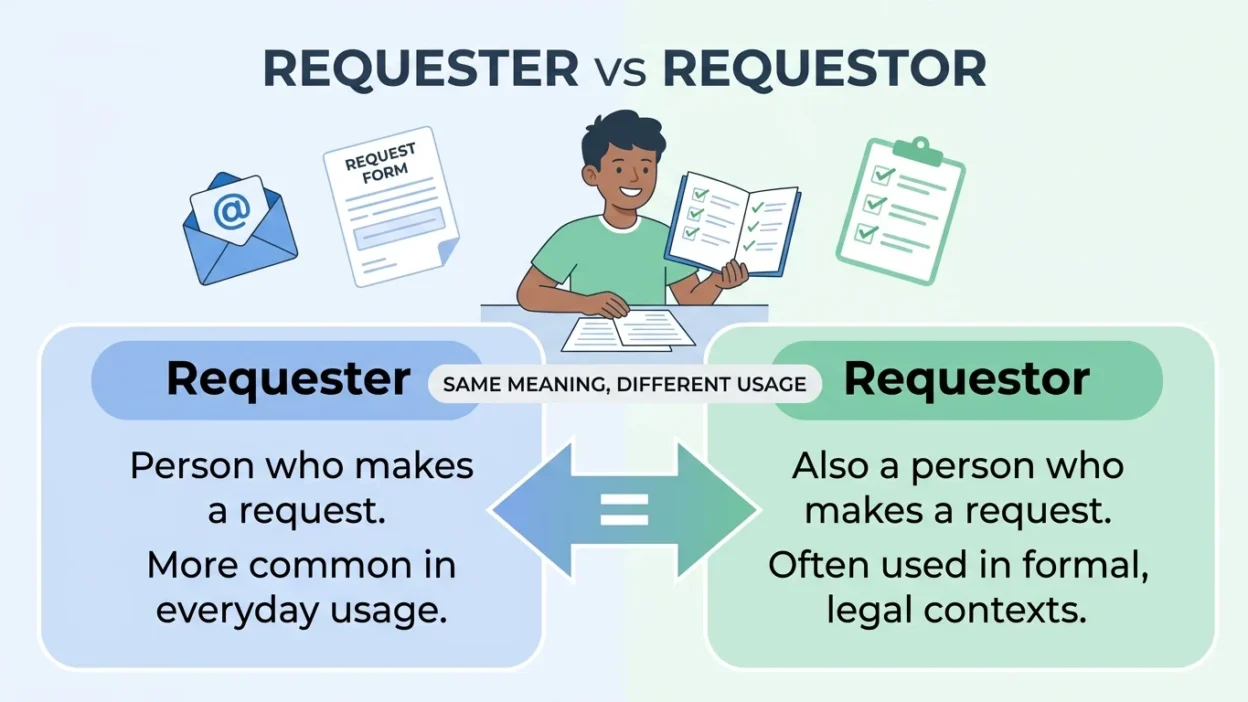
The most important thing to know is that the difference is usually about usage, not meaning.
Meaning of Requester
A requester is someone who asks for something.
Examples:
- The requester asked for more information.
- The requester submitted a support ticket.
- The requester received a reply.
This spelling appears frequently in:
- emails
- schools
- customer service
- business communication
- general writing
Meaning of Requestor
A requestor is also someone who asks for something.
Examples:
- The requestor filed an official application.
- The requestor must provide identification.
- The requestor received approval.
This spelling is often seen in:
- legal documents
- government forms
- technical systems
- software applications
- formal procedures
Do They Mean Different Things?
No.
In most situations, the meaning is exactly the same.
The difference is mainly that requester sounds more natural and modern in everyday English.
Comparison Table
| Feature | Requester | Requestor |
| Meaning | Person making a request | Person making a request |
| Correct spelling | Yes | Yes |
| Common in everyday English | Yes | Less common |
| Common in emails | Yes | Rarely |
| Common in technical systems | Sometimes | Often |
| Common in legal documents | Sometimes | Often |
| Recommended for general writing | Yes | Usually not |
| Easy for learners | Yes | Less familiar |
Which One to Use and When
Use “Requester” in Most Situations
For normal writing, requester is usually the best choice.
Examples:
- The requester asked for a refund.
- The requester sent an email.
- The requester requested more details.
Use it for:
- school assignments
- blog articles
- emails
- customer support
- workplace communication
- everyday writing
Use “Requestor” When Required
Sometimes organizations, software systems, or legal documents already use the spelling requestor.
Examples:
- Requestor Name
- Requestor ID
- Requestor Information
In these cases, it is usually best to keep the spelling that the system or document uses.
When Unsure
Choose requester.
It is more widely recognized and easier for most readers to understand.
Common Mistakes People Make
Thinking One Is Correct and the Other Is Wrong
Many people believe only one spelling is correct.
That is not true.
Both words are accepted English words.
Using Different Spellings in the Same Document
This can make writing look inconsistent.
Incorrect example:
- The requester submitted the form.
- The requestor received approval.
Better:
- Use requester throughout the document.
- Or use requestor throughout the document.
Choosing Requestor for Everyday Writing
While it is not wrong, many readers find requestor less familiar.
For general audiences, requester is usually the clearer choice.
Confusing the Words with “Request”
Remember:
- request = the action or the thing being asked for
- requester/requestor = the person asking
Example:
- The requester submitted a request.
Everyday Real Life Examples
Emails
- The requester would like an update on the application.
- Please contact the requester for more information.
- The requester attached the required files.
News
- The requester asked the agency to release records.
- Officials responded to the requester within five days.
Social Media
- The requester wanted permission to use the image.
- The requester received hundreds of replies.
Workplace Communication
- The requester needs access to the system.
- The manager approved the requester’s request.
Customer Service
- The requester reported a problem with the order.
- A representative contacted the requester.
Online Forms
You may see labels such as:
- Requester Name
- Requester Email
- Requestor Information
- Requestor Contact Details
Both labels refer to the person making the request.
Learning Section for Students and Beginners
A simple way to remember the difference is:
Think About Common English Patterns
Many English words use -er:
- teacher
- worker
- reader
- writer
Because of this pattern, requester feels more natural to many people.
Easy Memory Trick
Remember this sentence:
“The requester requests something.”
This can help you remember the spelling that is most common in everyday English.
Practice Sentences
Fill in the blank with the best choice.
- The ______ submitted the application.
- The ______ asked for a refund.
- The ______ sent an email.
Suggested answers:
- requester
- requester
- requester
These would be the preferred choices in ordinary writing.
FAQ
Is requester a real word?
Yes. It is a correct English word that means a person who makes a request.
Is requestor a real word?
Yes. It is also a correct English word with the same meaning.
Which spelling is more common?
Requester is generally more common in modern English.
Do requester and requestor mean different things?
No. Their meanings are essentially the same.
Which word should students use?
Students should usually use requester because it is more common and widely accepted.
Why do some forms use requestor?
Some organizations, legal documents, and software systems have traditionally used requestor as their preferred spelling.
Can I use requestor in an email?
Yes, but requester will usually sound more natural to most readers.
Which spelling is better for general writing?
In most cases, requester is the better choice because it is more familiar and easier to recognize.
Conclusion
The confusion between requester and requestor is understandable because both words have the same meaning: a person who makes a request.
The main difference is how often they are used. Requester is the more common choice in everyday English, emails, schools, workplaces, and general writing. Requestor is usually seen in legal, technical, government, or specialized documents.
If you are writing for a general audience and are unsure which spelling to choose, requester is usually the safest and most natural option. The key is to stay consistent and use the same spelling throughout your document.

Steven Mark is a writer, researcher, and contributor at Meanefy.com, a platform dedicated to exploring word meanings, language nuances, and everyday linguistic curiosities. With a passion for words and clear communication, Steven focuses on making language simple, engaging, and accessible to all readers.