
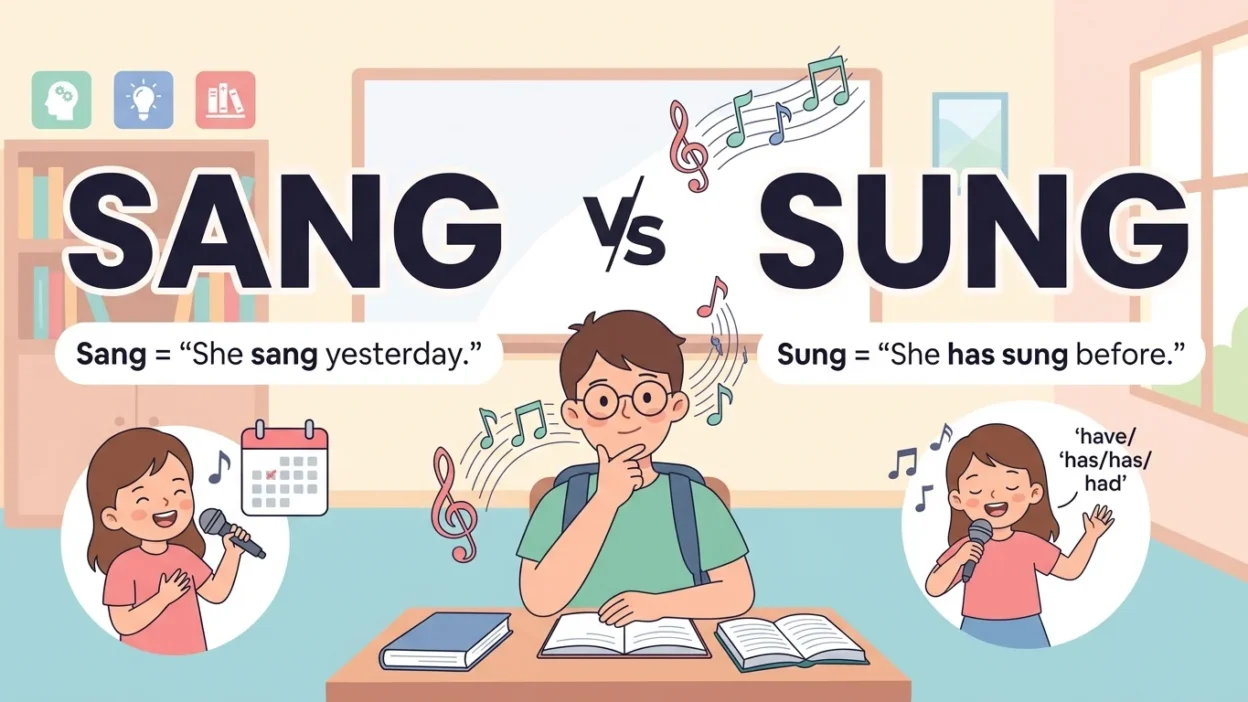
Many English learners get confused between “sang” and “sung.” Both words come from the verb “sing,” and both talk about music or songs. Because they look similar, people often use the wrong one in speaking and writing.
The good news is that the difference is actually very simple.
Once you understand how English verb forms work, you will know exactly when to use sang and when to use sung. This guide explains everything in very easy English with clear examples from daily life.
Quick Answer
- Sing = present form
- “I sing every day.”
- Sang = simple past form
- “She sang beautifully yesterday.”
- Sung = past participle form
- Usually used with has, have, had, was, were, or been
- “He has sung this song before.”
Easy Rule to Remember
- Use sang for a finished action in the past.
- Use sung with helping verbs like:
- has
- have
- had
- was
- were
- been
Origin and Background
The words sang and sung both come from the old English verb “sing.”
English verbs often change form depending on time. This is very common with irregular verbs.
For example:
| Present | Past | Past Participle |
| sing | sang | sung |
| drink | drank | drunk |
| ring | rang | rung |
These verbs do not simply add “-ed.” Their spelling changes completely.
That is why learners sometimes mix them up.
What Is the Difference Between Sang and Sung?
The main difference is grammar.
Sang = Simple Past
Use sang when talking about something that happened in the past and is already finished.
Examples:
- I sang at the school event.
- They sang loudly last night.
- My sister sang her favorite song yesterday.
In these sentences, no helping verb is needed.
Sung = Past Participle
Use sung with helping verbs.
Examples:
- I have sung this song before.
- She has sung in many competitions.
- The anthem was sung by the students.
Notice the helping words:
- have
- has
- was
Without these helping verbs, sung sounds wrong.
Incorrect:
- ❌ “I sung a song yesterday.”
Correct:
- ✅ “I sang a song yesterday.”
Simple Comparison
| Word | Verb Form | Used With Helping Verb? | Example |
| sing | Present | No | I sing every morning. |
| sang | Simple past | No | I sang yesterday. |
| sung | Past participle | Yes | I have sung before. |
Which One Should You Use and When?
Use “Sang” When:
- You talk about a finished past action
- There is no helping verb
- You mention yesterday, last night, last year, or another past time
Examples:
- We sang at the party.
- He sang very well yesterday.
- The children sang together.
Use “Sung” When:
- You use helping verbs
- You talk about experiences
- You use passive voice
Examples:
- She has sung this song many times.
- The song was sung beautifully.
- I had never sung on stage before.
Easy Trick to Remember
Try this quick test:
If the sentence has:
- has
- have
- had
- was
- were
- been
→ use sung
Examples:
- She has sung already.
- The song was sung live.
If there is no helping verb:
→ use sang
Examples:
- She sang already.
- They sang at dinner.
Common Mistakes People Make
Using “Sung” Without a Helping Verb
Incorrect:
- ❌ “He sung yesterday.”
Correct:
- ✅ “He sang yesterday.”
This is one of the most common mistakes in spoken English.
Using “Sang” After “Has” or “Have”
Incorrect:
- ❌ “She has sang before.”
Correct:
- ✅ “She has sung before.”
After has or have, use the past participle form.
Forgetting the Main Verb Forms
Many learners only remember:
- sing
- sang
But forget:
- sung
Try to remember all three together:
- sing
- sang
- sung
Everyday Real Life Examples
Learning grammar becomes easier when you see real examples from daily life.
In an Email
- “Maria sang at the office party yesterday.”
- “Maria has sung at many office events.”
On Social Media
- “He sang my favorite song tonight!”
- “She has sung this song so many times.”
In the News
- “The artist sang live during the concert.”
- “The national anthem was sung before the match.”
In School
- “The students sang together in music class.”
- “The song has been sung by many students this year.”
At Home
- “Dad sang while cooking dinner.”
- “Mom has sung that lullaby since I was little.”
Short Learning Section for Students and Beginners
Here is a very simple way to study these words.
Step One: Learn the Three Forms
| Base Verb | Past | Past Participle |
| sing | sang | sung |
Say them aloud several times.
Step Two: Practice Small Sentences
- I sing.
- I sang.
- I have sung.
This helps your brain see the pattern clearly.
Step Three: Look for Helping Verbs
If you see:
- has
- have
- had
then use sung.
Step Four: Practice Daily
Try making your own examples:
- I sang at school.
- I have sung on stage.
- She sang yesterday.
- She has sung before.
Daily practice makes grammar feel natural.
Mini Practice Quiz
Choose the correct word.
She ___ at the wedding last week.
- sang ✅
- sung
Why?
Because there is no helping verb.
They have ___ together before.
- sang
- sung ✅
Why?
Because the helping verb “have” is used.
The song was ___ beautifully.
- sang
- sung ✅
Why?
Because “was” is a helping verb.
FAQ
Is “sung” grammatically correct?
Yes. “Sung” is correct when used with a helping verb.
Example:
- “She has sung beautifully.”
Can I say “I sung a song”?
No. This is incorrect in standard English.
Correct sentence:
- “I sang a song.”
Why do people confuse sang and sung?
Because both words come from “sing” and both refer to past time. Their meanings are close, so learners mix them up.
Which is more common: sang or sung?
Both are common, but they are used in different grammar situations.
- “Sang” is common in simple past sentences.
- “Sung” is common with helping verbs.
Is “sung” past tense?
Not exactly.
“Sung” is a past participle, not the simple past tense.
Simple past:
- sang
Past participle:
- sung
Can “sung” be used alone?
Usually no.
It normally needs helping verbs like:
- has
- have
- had
- was
What is the easiest way to remember the difference?
Remember this pattern:
- sing
- sang
- sung
And remember:
- no helping verb → sang
- helping verb → sung
Do native English speakers make mistakes too?
Yes, sometimes in casual speech. But in standard grammar, the correct forms are:
- “I sang.”
- “I have sung.”
Conclusion
The difference between sang and sung becomes very easy once you know the grammar pattern.
- Sang is the simple past form.
- “She sang yesterday.”
- Sung is the past participle form.
- “She has sung before.”
A simple rule can help you every time:
- No helping verb → sang
- Helping verb → sung
With a little practice, you will start using both words naturally and correctly in conversations, writing, schoolwork, emails, and daily English.

Anthony Charles is the founder and lead content creator at Meanefy.com, a platform dedicated to exploring word meanings, language nuances, and everyday curiosities. With a passion for language and a keen eye for detail, Anthony aims to make complex words and concepts simple and accessible for readers around the world.