Many English learners get confused by “spoiled” and “spoilt.” Both words look similar, sound similar, and even mean the same thing in many situations. So why are there two versions?
The good news is that the difference is actually very simple.
In this article, you will learn:
- What “spoiled” and “spoilt” mean
- Why both words exist
- Which one is more common
- When to use each one
- Common mistakes to avoid
- Easy examples from daily life
By the end, you will understand the difference clearly and feel confident using both words correctly.
Quick Answer
- Spoiled and spoilt are both correct.
- Both are past forms of the verb “spoil.”
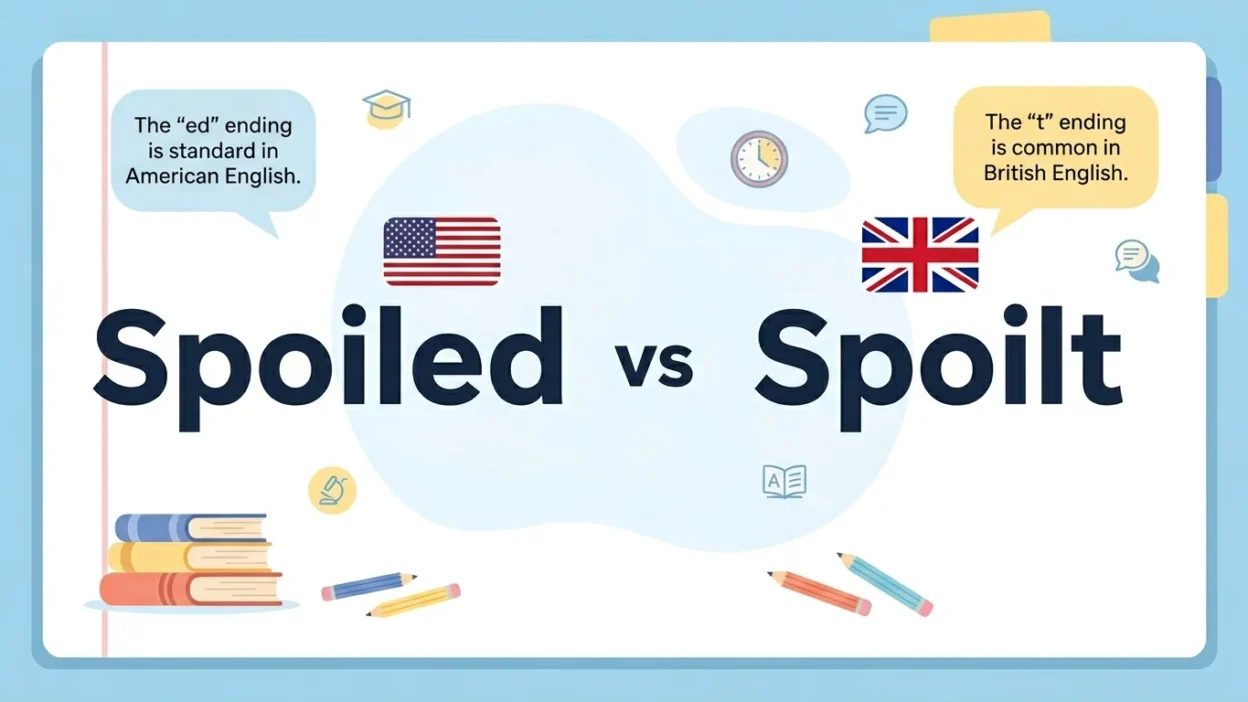
- Spoiled is more common in American English.
- Spoilt is more common in British English.
- In most situations, they mean exactly the same thing.
Simple Example
- The milk spoiled overnight.
- The milk spoilt overnight.
Both sentences are correct.
Origin and Background
The word “spoil” has been in English for a very long time. Over the years, English developed different styles in different countries.
That is why some words now have two accepted forms.
For example:
- burned / burnt
- dreamed / dreamt
- learned / learnt
- spoiled / spoilt
American English usually prefers forms ending in “-ed.”
British English often accepts both forms, including shorter forms ending in “-t.”
So:
- Americans usually say spoiled
- British speakers may say spoilt more often
Even so, both words are understood almost everywhere.
What Does “Spoil” Mean?
Before comparing the two words, let’s first understand the verb “spoil.”
“Spoil” can mean:
- To damage something
- To ruin something
- To go bad
- To give a child too much freedom or too many gifts
Examples
- Rain spoiled our picnic.
- The food spoiled in the heat.
- The child was spoiled by his grandparents.
Now let’s see how “spoiled” and “spoilt” work.
The Difference Between Spoiled and Spoilt
The main difference is not meaning.
The main difference is style and region.
“Spoiled”
“Spoiled” is:
- More common in American English
- More common in formal and everyday writing
- Used worldwide more often
“Spoilt”
“Spoilt” is:
- More common in British English
- Slightly less common overall
- Often heard in casual British speech and writing
Important Point
In most sentences, you can replace one with the other without changing the meaning.
Comparison
| Feature | Spoiled | Spoilt |
| Correct English? | Yes | Yes |
| Meaning | Same | Same |
| Common in American English | Very common | Less common |
| Common in British English | Common | Common |
| More modern worldwide | Yes | Slightly less |
| Used in formal writing | Very often | Sometimes |
| Easy for all readers to understand | Yes | Yes |
Which One Should You Use?
The best choice depends on your audience and writing style.
Use “Spoiled” If:
- You are learning American English
- You want the safest and most common choice
- You are writing for international readers
- You are writing school assignments or formal work
Use “Spoilt” If:
- You use British English
- You live in the UK or follow British style
- You personally prefer it
Easy Tip for Beginners
If you are unsure, use “spoiled.”
It is the most widely used version and is accepted everywhere.
Different Meanings and Examples
Both “spoiled” and “spoilt” can describe different situations.
Food Going Bad
This is one of the most common uses.
Examples
- The chicken spoiled in the fridge.
- The milk spoilt because it was too warm.
- Don’t eat spoiled food.
- The fruit was spoilt after two days.
Ruining an Event or Experience
Examples
- The rain spoiled our vacation.
- The ending was spoilt by spoilers online.
- Loud noise spoiled the movie.
- Bad weather spoilt the game.
Giving a Child Too Much
This meaning describes a child who gets everything they want.
Examples
- Their son is very spoiled.
- She grew up as a spoilt child.
- The dog is spoiled by the family.
- He became spoilt because nobody said no to him.
Common Mistakes People Make
Thinking One Word Is Wrong
Some learners think “spoilt” is incorrect.
That is not true.
Both forms are correct English.
Mixing American and British Style
Sometimes writers switch styles in the same piece of writing.
For example:
- The food spoiled quickly.
- The child was spoilt.
This is not a serious mistake, but it can look inconsistent.
Try to choose one style and stay with it.
Using the Wrong Meaning
Remember that “spoiled” does not only mean “bad food.”
It can also mean:
- ruined
- damaged
- given too much attention
Context is important.
Confusing “Spoiler” With “Spoiled”
A spoiler reveals important story details.
Example:
- My friend spoiled the movie ending.
- My friend gave me a spoiler.
These words are connected but not exactly the same.
Everyday Real Life Examples
Learning through daily examples makes English easier.
In Emails
- Sorry, the food spoiled before the party.
- The surprise was spoiled because someone told her early.
On Social Media
- Don’t spoil the ending!
- My little brother is so spoiled.
- The ice cream melted and spoiled in the car.
In News and Daily Conversation
- Heavy rain spoiled the outdoor event.
- Thousands of pounds of food spoilt during the power cut.
- Experts warned people not to eat spoiled meat.
At Home
- This milk smells spoiled.
- The kids are spoiled by their grandparents.
- The weather spoilt our weekend plans.
Short Learning Section for Students and Beginners
Here are some easy learning tips.
Remember the Main Rule
- American English → usually spoiled
- British English → often spoilt
Learn Through Patterns
English has several words like this:
| American English | British English |
| burned | burnt |
| dreamed | dreamt |
| learned | learnt |
| spoiled | spoilt |
This pattern will help you remember.
Practice Sentences
Try reading these aloud:
- The food spoiled overnight.
- The game was spoilt by rain.
- She is a spoiled child.
- The surprise party was spoiled early.
Speaking helps memory.
Beginner Tip
Do not worry too much about choosing the “perfect” form.
Native speakers understand both words easily.
The most important thing is clear communication.
FAQ
Is “spoilt” correct English?
Yes. “Spoilt” is completely correct, especially in British English.
Is “spoiled” more common?
Yes. “Spoiled” is more common worldwide, especially in American English.
Do “spoiled” and “spoilt” mean the same thing?
Yes. In almost all situations, they have the same meaning.
Which word should students use?
Students can safely use “spoiled,” especially in international or American style writing.
Can I use both in the same article?
You can, but it is better to stay consistent with one style.
Is “spoilt child” correct?
Yes. “Spoilt child” is common in British English.
Is “spoiled food” correct?
Yes. This is a very common phrase.
Why do some English words end in “-t” in British English?
British English sometimes keeps older word forms like:
- burnt
- dreamt
- spoilt
American English usually prefers “-ed” endings.
Conclusion
The difference between “spoiled” and “spoilt” is simple:
- Both words are correct.
- Both come from the verb “spoil.”
- Both usually mean the same thing.
- “Spoiled” is more common in American English.
- “Spoilt” is more common in British English.
If you want the easiest and most widely accepted choice, use “spoiled.”
If you prefer British English style, “spoilt” is also perfectly correct.
Once you understand the regional difference, the confusion disappears completely.

Steven Mark is a writer, researcher, and contributor at Meanefy.com, a platform dedicated to exploring word meanings, language nuances, and everyday linguistic curiosities. With a passion for words and clear communication, Steven focuses on making language simple, engaging, and accessible to all readers.