
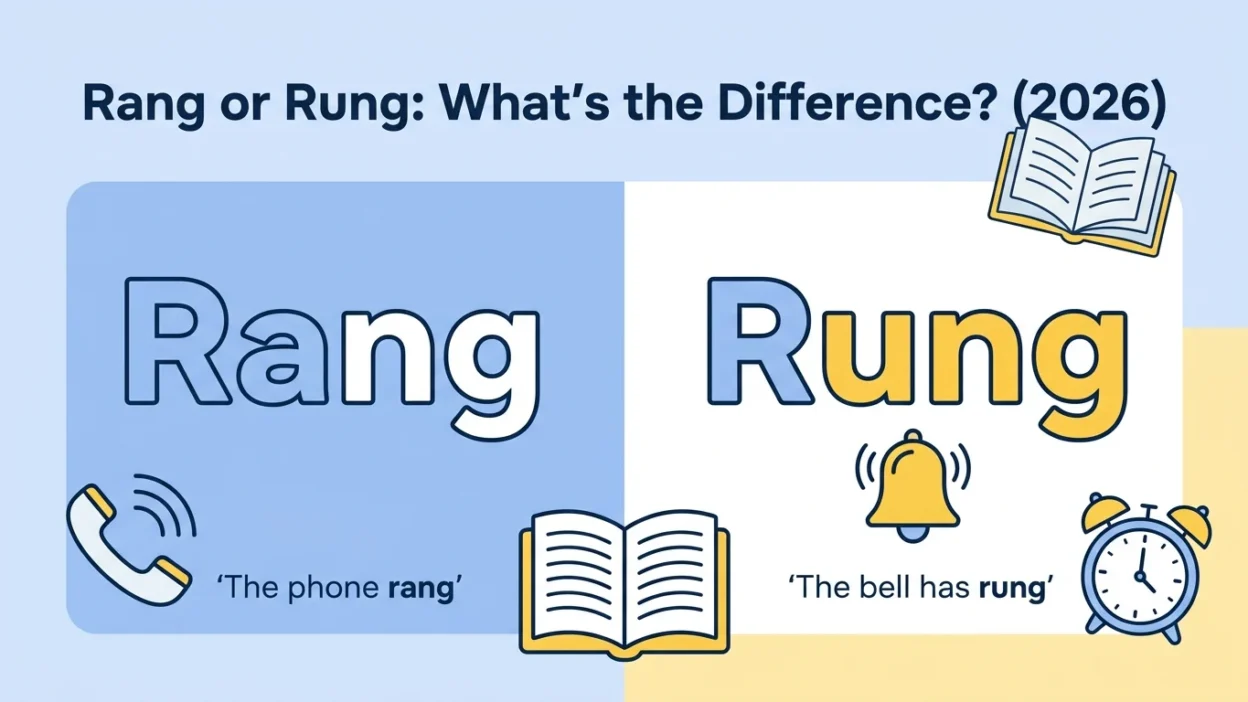
Many English learners get confused between “rang” and “rung.” Both words come from the verb “ring,” and both are used in English conversations, books, messages, and daily speaking.
Because these two words look similar, many people use the wrong one by mistake. But the good news is that the difference is actually very simple.
After reading this guide, you will clearly understand:
- What “rang” means
- What “rung” means
- When to use each word
- Common mistakes to avoid
- Easy examples from real life
This article is written in very simple English so students and beginners can understand it easily.
Quick Answer
- Rang = simple past tense of ring
- Example: The phone rang yesterday.
- Rung = past participle of ring
- Example: The phone has rung many times.
Easy Memory Trick
- Use rang for something finished in the past.
- Use rung with helping verbs like:
- has
- have
- had
Simple Background of the Word
The verb “ring” is an irregular verb in English.
Irregular verbs do not follow the normal “-ed” pattern.
For example:
| Base Form | Past Tense | Past Participle |
| ring | rang | rung |
This pattern has been used in English for a very long time.
Many common English verbs change their spelling in the past tense, such as:
- sing → sang → sung
- drink → drank → drunk
- ring → rang → rung
That is why “rang” and “rung” look similar.
Understanding the Difference Clearly
The biggest difference is the grammar use.
What Does “Rang” Mean?
“Rang” is the simple past tense of “ring.”
Use it when talking about something that happened in the past and is already finished.
Examples
- The school bell rang at 8 AM.
- My phone rang during dinner.
- Someone rang the doorbell last night.
- The alarm rang early this morning.
In all these examples, the action is complete.
What Does “Rung” Mean?
“Rung” is the past participle form of “ring.”
It is usually used with helping verbs such as:
- has
- have
- had
Examples
- The phone has rung three times.
- Someone had rung the bell before we arrived.
- The alarm has already rung.
Notice that “rung” does not usually stand alone.
You normally see it after a helping verb.
Simple Comparison
| Word | Grammar Form | Used With Helping Verb? | Example |
| rang | Past tense | No | The bell rang loudly. |
| rung | Past participle | Yes | The bell has rung already. |
Which One Should You Use?
Use “Rang” When:
- You talk about a finished past action
- No helping verb is used
- The sentence is simple past tense
Examples
- My phone rang at midnight.
- The church bells rang on Sunday.
- She rang me yesterday.
Use “Rung” When:
- You use has, have, or had
- The sentence is in present perfect or past perfect tense
Examples
- My phone has rung all day.
- She had rung the wrong number.
- The bell has rung twice already.
A Very Easy Grammar Trick
If you see:
- has
- have
- had
then you usually need rung, not rang.
Correct
- The phone has rung.
- She had rung me before.
Incorrect
- The phone has rang.
- She had rang me before.
This is one of the most common mistakes in English.
Common Mistakes People Make
Many learners mix these words because both sound correct in conversation.
Here are some common mistakes.
Mistake: “Has rang”
❌ The phone has rang.
✅ The phone has rung.
Reason:
After “has,” use the past participle form “rung.”
Mistake: “Yesterday it rung”
❌ Yesterday the bell rung.
✅ Yesterday the bell rang.
Reason:
For simple past tense, use “rang.”
Mistake: Using “rung” alone
❌ The bell rung loudly.
✅ The bell rang loudly.
Reason:
“Rung” usually needs a helping verb.
Real Life Examples
Learning grammar becomes easier when you see everyday examples.
In Emails
- My phone rang during the meeting.
- The office phone has rung nonstop today.
In Text Messages
- Sorry, I missed your call. My phone never rang.
- Your phone has rung three times already!
On Social Media
- My alarm rang at 5 AM and ruined my sleep.
- The school bell has rung and everyone is running outside.
In News or Reports
- Emergency alarms rang across the city.
- The warning bell had rung before the storm arrived.
At Home
- Someone rang the doorbell.
- The bell has rung twice already.
Easy Practice Sentences
Choose the correct word.
Example One
The phone ___ while I was sleeping.
✅ rang
Example Two
The bell has ___ three times.
✅ rung
Example Three
Someone ___ the doorbell last night.
✅ rang
Example Four
The alarm had already ___ before I woke up.
✅ rung
Learning Section for Students and Beginners
Here is a simple way to remember everything.
Step One: Learn the Three Forms
- ring
- rang
- rung
Say them aloud several times.
Step Two: Remember the Pattern
Many English verbs follow a similar sound pattern.
| Present | Past | Past Participle |
| sing | sang | sung |
| drink | drank | drunk |
| ring | rang | rung |
This can help your memory.
Step Three: Watch for Helping Verbs
If you see:
- has
- have
- had
use “rung.”
Examples
- has rung
- have rung
- had rung
Step Four: Practice Daily
Make your own sentences.
Examples:
- My alarm rang early.
- The phone has rung twice.
Simple practice helps you learn faster.
Why English Learners Get Confused
There are several reasons.
Similar Sound
“Rang” and “rung” sound close to each other.
Fast Spoken English
Native speakers often speak quickly, so learners may not hear the difference clearly.
Grammar Rules
Past tense and past participles can be confusing in irregular verbs.
Mixing Patterns
Learners sometimes copy incorrect sentences they hear online or in casual speech.
For example:
❌ “He has rang me.”
Even native speakers sometimes make this mistake in informal conversation.
But standard English uses:
✅ “He has rung me.”
FAQ
Is “rang” correct English?
Yes. “Rang” is the correct simple past tense of “ring.”
Example:
- The bell rang at noon.
Is “rung” correct English?
Yes. “Rung” is the correct past participle form.
Example:
- The bell has rung already.
Which is correct: “has rang” or “has rung”?
✅ “Has rung” is correct.
❌ “Has rang” is incorrect in standard English.
Can I say “the phone rung”?
In standard grammar, no.
✅ Correct:
- The phone rang.
- The phone has rung.
Why does English use both words?
English irregular verbs often change forms.
Example:
- ring → rang → rung
Each form has a different grammar job.
Is “rung” ever used without “has,” “have,” or “had”?
Usually no.
“Rung” normally appears with a helping verb.
What is the easiest way to remember the difference?
Remember this simple rule:
- rang = past action
- rung = used with has/have/had
Do native speakers confuse these words too?
Yes, sometimes.
In casual speech, people may say incorrect forms. But in correct written English, the difference matters.
Final Thoughts
The difference between “rang” and “rung” is easier than many learners think.
Here is the simplest way to remember it:
- Rang = simple past tense
- The phone rang.
- Rung = past participle used with helping verbs
- The phone has rung.
Whenever you see has, have, or had, choose rung.
If there is no helping verb and the action happened in the past, choose rang.
With a little practice, using these two words correctly will become natural and easy.