Many learners feel confused when they see “sewed” and “sewn.” Both words come from the verb “sew,” which means to join cloth or fabric using a needle and thread. Since both forms are correct, people often wonder: Which one should I use?
The confusion happens because English sometimes has two past forms for the same verb. These forms are used in different ways, and the rules are not always obvious at first. But don’t worry this guide will make everything clear in a simple and easy way.
Quick Answer
Here is the short and simple answer:
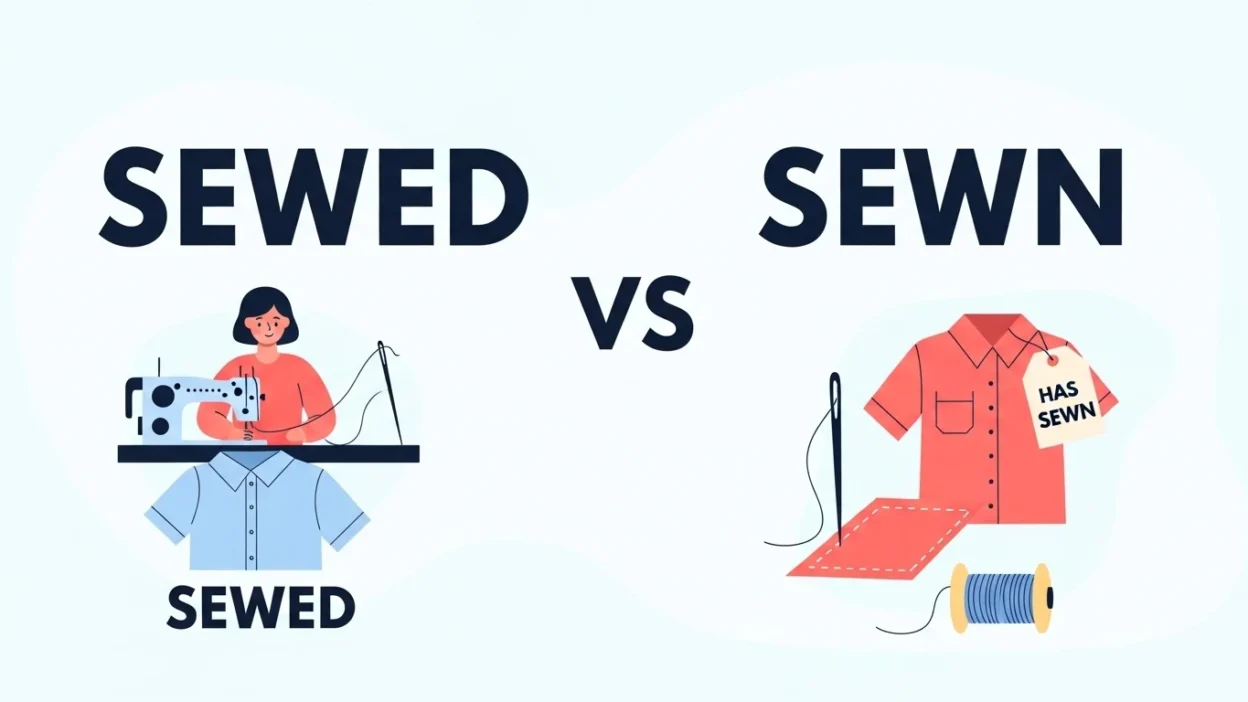
- Sewed
- Used as the simple past tense
- Example: She sewed a dress yesterday.
- Sewn
- Used as the past participle
- Usually comes with words like has, have, had, was, were
- Example: She has sewn a dress.
👉 In short:
- Use sewed for past actions
- Use sewn with helping verbs
Simple background of the word
The verb “sew” is an old English word. Over time, English kept two forms for its past:
- One form became sewed
- The other form became sewn
This is not unusual in English. Some verbs have more than one past form. For example:
- Show → showed → shown
In the same way:
- Sew → sewed → sewn
So, both words are correct they just have different jobs.
The main difference explained simply
Let’s break it down in the easiest way possible.
Sewed = Simple past
Use sewed when you talk about something that happened in the past and is finished.
- I sewed a button on my shirt.
- She sewed a bag last night.
👉 Think: Action happened in the past
Sewn = Past participle
Use sewn when you use a helping verb like:
- has
- have
- had
- was
- were
- be / been
Examples:
- I have sewn a button.
- The dress was sewn by my mother.
- She had sewn the clothes before the event.
👉 Think: Used with helping verbs
Easy comparison
| Form | Type | How to use it | Example |
| Sewed | Simple past | No helping verb | She sewed a shirt. |
| Sewn | Past participle | With has, have, had, was, etc. | She has sewn a shirt. |
Which one should you use and when?
Here is a simple way to decide:
Use “sewed” when:
- You are talking about a finished past action
- There is no helping verb
Examples:
- He sewed the torn jeans.
- They sewed costumes for the play.
Use “sewn” when:
- You see a helping verb
- The sentence is in perfect tense or passive voice
Examples:
- She has sewn many dresses.
- The pillow was sewn by hand.
Common mistakes people make
Let’s look at mistakes and fix them.
Mistake 1: Using “sewn” alone
❌ I sewn a shirt yesterday.
✔ I sewed a shirt yesterday.
👉 “Sewn” cannot stand alone. It needs a helping verb.
Mistake 2: Using “sewed” with helping verbs
❌ She has sewed a dress.
✔ She has sewn a dress.
👉 After “has/have/had,” always use “sewn.”
Mistake 3: Mixing forms in one sentence
❌ He has sewed and sewn many clothes.
✔ He has sewn many clothes.
👉 Keep it simple use one correct form.
Mistake 4: Forgetting passive voice
❌ The shirt was sewed by her.
✔ The shirt was sewn by her.
👉 Passive sentences need “sewn.”
Everyday Real Life Examples
Let’s see how people use these words in daily life.
In emails
- I sewed the badge on your uniform.
- I have sewn your name on the jacket.
In social media posts
- Just sewed my first dress! So happy 😊
- I’ve sewn three pillows today!
In daily conversation
- My grandmother sewed all our clothes.
- This bag was sewn by hand.
In news or simple writing
- Local women have sewn clothes for charity.
- The costumes were sewn by volunteers.
Learning section for students and beginners
Here are some easy tips to help you remember:
Tip 1: Look for helping verbs
If you see:
- has
- have
- had
- was
- were
👉 Use sewn
Tip 2: No helping verb?
👉 Use sewed
Tip 3: Practice with simple sentences
Try these:
- I ______ (sew) a button yesterday.
✔ Answer: sewed - She has ______ (sew) a dress.
✔ Answer: sewn
Tip 4: Use a memory trick
Think of this:
- Sewed = simple
- Sewn = with helper
This small trick can help you remember quickly.
FAQ (Frequently Asked Questions)
What is the difference between sewed and sewn?
- Sewed is simple past
- Sewn is past participle (used with helping verbs)
Can I use “sewn” without a helping verb?
No.
You must use a helping verb.
❌ I sewn it.
✔ I have sewn it.
Is “sewed” incorrect?
No.
It is correct, but only in simple past tense.
Which one is more common?
Both are common, but:
- “Sewn” appears more in formal or complete sentences
- “Sewed” is common in simple past speech
Can both be used in the same sentence?
Yes, but only if grammar is correct.
✔ She sewed the dress and has sewn many others.
How do I remember the difference easily?
Use this rule:
- No helper → sewed
- With helper → sewn
Is this similar to other verbs?
Yes.
Example:
- Show → showed → shown
Same pattern:
- Sew → sewed → sewn
Conclusion
The difference between sewed and sewn is simple once you understand the pattern.
- Sewed is used for actions completed in the past
- Sewn is used with helping verbs like has, have, had, was
The key idea is to look at the sentence structure. If there is a helping verb, choose sewn. If not, choose sewed.
With a little practice, this confusion will disappear completely. Keep using simple sentences, and soon it will feel natural and easy.