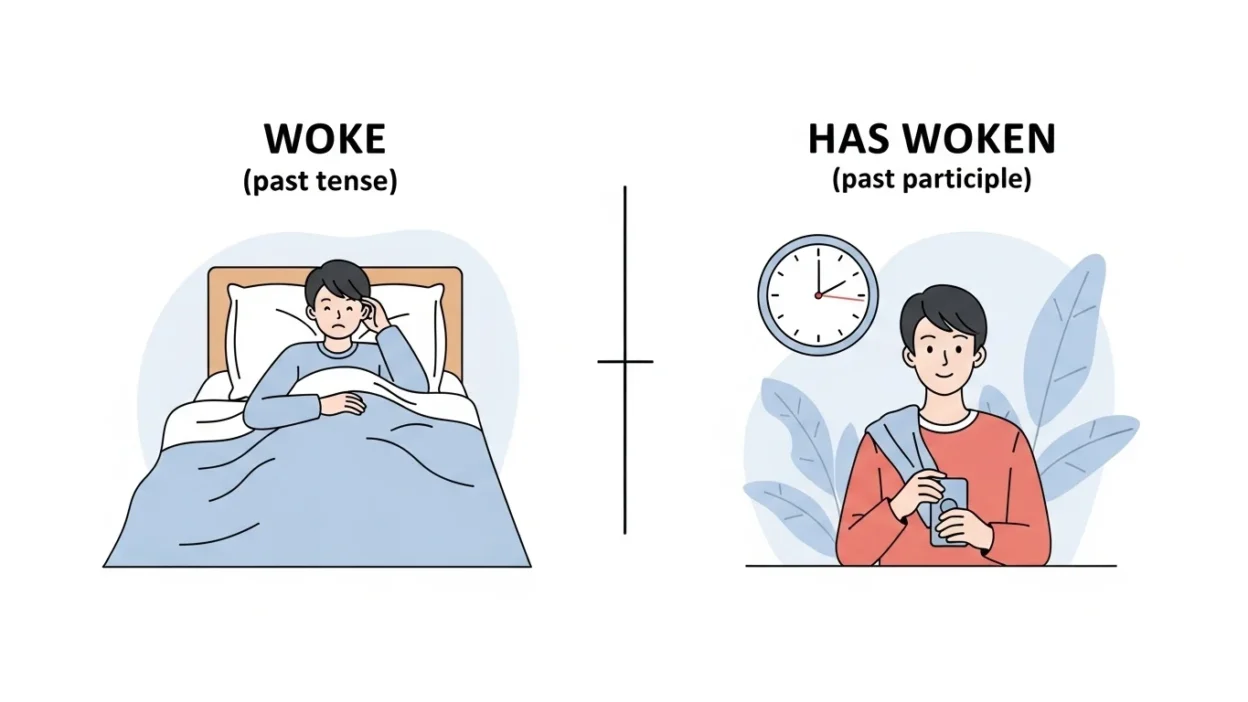
Many learners feel confused about “woke” and “woken.” Both words come from the verb “wake,” but they are used in different ways.
The problem is that in everyday English, people sometimes use “woke” in more than one meaning. Also, “woken” needs a helper verb, while “woke” usually does not.
This article will make everything clear in very simple English so you can understand the difference right away.
Quick Answer
- Woke
- Past tense of “wake”
- Used alone (no helper verb)
- Example: I woke up at 7 a.m.
- Woken
- Past participle of “wake”
- Used with helper verbs like have, has, had, was
- Example: I have woken up early today.
- Extra meaning of “woke”
- Can also mean being aware of social issues
- Example: She is very woke about equality.
Origin and Background
The verb “wake” is an irregular verb. This means it does not follow the simple rule of adding “ ed” to make the past form.
Here are its main forms:
- Base form: wake
- Past tense: woke
- Past participle: woken
In older English, “woken” was used more often in formal speech. Today, both forms are common, but they follow different grammar rules.
Also, in modern English, especially in social media and news, “woke” has a second meaning. It describes someone who understands social problems like fairness, equality, and justice.
Clear Explanation of the Difference
The main difference is how the words are used in a sentence.
Woke
- Used as the past tense
- Shows that something happened in the past
- Does not need a helper verb
Example:
- She woke up late.
- They woke at sunrise.
Woken
- Used as the past participle
- Always needs a helper verb like:
- have / has / had
- was / were
Example:
- He has woken up already.
- I was woken by a loud noise.
Simple Way to Remember
- If there is no helper verb, use woke
- If there is a helper verb, use woken
Comparison
| Feature | Woke | Woken |
| Verb type | Past tense | Past participle |
| Needs helper verb | No | Yes |
| Common helpers | None | have, has, had, was, were |
| Example | I woke up early | I have woken up early |
| Use in speech | Very common | Common in formal and daily use |
Which One to Use and When
Use woke when:
- You talk about something that happened in the past
- There is no helper verb in the sentence
Examples:
- I woke up at 6 a.m.
- She woke suddenly.
Use woken when:
- You use a helper verb
- You talk about a completed action connected to another action
Examples:
- I have woken up too early.
- He was woken by his alarm.
Common Mistakes People Make
Here are some mistakes learners often make:
Using “woken” without a helper verb
❌ I woken up late.
✔ I woke up late.
✔ I have woken up late.
Using “woke” with a helper verb
❌ I have woke up early.
✔ I have woken up early.
Confusing the second meaning of “woke”
Sometimes people think “woke” always means waking from sleep. But it can also mean being socially aware.
Example:
- He is very woke about climate change.
Forgetting verb forms
Many learners forget that “wake” is irregular.
Wrong:
- I waked up early
Correct:
- I woke up early
Everyday Real Life Examples
In Emails
- I woke up late, so I missed the meeting.
- I have woken up earlier this week to prepare.
In News
- People woke to the sound of heavy rain.
- Residents have been woken by loud construction work.
On Social Media
- I woke up and saw so many messages!
- She has woken up to the truth about the issue.
Daily Conversation
- Did you wake early?
→ Yes, I woke at 5. - Have you woken up yet?
→ Yes, I have woken up.
Learning Section for Students and Beginners
Here are simple tips to remember:
Easy Rule
- No helper verb → woke
- With helper verb → woken
Practice Sentences
Fill in the blank:
- I ___ up late yesterday.
→ woke - She has ___ up early today.
→ woken - They were ___ by noise.
→ woken
Speak and Repeat
- I woke up early.
- I have woken up early.
Say these sentences out loud to remember the pattern.
FAQ
What is the main difference between woke and woken?
“Woke” is the past tense. “Woken” is the past participle and needs a helper verb.
Can I say “I have woke up”?
No. This is incorrect. You should say: I have woken up.
Is “woken” formal?
It can sound a little more formal, but it is also used in daily speech.
Can “woke” have another meaning?
Yes. It can mean being aware of social issues like equality and justice.
Which one is more common?
“Woke” is more common in simple past sentences. “Woken” is common when using helper verbs.
Is “waked” correct?
No. “Wake” is irregular. The correct forms are “woke” and “woken.”
Can I use “woken” without “have” or “was”?
No. “Woken” always needs a helper verb.
How can I remember the difference easily?
Think:
- I woke (simple past)
- I have woken (with helper verb)
Conclusion
The difference between “woke” and “woken” is simple once you understand the pattern.
- Woke is used for past actions without a helper verb
- Woken is used with helper verbs like have or was
Also, remember that “woke” can have a second meaning about social awareness.
With a little practice, you will use both words correctly and confidently in your speaking and writing.

Daniel Matthew is a language enthusiast, writer, and contributor at Meanefy.com, where he explores the meanings, origins, and nuances of words and phrases. With a deep passion for language, Daniel aims to make complex concepts simple, engaging, and easy to understand for readers of all ages.