Many learners feel confused when they see “swore” and “sworn.” Both words come from the same verb, and both talk about promises or strong statements. But they are used in different ways.
The good news is that the difference is not hard. Once you understand a few simple rules, you will never mix them up again.
This guide will explain everything in very easy English so you can understand it the first time.
Quick Answer
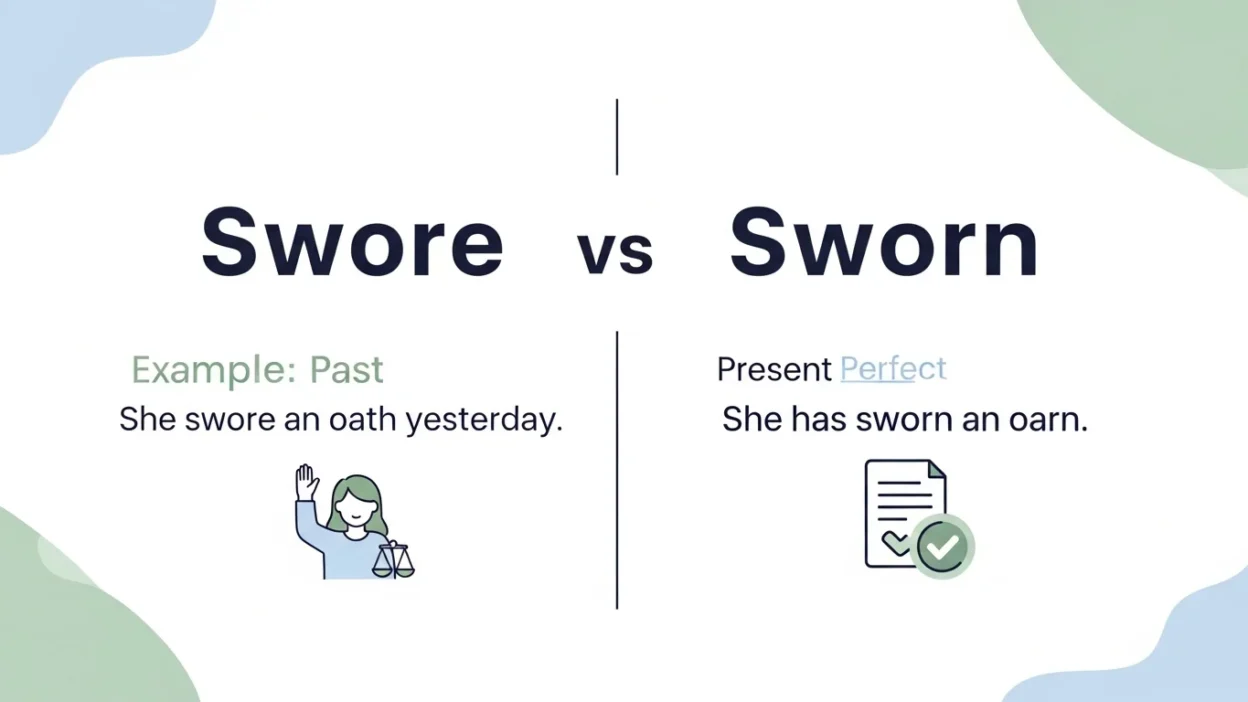
- Swore = past tense of “swear”
→ Used for something that happened in the past
→ Example: She swore to tell the truth. - Sworn = past participle of “swear”
→ Used with helping verbs like has, have, had, was
→ Example: She has sworn to tell the truth.
Simple Background
The base verb is “swear.”
It has three main forms:
- Present: swear
- Past: swore
- Past participle: sworn
These forms are part of what we call an irregular verb, which means it does not follow the normal “ ed” pattern (like walk → walked).
Instead, it changes like this:
- swear → swore → sworn
This is why many learners feel confused.
Clear Explanation of the Difference
Let’s make it very simple.
What “Swore” Means
Swore is used when you talk about the past.
It tells us something already happened.
You use it alone (without helping verbs).
Examples:
- He swore he was innocent.
- They swore to keep the secret.
- I swore I would never go back.
Think of it like this:
👉 Swore = past action (finished)
What “Sworn” Means
Sworn is used with helping verbs such as:
- has
- have
- had
- was
- were
It cannot stand alone.
Examples:
- She has sworn to protect the team.
- They have sworn loyalty.
- He had sworn never to lie.
Think of it like this:
👉 Sworn = used with helper verbs
Comparison
| Feature | Swore | Sworn |
| Type | Past tense | Past participle |
| Used alone? | Yes | No |
| Needs helper verb? | No | Yes |
| Example | I swore to help. | I have sworn to help. |
| Time meaning | Completed past action | Linked to another verb/time |
Which One to Use and When
Here is a simple way to choose the correct word.
Use “Swore” when:
- You are talking about the past
- You do not use a helping verb
Examples:
- She swore she was telling the truth.
- I swore to finish my work.
- He swore at the driver.
Use “Sworn” when:
- You see words like has, have, had, was, were
- You are forming perfect tenses or passive forms
Examples:
- She has sworn to be honest.
- They had sworn to support him.
- He was sworn into office.
Common Mistakes People Make
Many learners make small mistakes with these words. Let’s fix them.
Mistake: Using “sworn” alone
❌ I sworn to tell the truth.
✅ I swore to tell the truth.
Mistake: Using “swore” with helper verbs
❌ She has swore to help.
✅ She has sworn to help.
Mistake: Forgetting the helper verb
❌ They sworn loyalty.
✅ They have sworn loyalty.
Simple Tip
👉 If you see has / have / had, use sworn
👉 If there is no helper verb, use swore
Everyday Real Life Examples
Let’s look at how people use these words in daily life.
In Emails
- I swore I sent the file yesterday.
- I have sworn to complete the task on time.
In News
- The president was sworn into office today.
- The witness swore to tell the truth in court.
On Social Media
- I swore I would never watch this show again 😂
- She has sworn off junk food!
In Daily Conversations
- He swore he didn’t break the window.
- I have sworn to wake up early every day.
Learning Section for Students and Beginners
Here is an easy way to remember everything.
Step One: Learn the forms
- swear → swore → sworn
Say them out loud a few times.
Step Two: Use a simple rule
Ask yourself:
👉 “Is there a helper verb?”
- Yes → use sworn
- No → use swore
Step Three: Practice with sentences
Try to complete these:
- I ______ (swear) I saw him yesterday.
- She has ______ (swear) to help us.
Answers:
- swore
- sworn
Step Four: Make your own sentences
Practice like this:
- I swore…
- I have sworn…
This helps your brain remember faster.
FAQ Section
What is the main difference between swore and sworn?
Swore is the past tense.
Sworn is the past participle used with helper verbs.
Can I use “sworn” without “has” or “have”?
No. “Sworn” needs a helping verb. It cannot stand alone.
Is “swore” always about the past?
Yes. It talks about something that already happened.
Why is it “has sworn” and not “has swore”?
Because “has” needs the past participle form, which is sworn, not swore.
Which one is correct: “I have swore” or “I have sworn”?
Correct: I have sworn
What does “sworn in” mean?
It means someone officially takes an oath for a job, like a president or judge.
Example:
- She was sworn in yesterday.
Can “swear” also mean using bad language?
Yes.
Example:
- He swore loudly when he got angry.
Is this an irregular verb?
Yes.
“Swear” is an irregular verb, so it does not follow the normal “ ed” rule.
Conclusion
The difference between swore and sworn is simple once you see the pattern.
- Swore = past tense (used alone)
- Sworn = used with helper verbs like has, have, had
If you remember just one rule, remember this:
👉 No helper verb? Use swore
👉 Helper verb present? Use sworn
With a little practice, you will start using both words naturally and correctly.

Anthony Charles is the founder and lead content creator at Meanefy.com, a platform dedicated to exploring word meanings, language nuances, and everyday curiosities. With a passion for language and a keen eye for detail, Anthony aims to make complex words and concepts simple and accessible for readers around the world.