Many learners feel confused when they see the words “split” and “splitted.” Both look correct, and both seem to come from the same base word: split. So why do people say one is right and the other is not?
This confusion happens because English verbs do not always follow simple rules. Some verbs change in special ways when we talk about the past. The verb split is one of those special cases.
This guide will explain everything in very simple English so you can understand it easily and use the correct form with confidence.
Quick Answer
Here is the simple truth:
- “Split” is correct (present, past, and past participle)
- “Splitted” is not standard English
- You should always use “split”, even when talking about the past
Examples:
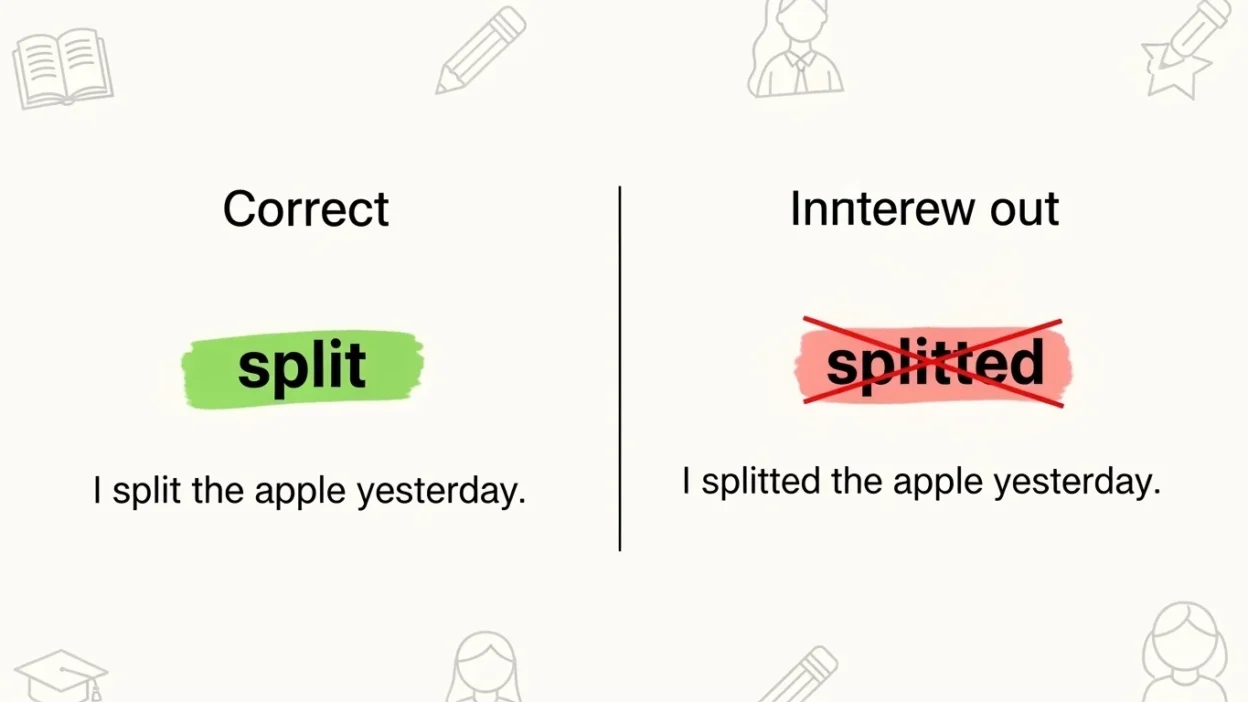
- Correct: I split the cake yesterday.
- Incorrect: I splitted the cake yesterday.
Origin and Background
To understand this better, we need to look at how English verbs work.
In English, most verbs follow a simple pattern:
- Present: walk
- Past: walked
But some verbs are irregular. This means they do not follow the usual “ ed” rule.
The verb “split” is one of these irregular verbs. It is special because:
- It does not change at all
- It stays the same in all forms
So we say:
- I split (present)
- I split (past)
- I have split (past participle)
Over time, some people tried to make it regular by adding “ ed,” creating “splitted.” However, this form is not accepted in standard English.
Clear Explanation of the Difference
What is “split”?
“Split” is the correct form of the verb in all tenses.
It means:
- To divide something into parts
- To break something into pieces
- To separate
Examples:
- She splits the wood every morning.
- Yesterday, she split the wood.
- She has split the wood already.
What is “splitted”?
“Splitted” is not correct in standard English.
Some learners think:
- “If ‘walk’ becomes ‘walked,’ then ‘split’ should become ‘splitted.’”
But this is not how irregular verbs work.
So:
- ❌ Splitted = wrong (in normal use)
- ✅ Split = correct
Comparison
| Form Type | Correct Form | Incorrect Form |
| Present | split | splitted ❌ |
| Past | split | splitted ❌ |
| Past Participle | split | splitted ❌ |
Key idea:
The word “split” never changes.
Which One to Use and When
Always use “split.” It works in every situation.
Present tense
- I split my time between study and rest.
- They split the money equally.
Past tense
- I split the bill yesterday.
- He split the apple into two parts.
Past participle
- We have split the work already.
- The road has split into two directions.
There is no situation in normal English where “splitted” is the correct choice.
Common Mistakes People Make
Here are some mistakes learners often make:
Adding “ ed” to all verbs
- ❌ I splitted the paper.
- ✅ I split the paper.
Thinking longer words are more correct
Some people feel that “splitted” sounds more formal or advanced. This is not true.
- ❌ The company splitted into two parts.
- ✅ The company split into two parts.
Mixing forms
- ❌ I have splitted my work.
- ✅ I have split my work.
Copying from incorrect sources
Sometimes learners see “splitted” online or in informal writing. Not everything online is correct.
Everyday Real Life Examples
In emails
- We have split the tasks between team members.
- The cost was split equally among us.
In news
- The country split into two regions.
- The company split after a major disagreement.
On social media
- We split the bill at dinner.
- Our group split into two teams for the game.
In daily conversation
- Let’s split the pizza.
- He split the log with an axe.
- They split up after many years together.
Learning Section for Students and Beginners
Here is a simple way to remember this:
Easy rule
If the verb is “split,” it always stays “split.”
Practice sentences
Try filling in the blanks:
- Yesterday, I ______ the sandwich.
- We have ______ the money.
- She ______ the class into groups.
Answers:
- split
- split
- split
Memory trick
Think of this:
“Split is simple. It never changes.”
FAQ
Is “splitted” ever correct?
In standard English, no. It is not accepted in normal writing or speaking.
Why do some people say “splitted”?
They are trying to follow the regular verb rule (add “ ed”), but split is irregular, so this rule does not apply.
Is “split” both present and past?
Yes. The word “split” is used for:
- Present
- Past
- Past participle
Can I use “splitted” in exams?
No. You should always use “split” in exams and formal writing.
Is “split” a common verb?
Yes. It is very common in everyday English.
What does “split up” mean?
“Split up” means to separate, often used for people or groups.
Example:
- They split up after the meeting.
What about British and American English?
Both British and American English use “split”. “Splitted” is not standard in either.
Is “split” an irregular verb?
Yes. It is an irregular verb because it does not follow the “ ed” rule.
Conclusion
The difference between “split” and “splitted” is actually very simple:
- “Split” is always correct
- “Splitted” is not standard English
Even though English can feel confusing at times, this is one of the easier rules to remember. Just keep in mind that split never changes, no matter the tense.
With practice, this will become natural, and you will use “split” correctly without even thinking about it.

Anthony Charles is the founder and lead content creator at Meanefy.com, a platform dedicated to exploring word meanings, language nuances, and everyday curiosities. With a passion for language and a keen eye for detail, Anthony aims to make complex words and concepts simple and accessible for readers around the world.