Many people wonder whether someone has ADHD or autism because some signs can look similar. For example, both conditions can affect social interactions, communication, focus, emotions, and daily activities.
A child with ADHD may seem distracted and energetic. A child with autism may also appear different from others in social situations. Because some behaviors overlap, people often confuse the two.
However, ADHD and autism are not the same thing. They are different conditions with different challenges and strengths. Understanding the differences can help parents, students, teachers, and caregivers provide better support.
Quick Answer
- ADHD stands for Attention Deficit/Hyperactivity Disorder.
- Autism is short for Autism Spectrum Disorder (ASD).
- ADHD mainly affects attention, self control, and activity levels.
- Autism mainly affects communication, social understanding, and behavior patterns.
- Some people have ADHD.
- Some people have autism.
- Some people have both ADHD and autism.
- Neither condition is an illness that someone catches from another person.
- Both are lifelong conditions that affect how the brain works.
Simple Background Explanation
ADHD and autism are both neurodevelopmental conditions. This means they affect how the brain develops and works from an early age.
Researchers believe that genetics play an important role in both conditions. They are usually noticed during childhood, although some people are not diagnosed until their teenage years or adulthood.
People with ADHD or autism are not less intelligent because of their condition. In fact, many have unique talents, interests, and abilities.
Every person is different. Two people with ADHD may not act exactly the same. The same is true for autism.
Clear Explanation of the Difference
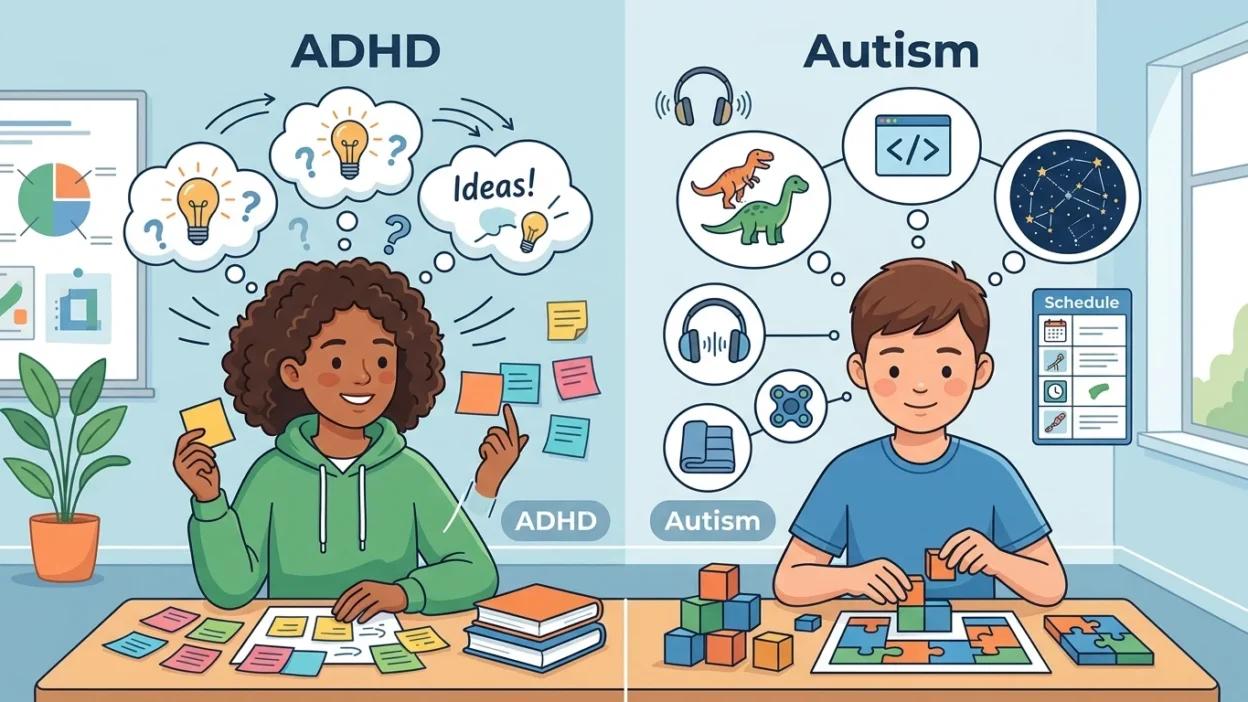
The easiest way to understand the difference is to look at what each condition mainly affects.
ADHD Focuses on Attention and Self Control
People with ADHD may:
- Have trouble staying focused
- Get distracted easily
- Forget things often
- Act without thinking
- Talk a lot
- Feel restless
- Have difficulty sitting still
Their main challenge is usually managing attention, impulses, and activity levels.
Autism Focuses on Communication and Social Understanding
People with autism may:
- Communicate differently
- Find social situations challenging
- Prefer routines
- Have strong interests in specific topics
- Be sensitive to sounds, lights, or textures
- Interpret language differently
Their main challenge is often understanding and managing social communication and changes in routine.
Some Signs Can Overlap
Both ADHD and autism may involve:
- Difficulty paying attention
- Emotional reactions
- Challenges in social situations
- Sensory sensitivities
- Trouble with organization
This overlap is one reason why people sometimes confuse them.
Comparison Table
| Feature | ADHD | Autism |
| Main area affected | Attention and self control | Communication and social understanding |
| Focus | Easily distracted | May focus deeply on favorite interests |
| Activity level | Often very active or restless | Activity level varies greatly |
| Social interaction | Wants interaction but may interrupt | May interact differently or find social rules confusing |
| Routine | Often struggles to follow routines | Often prefers routines and predictability |
| Impulsiveness | Common | Less common as a main feature |
| Special interests | Interests may change often | Interests may be very strong and focused |
| Sensory sensitivity | Can occur | Very common |
| Organization | Often difficult | May vary from person to person |
| Communication style | Usually understands social language but may act impulsively | May communicate in unique ways |
Which One to Use and When?
When ADHD Fits Better
ADHD may be a better explanation when a person mainly struggles with:
- Staying focused
- Following instructions
- Waiting their turn
- Sitting still
- Managing impulsive behavior
- Completing tasks
For example, a student may understand social situations well but have trouble paying attention in class.
When Autism Fits Better
Autism may be a better explanation when a person mainly struggles with:
- Understanding social cues
- Handling changes in routine
- Communication differences
- Sensory sensitivities
- Repetitive behaviors
- Strong special interests
For example, a student may excel in a favorite subject but find social conversations difficult.
When Both Can Be Present
Some people have both ADHD and autism.
A person might:
- Be easily distracted
- Prefer routines
- Have sensory sensitivities
- Struggle with social communication
- Act impulsively
A trained healthcare professional can help determine whether one or both conditions are present.
Common Mistakes People Make
Thinking ADHD and Autism Are the Same
They are different conditions, even though some signs overlap.
Believing Everyone Shows the Same Signs
Every person is unique. Symptoms can vary greatly.
Assuming Intelligence Is Affected
Many people with ADHD or autism are highly intelligent and talented.
Thinking Someone Will Simply Outgrow It
People often learn coping skills, but ADHD and autism are usually lifelong conditions.
Judging Behavior Without Understanding
Some behaviors that seem unusual may be connected to how a person’s brain processes information.
Assuming Quiet People Cannot Have ADHD
Not everyone with ADHD is hyperactive. Some people mainly struggle with attention.
Everyday Real Life Examples
Emails
A worker with ADHD might start writing an email and become distracted before finishing it.
A worker with autism might write a detailed email but find unclear instructions confusing.
News
A journalist with ADHD may generate many ideas quickly but struggle with organization.
A journalist with autism may excel at researching a specific topic in great detail.
Social Media
Someone with ADHD might post quickly without thinking through every detail.
Someone with autism may focus deeply on a favorite topic and share detailed information about it.
School Life
A student with ADHD may forget homework even when they understand the lesson.
A student with autism may complete homework well but find group discussions challenging.
Daily Use
A person with ADHD might lose keys frequently because of distraction.
A person with autism might keep keys in the same place every day and feel uncomfortable if the routine changes.
Short Learning Section for Students and Beginners
Easy Way to Remember
Think of ADHD as mainly affecting:
- Attention
- Impulse control
- Activity level
Think of autism as mainly affecting:
- Social communication
- Understanding social situations
- Preferences for routines
- Sensory experiences
Simple Memory Trick
ADHD:
- Attention challenges
- Hyperactivity
- Doing things impulsively
Autism:
- Understanding social communication differently
- Strong routines
- Unique interests and sensory experiences
Important Note
Not everyone fits perfectly into these descriptions. Real people are much more complex than simple lists.
FAQ
What does ADHD stand for?
ADHD stands for Attention Deficit/Hyperactivity Disorder.
What does autism mean?
Autism is a developmental condition that affects communication, social understanding, behavior, and sensory experiences.
Can someone have both ADHD and autism?
Yes. Some people are diagnosed with both conditions.
Which is more common, ADHD or autism?
ADHD is generally more common than autism.
Is autism a mental illness?
No. Autism is a neurodevelopmental condition, not a mental illness.
Is ADHD caused by poor parenting?
No. ADHD is not caused by poor parenting.
Can adults have ADHD or autism?
Yes. Many adults have ADHD, autism, or both.
Can people with ADHD or autism live successful lives?
Absolutely. Many people with ADHD and autism succeed in school, work, relationships, sports, business, science, and creative fields.
Conclusion
ADHD and autism are different conditions, but they can sometimes look similar. ADHD mainly affects attention, impulse control, and activity levels. Autism mainly affects communication, social understanding, routines, and sensory experiences.
Because some signs overlap, confusion is common. The best way to understand the difference is to focus on the main challenges each condition creates. ADHD is mostly about managing attention and impulses, while autism is mostly about social communication and behavioral patterns.
Most importantly, people with ADHD or autism have their own strengths, talents, and ways of seeing the world. Understanding these differences helps create more supportive schools, workplaces, and communities for everyone.

Daniel Matthew is a language enthusiast, writer, and contributor at Meanefy.com, where he explores the meanings, origins, and nuances of words and phrases. With a deep passion for language, Daniel aims to make complex concepts simple, engaging, and easy to understand for readers of all ages.