Many English learners get confused about “burned” and “burnt.” Both words look correct, and both are used bya native speakers. So which one should you use?
The good news is simple: both words are correct in many situations. The difference is mostly about style, region, and how the word sounds in a sentence.
This article will explain everything in very easy English. By the end, you will clearly understand when to use burned and when to use burnt.
Quick Answer
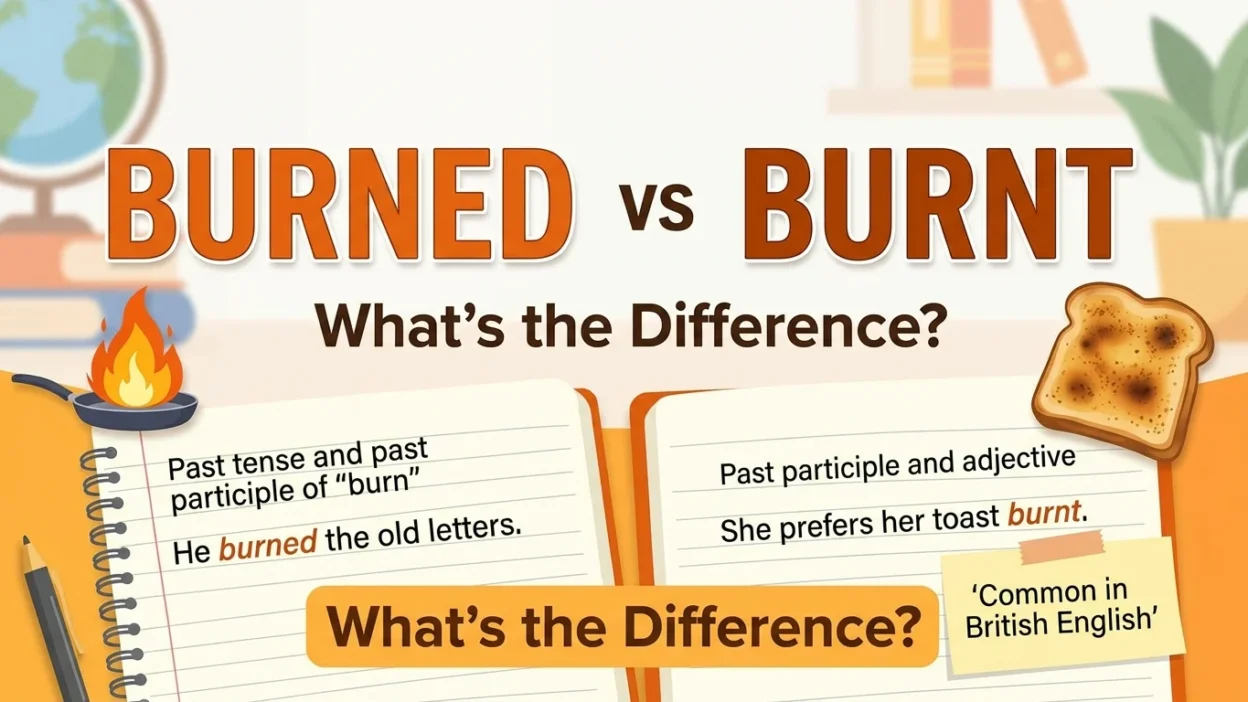
- Burned and burnt are both past forms of the verb burn
- Burned is more common in American English
- Burnt is more common in British English
- Burned is often used in formal writing
- Burnt is often used as an adjective in everyday speech
Simple examples
- I burned my hand while cooking.
- The toast is burnt.
- She burned the old papers.
- The rice smells burnt.
In many cases, you can use either word without changing the meaning.
Background and Origin
The verb burn is a very old English word.
Long ago, English had many verbs that changed in different ways. Over time, two past forms became common:
- burned
- burnt
This happens with some other English words too:
- learned / learnt
- dreamed / dreamt
- spoiled / spoilt
American English slowly started using -ed forms more often:
- burned
- learned
- dreamed
British English kept many -t forms:
- burnt
- learnt
- dreamt
That is why people in different countries may choose different forms today.
The Difference Between Burned and Burnt
The meaning is almost the same, but there are small differences in use.
Burned
“Burned” is usually used as:
- the past tense of the verb
- the past participle
- the more formal choice
- the more common American English form
Examples
- He burned the letter.
- I burned my finger.
- They have burned all the dry leaves.
Burnt
“Burnt” is often used as:
- an adjective
- a more informal or natural sounding word
- a common British English form
Examples
- The bread is burnt.
- I smell burnt coffee.
- She wore a burnt orange sweater.
Comparison
| Feature | Burned | Burnt |
| Correct in English? | Yes | Yes |
| More common in American English | Yes | Less common |
| More common in British English | Also used | Yes |
| Usually used as a verb | Yes | Sometimes |
| Often used as an adjective | Sometimes | Very common |
| Formal writing | More common | Less common |
| Example | I burned dinner. | The dinner is burnt. |
Which One Should You Use?
The best choice depends on the sentence and the type of English you use.
Use “burned” when:
- writing school assignments
- using formal English
- speaking American English
- using the word as an action verb
Examples
- She burned the cookies.
- The factory burned down last year.
- I accidentally burned the document.
Use “burnt” when:
- describing something
- speaking British English
- using casual everyday English
- talking about appearance or smell
Examples
- The cookies are burnt.
- I hate the smell of burnt popcorn.
- The grass looked burnt after the heat.
Burned as a Verb
When talking about an action, many people prefer burned.
Examples
- He burned his hand on the stove.
- Someone burned the old newspapers.
- The fire burned for hours.
These sentences focus on the action itself.
Burnt as an Adjective
“Burnt” sounds very natural when describing something.
Examples
- burnt toast
- burnt wood
- burnt sugar
- burnt coffee
- burnt skin
Here, “burnt” acts like a describing word.
Can You Use Both in the Same Situation?
Yes, sometimes both are correct.
Example
- The house burned down.
- The house burnt down.
Both sentences are understandable.
Still, many people feel that:
- burned sounds more standard
- burnt sounds more natural in conversation
Common Mistakes People Make
Thinking one word is wrong
Many learners believe only one form is correct. That is not true.
Both are correct English words.
Using “burnt” in very formal American writing
In American school or business writing, teachers often prefer burned.
Better choice
- The papers were burned in the fire.
Using “burned” for every adjective
Sometimes “burnt” sounds more natural as a description.
More natural
- burnt toast
- burnt smell
- burnt edges
Mixing styles in the same piece of writing
Try to stay consistent.
If you mostly use American English, choose burned more often.
If you use British English, burnt may fit better.
Everyday Real Life Examples
In Daily Conversation
- I think I burned the pizza.
- Something smells burnt in the kitchen.
- Be careful or you’ll get burned.
In Emails
- Sorry, I burned the copies by mistake.
- The food was slightly burnt, but still tasty.
In News Reports
- Several cars were burned during the fire.
- The building had burnt walls and broken windows.
On Social Media
- I totally burned dinner tonight.
- Why does my popcorn always come out burnt?
In School Writing
- The scientist burned the material during the test.
- The paper had burnt corners after the experiment.
Short Learning Section for Students and Beginners
Here is a very easy trick to remember.
Think about the sentence type
Action = usually “burned”
- I burned my hand.
- She burned the letter.
Description = often “burnt”
- burnt toast
- burnt popcorn
- burnt smell
Easy memory tip
Ask yourself:
“Am I talking about an action or describing something?”
If it is an action, use burned.
If it describes something, burnt often sounds better.
Simple Practice Sentences
Choose the best word.
Sentence 1
I ______ the cake yesterday.
Answer: burned
Sentence 2
The cake smells ______.
Answer: burnt
Sentence 3
He ______ his finger while cooking.
Answer: burned
Sentence 4
We could see the ______ wood after the fire.
Answer: burnt
FAQ
Is “burnt” a real English word?
Yes. “Burnt” is completely correct English.
Which is more common: burned or burnt?
“Burned” is more common in American English. “Burnt” is more common in British English.
Can I use “burnt” in school writing?
Yes, but many American teachers prefer “burned” in formal writing.
Is “burned” more formal?
Usually, yes. “Burned” often sounds more formal and standard.
Why do native speakers use both?
English developed over many years, and both forms stayed in the language.
Is “burnt toast” correct?
Yes. In fact, “burnt toast” sounds very natural.
Can I say “burnt my hand”?
Yes, especially in British English. But many Americans would say “burned my hand.”
Which word should beginners use?
If you are unsure, use burned. It works well in almost every situation.
Conclusion
The words burned and burnt both come from the verb burn, and both are correct.
The main difference is simple:
- Burned is more common in American English and formal writing
- Burnt is more common in British English and as an adjective
In everyday English, native speakers use both forms naturally.
The easiest way to remember is:
- Use burned for actions
- Use burnt for descriptions
Once you practice a few examples, the confusion becomes much easier to understand.

Anthony Charles is the founder and lead content creator at Meanefy.com, a platform dedicated to exploring word meanings, language nuances, and everyday curiosities. With a passion for language and a keen eye for detail, Anthony aims to make complex words and concepts simple and accessible for readers around the world.