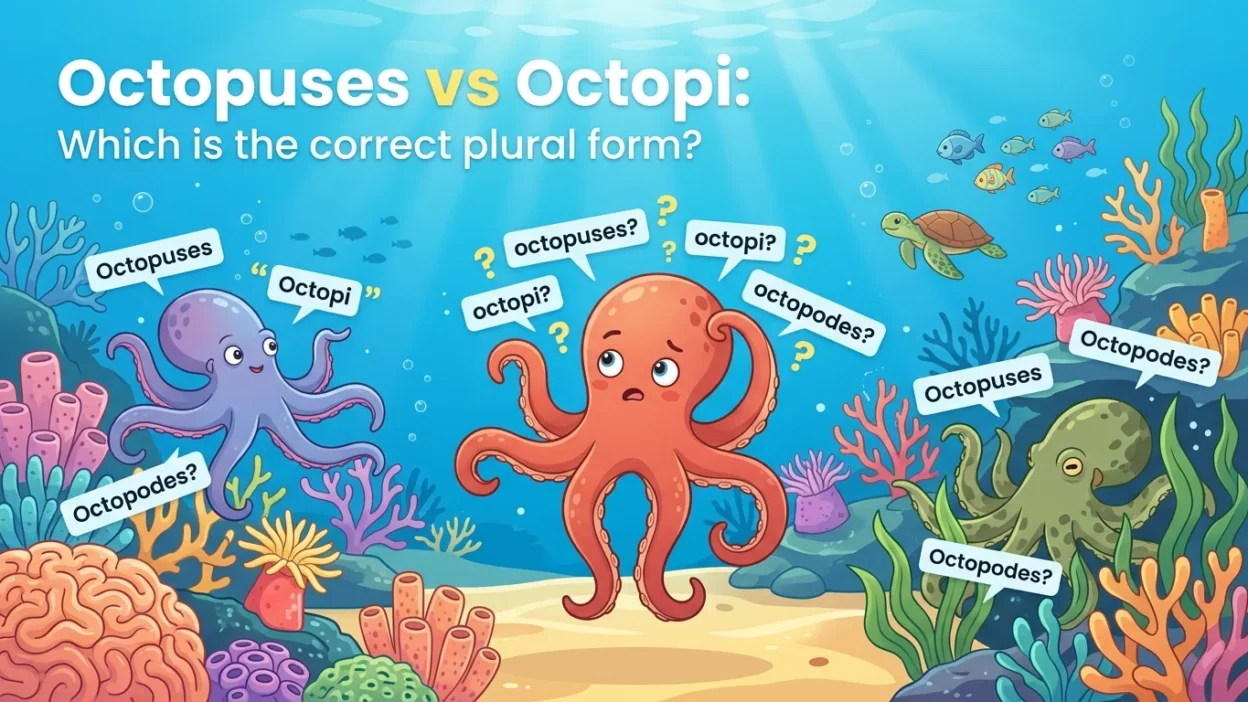
Many English learners and even native speakers get confused when they talk about more than one octopus. Some people say “octopi”, some say “octopuses”, and a few even say “octopodes.”
So which one is correct?
The confusion happens because people try to use Latin rules for a word that does not fully follow Latin grammar. Also, “octopus” comes from Greek, not Latin, which makes the plural form tricky.
In simple words: different language rules got mixed together, and that created more than one “correct sounding” plural.
Quick Answer (Simple Explanation)
Here is the clear and simple answer:
- Octopuses → Correct in modern English (most accepted)
- Octopi → Common but not fully correct (based on wrong Latin rule)
- Octopodes → Technically closest to Greek, but very rare
👉 If you are writing or speaking English today, “octopuses” is the safest and most correct choice.
Simple Origin or Background
To understand the confusion, we need to look at the word “octopus.”
Where the word comes from
- “Octo” means eight
- “Pous” means foot (in Greek)
- So “octopus” means eight footed animal
The word originally comes from Greek, not Latin.
But later, when English borrowed the word, people thought it was a Latin word. That mistake caused people to form the plural like Latin words.
Why “octopi” became popular
In Latin, many words ending in “-us” change to “-i” in plural.
For example:
- cactus → cacti
- fungus → fungi
So people assumed:
- octopus → octopi
But this is incorrect because “octopus” is not a true Latin word.
Clear Explanation of the Difference
Let’s break down each form in a very simple way.
1. Octopuses (Correct English Form)
- This is the standard English plural
- Used in schools, books, and science writing
- Easy and logical in modern English
👉 Example:
- I saw two octopuses in the aquarium.
2. Octopi (Common but Incorrect Rule)
- Based on wrong Latin thinking
- Still used in casual speech
- Not recommended in formal writing
👉 Example:
- Some people say they saw two octopi, but this is not fully correct.
3. Octopodes (Rare and Academic)
- Based on original Greek grammar
- Very rarely used
- Mostly found in linguistic discussions
👉 Example:
- Scholars may refer to multiple octopodes, but this is not common.
Comparison
| Form | Language Rule | Correct in English? | Usage Level |
| Octopuses | English rule | Yes (best choice) | Very common |
| Octopi | Latin rule | Not fully correct | Common but informal |
| Octopodes | Greek rule | Technically correct | Rare / academic |
👉 The easiest rule: Use “octopuses” in normal English.
Which One to Use and When
Choosing the correct form depends on the situation.
Use “octopuses” when:
- Writing essays
- Talking in school
- Writing emails
- Giving presentations
- Using formal or professional English
Avoid “octopi” when:
- Writing exams
- Writing academic work
- Speaking formally
(It is still widely understood, but not fully correct.)
“Octopodes” is used only when:
- You are studying language history
- You are discussing grammar rules
- You are reading academic linguistics texts
👉 In daily life, you almost never need “octopodes.”
Common Mistakes People Make
Many learners make simple mistakes with this word. Let’s fix them.
Mistake 1: Thinking Latin rules always apply
Not every word ending in “-us” becomes “-i.”
👉 Correct idea: English has its own rules.
Mistake 2: Using “octopi” everywhere
People often think “octopi” sounds smarter or more correct.
👉 Reality: It is not the best choice in modern English.
Mistake 3: Mixing all forms in one sentence
Some learners write:
- “The octopi and octopuses were swimming.”
This is confusing and unnecessary.
👉 Better:
- “The octopuses were swimming.”
Mistake 4: Overthinking the plural
People sometimes stop writing because they are unsure.
👉 Simple rule: Just use “octopuses” and move on.
Everyday Real Life Examples
Let’s see how the word is used in daily life.
In Emails
- “We visited the aquarium and saw three octopuses in the tank.”
In Social Media
- “These octopuses are so smart! They can open jars!”
In News or Articles
- “Scientists studied how octopuses change color for protection.”
In Daily Conversation
- “Have you ever seen octopuses in real life?”
In School Writing
- “Octopuses are marine animals with eight arms.”
👉 Notice how “octopuses” fits naturally everywhere.
Short Learning Section for Students and Beginners
Here is a simple way to remember everything:
Easy memory trick:
- Think: English is simple → add “-es”
- octopus → octopuses
One line rule:
👉 “Octopuses” is the correct modern English plural.
Quick practice:
Try saying these sentences:
- I saw one octopus.
- I saw three octopuses.
Now compare:
- ❌ I saw three octopi (not preferred)
- ❌ I saw three octopodes (too rare)
Why this matters
Using the correct form helps you:
- Speak more clearly
- Write better English
- Avoid confusion in exams
- Sound natural
FAQ (Frequently Asked Questions)
1. What is the correct plural of octopus?
The correct plural in modern English is octopuses.
2. Is “octopi” wrong?
It is not fully correct. It is based on Latin rules, but “octopus” is not Latin.
3. Why do people still say “octopi”?
Because it sounds more “Latin” and people learned it from others, even though it is incorrect.
4. Is “octopodes” ever used?
Yes, but very rarely. It is mostly used in language studies.
5. What should I use in exams?
Always use octopuses. It is the safest and most accepted form.
6. Do native English speakers use “octopi”?
Some do in casual speech, but most modern usage prefers octopuses.
7. Is “octopuses” accepted in science?
Yes, scientists and educators commonly use octopuses.
8. Can I use more than one form in writing?
It is better not to mix forms. Choose one correct form: octopuses.
Conclusion
The confusion between “octopi” and “octopuses” comes from mixing Greek and Latin language rules. While “octopi” is popular, it is not fully correct. The word “octopus” comes from Greek, and in modern English, the best plural form is octopuses.
If you remember just one thing, remember this:
👉 Octopuses is the correct and safe plural in English today.
It is simple, clear, and used in real communication everywhere from classrooms to science books.

Daniel Matthew is a language enthusiast, writer, and contributor at Meanefy.com, where he explores the meanings, origins, and nuances of words and phrases. With a deep passion for language, Daniel aims to make complex concepts simple, engaging, and easy to understand for readers of all ages.