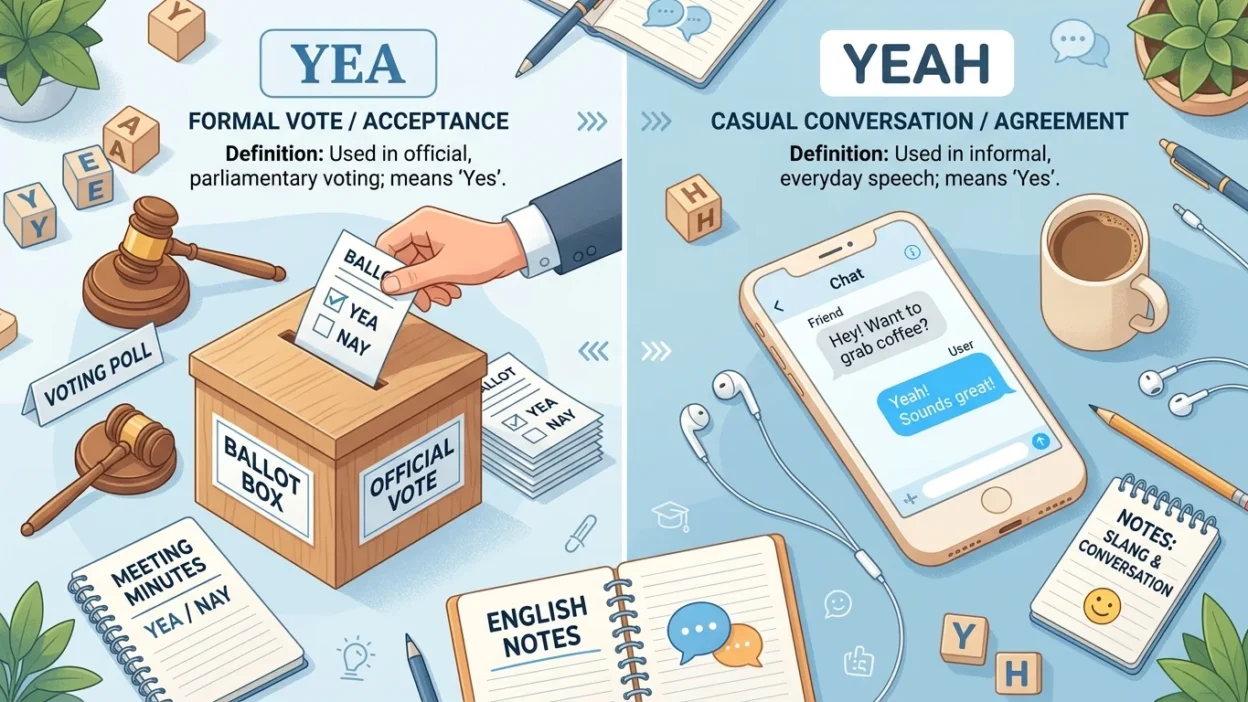
Many English learners and even native speakers get confused between “yea” and “yeah” because they look and sound almost the same. Both are used to say “yes,” but they are not used in the same way.
Another reason for confusion is that people see both words in messages, social media posts, and comments. Since English online is often informal and fast, spelling changes a lot. So learners may think both words mean exactly the same thing in every situation.
But the truth is simple: these words have different uses, tones, and history. Once you understand them clearly, you will never mix them again.
Quick answer: simple meaning in short points
Here is the easiest way to understand both words:
- Yeah
- Informal way to say “yes”
- Used in speaking and casual writing
- Very common in daily conversation
- Yea
- Old and formal word for “yes”
- Used in voting or official situations
- Rare in everyday speech today
👉 In simple words:
- “Yeah” = casual yes (modern English)
- “Yea” = formal or old yes (official English)
Where these words come from (simple history)
To understand the difference better, it helps to know a little history.
“Yeah”
“Yeah” is a modern English word. It became popular in spoken English because it is short, easy, and natural when talking quickly. People often say it instead of “yes” in relaxed situations.
Over time, “yeah” became part of everyday speech in many English speaking countries. It is now one of the most common informal words for agreement.
“Yea”
“Yea” is much older. It comes from Old English and was used hundreds of years ago. In the past, it simply meant “yes.”
Today, you mostly see “yea” in:
- Voting records (for approval)
- Formal documents
- Old style writing or literature
So, while “yeah” is modern and active, “yea” is mostly historical or formal.
Clear difference between yea and yeah
The main difference is not just spelling—it is use and style.
1. Tone
- Yeah → relaxed, friendly, casual
- Yea → formal, official, or old fashioned
2. Situation
- Yeah → everyday talking, texting, chatting
- Yea → voting, legal records, formal approval
3. Frequency
- Yeah → used very often
- Yea → used rarely
4. Meaning today
- Yeah → means “yes” in casual life
- Yea → means “yes” in formal vote or historical context
So even though both can mean “yes,” they live in completely different worlds of English.
Easy comparison
| Feature | Yea | Yeah |
| Meaning | Yes (formal/old use) | Yes (casual use) |
| Style | Formal / historical | Informal / modern |
| Usage today | Rare | Very common |
| Where used | Voting, official records | Daily speech, texting |
| Tone | Serious | Friendly, relaxed |
| Example | “All those in favor say yea” | “Yeah, I’m coming!” |
When to use each word
Use “yeah” when:
- Talking with friends
- Replying in chat or text
- Speaking casually
- Showing agreement in a relaxed way
Examples:
- “Yeah, I’m free today.”
- “Yeah, that sounds good.”
- “Yeah, I saw that movie.”
Use “yea” when:
- Voting in meetings or groups
- Reading or writing formal records
- Studying historical English texts
Examples:
- “The motion passed: 10 yea, 2 nay.”
- “All those in favor say yea.”
👉 Simple rule:
If you are not voting or in a formal meeting, use “yeah.”
Common mistakes people make
1. Using “yea” in casual texting
Many learners write “yea” in chats thinking it is a short form of “yeah.” But this sounds unusual or incorrect in modern English.
2. Thinking both words are the same
They may look similar, but their usage is very different. Mixing them can confuse readers.
3. Using “yeah” in formal documents
In official writing, “yeah” is too informal. It is better to use “yes.”
4. Overthinking spelling
Some learners try to replace “yes” with both words randomly. This is not correct. Each has a specific place.
Real life examples in daily life
Conversations
- A: “Do you want coffee?”
- B: “Yeah, sure!”
- A: “Are you coming to school?”
- B: “Yeah, I’ll be there.”
Social media
- “Yeah, this song is amazing!”
- “Yeah, I agree with you 100%.”
On social media, “yeah” is used to sound natural and friendly.
Emails (informal)
- “Yeah, I received your message.”
- “Yeah, I can help with that.”
But remember: in professional emails, “yes” is better.
Voting or meetings
- “All those in favor say yea.”
- “10 yea, 3 nay.”
Here, “yea” is part of official decision making.
Simple learning section for students and beginners
If you are learning English, here is a very simple way to remember:
Think like this:
- Yeah = everyday yes
- Yea = voting yes
Easy memory trick:
- “Yeah” has extra letters, so it is used more often in real life.
- “Yea” is shorter and older, so it is used less today.
Practice idea:
Try replacing “yes” in sentences:
- Casual: “Yeah, I understand.”
- Formal: “All votes are yea.”
Practicing like this helps your brain remember the difference naturally.
Frequently asked questions
1. Is “yea” still used today?
Yes, but only in formal voting or old style writing. It is not common in daily speech.
2. Is “yeah” correct English?
Yes, “yeah” is correct in informal spoken and written English.
3. Can I use “yeah” in exams?
It depends. In formal writing exams, “yes” is safer. “Yeah” is usually too informal.
4. Are “yea” and “yeah” pronounced the same?
They sound similar, but “yeah” is more natural and common in speech today.
5. Which word should beginners learn first?
Beginners should focus on “yeah” and “yes.” “Yea” is rarely needed.
6. Is “yea” the same as “yes”?
Yes in meaning, but not in usage. “Yea” is formal or old fashioned.
7. Why do people still use “yea”?
Because it is used in voting systems and traditional formal language.
Conclusion
The difference between “yea” and “yeah” is simple once you understand their purpose. Both can mean “yes,” but they are used in very different situations.
- “Yeah” is modern, casual, and used in daily conversation.
- “Yea” is old, formal, and mostly used in voting or official records.
If you are speaking or texting in everyday English, “yeah” is almost always the right choice. If you see “yea,” think of meetings, votes, or formal approval.
With this clear understanding, you can now use both words correctly without confusion.