
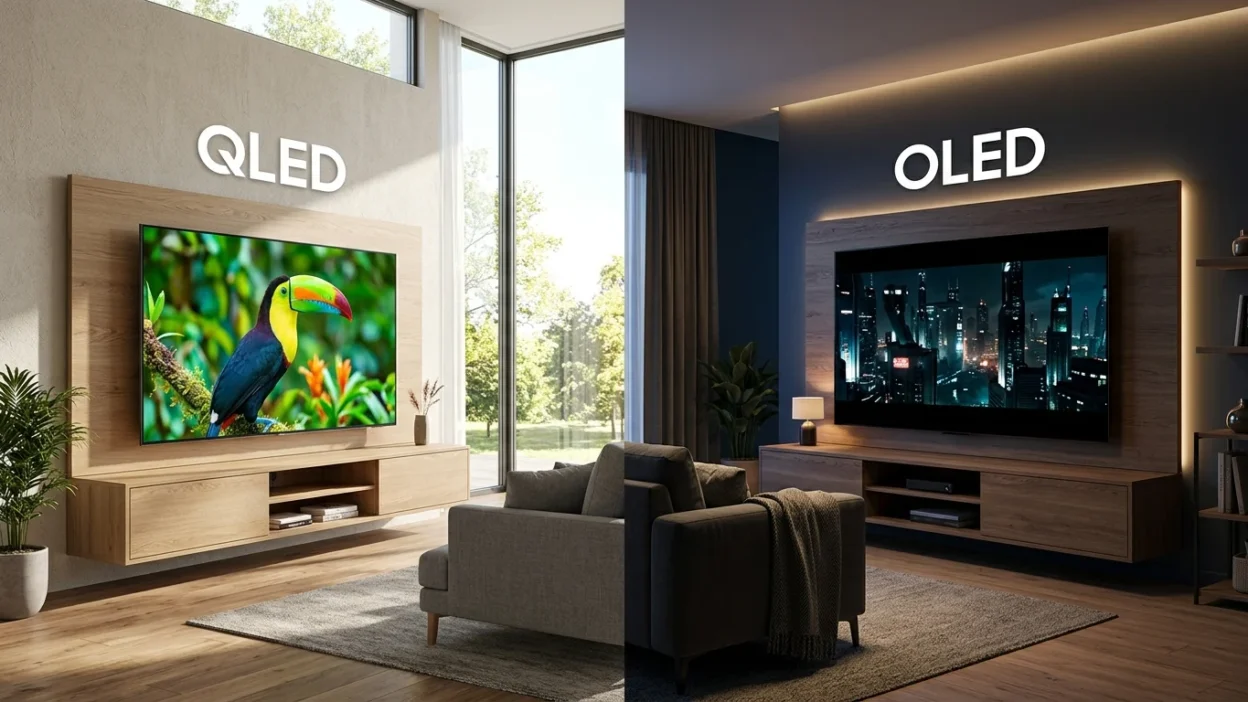
Many people become confused when they hear the words “QLED” and “OLED” while shopping for a TV. The names sound almost the same, but the technology behind them is very different.
Some people think one is simply a newer version of the other. Others believe both screens work in the same way. This confusion happens because TV companies use technical names that are not easy for beginners to understand.
The good news is that the difference is actually simple once you break it down step by step. In this guide, you will learn what QLED and OLED mean, how they work, and which one may be better for your needs.
Quick Answer
Here is the short and simple answer:
- QLED TVs use LED lights behind the screen.
- OLED TVs create light from each pixel individually.
- OLED usually gives:
- better black colors
- stronger contrast
- better movie quality
- QLED usually gives:
- brighter screens
- lower prices
- longer brightness life
- OLED is great for dark rooms and cinema lovers.
- QLED is great for bright rooms and budget friendly buying.
Neither one is perfect for everyone. The best choice depends on how and where you use your TV.
Simple Origin or Background Explanation
What Does QLED Mean?
QLED stands for Quantum Dot Light Emitting Diode.
It is a type of LED TV that uses tiny particles called quantum dots. These dots help improve color and brightness.
QLED TVs still use a backlight behind the screen, just like normal LED TVs.
What Does OLED Mean?
OLED stands for Organic Light Emitting Diode.
In OLED screens, each tiny pixel creates its own light. This means the TV does not need a separate backlight.
Because every pixel can turn on and off by itself, OLED screens can create very deep black colors and strong contrast.
Why Were These Technologies Created?
TV makers wanted to improve picture quality over older LCD and LED TVs.
They wanted:
- brighter colors
- smoother motion
- deeper blacks
- better viewing angles
- thinner screens
QLED and OLED were created to solve these problems in different ways.
Clear Explanation of the Difference
The biggest difference is how the screen creates light.
How QLED Works
A QLED TV has:
- a backlight
- LCD layers
- quantum dots
The backlight shines through the screen to create the image.
Think of it like a flashlight shining through colored glass.
Because of this system:
- QLED TVs can become very bright
- they work well in sunny rooms
- black colors may look a little gray sometimes
How OLED Works
An OLED TV works differently.
Each pixel creates its own light.
When a part of the screen needs to be black, the pixel simply turns off completely.
This creates:
- true black colors
- amazing contrast
- more realistic pictures
Think of it like millions of tiny lights working independently.
Why This Matters
The way light is created changes:
- picture quality
- brightness
- energy use
- screen thickness
- viewing experience
That is why people compare QLED and OLED so often.
Comparison
| Feature | QLED | OLED |
| Light Source | Backlight behind screen | Each pixel creates its own light |
| Brightness | Very bright | Bright, but usually less than QLED |
| Black Colors | Dark gray sometimes | True black |
| Contrast | Good | Excellent |
| Viewing Angles | Good | Excellent |
| Burn In Risk | Very low | Possible with long static images |
| Price | Usually cheaper | Usually more expensive |
| Best For | Bright rooms | Dark rooms and movies |
| Screen Thickness | Thin | Very thin |
| Gaming Quality | Very good | Excellent response time |
Which One to Use and When
Choose QLED If:
You Have a Bright Room
QLED TVs can fight sunlight and room lighting better because they become very bright.
You Want a Lower Price
QLED TVs are often cheaper than OLED TVs of the same size.
You Watch TV for Many Hours
If news channels, sports scores, or game menus stay on screen for a long time, QLED may be safer because burn in risk is lower.
You Want Strong Colors
QLED screens can produce very colorful and bright images.
Choose OLED If:
You Love Watching Movies
OLED gives deep blacks and cinema like picture quality.
You Watch TV in a Dark Room
Dark scenes look much better on OLED screens.
You Want the Best Contrast
Because pixels turn off individually, bright and dark areas look more realistic together.
You Care About Thin Design
OLED TVs are usually thinner and more modern looking.
Common Mistakes People Make
Thinking QLED and OLED Are the Same
The names look similar, but the technology is very different.
Believing OLED Is Always Better
OLED picture quality is excellent, but QLED may still be better for bright rooms or lower budgets.
Ignoring Room Lighting
A TV that looks amazing in a dark store may look different at home during daytime.
Buying Only Based on Price
A cheaper TV is not always the best value. Think about how you actually use your TV.
Forgetting About Burn In
OLED screens can sometimes show faint marks if the same image stays on screen for many hours repeatedly.
This does not happen easily for most users, but it is something to understand before buying.
Everyday Real Life Examples
Movies and Streaming
If you watch action movies, space films, or dark scenes:
- OLED often looks more realistic
- black scenes appear deeper
Example:
A night scene in a movie may look truly dark on OLED but slightly gray on QLED.
Sports
For sports:
- QLED brightness works very well in bright living rooms
- fast motion looks smooth on both technologies
Example:
Watching football during daytime may feel brighter and clearer on QLED.
Video Games
Gamers often enjoy OLED because:
- response time is very fast
- movement looks smoother
- contrast is stronger
But gamers who play the same game for many hours daily may prefer QLED because burn in risk is lower.
Social Media and YouTube
People who watch:
- YouTube videos
- TikTok clips
- live streams
- daily content
may enjoy either option.
Most casual viewers are happy with both QLED and OLED if the TV quality is good.
Family Living Rooms
For family use:
- cartoons
- news
- cooking videos
- daytime TV
QLED is often practical because of its brightness and lower price.
Short Learning Section for Students and Beginners
Here is an easy way to remember the difference:
Simple Memory Trick
- QLED = backlight
- OLED = self light
This means:
- QLED needs light behind the screen
- OLED creates light inside each pixel
Easy Comparison
Imagine two drawing boards:
QLED Example
A lamp shines behind a picture.
OLED Example
Every color spot glows by itself.
That is the main difference.
Beginner Summary
QLED Strengths
- brighter
- cheaper
- safer from burn in
OLED Strengths
- deeper blacks
- stronger contrast
- better movie experience
FAQ Section
Is OLED better than QLED?
OLED usually gives better picture quality and deeper blacks. QLED is often brighter and cheaper.
Which lasts longer?
Both can last many years. QLED may keep brightness longer over time.
Is burn in a big problem on OLED?
For most people, no. But static images shown for very long periods repeatedly can sometimes leave marks.
Which is better for gaming?
Both are excellent. OLED often gives faster response times and smoother visuals.
Which works better in sunlight?
QLED usually performs better in very bright rooms.
Why is OLED more expensive?
OLED technology is harder and more expensive to produce.
Can normal viewers notice the difference?
Yes, especially in dark scenes and movie watching.
Which should students or beginners buy?
If budget matters, QLED is often a smart choice. If picture quality matters most, OLED may be better.
Conclusion
QLED and OLED are both modern TV technologies, but they work differently.
QLED uses a backlight behind the screen, while OLED lights each pixel individually.
If you want:
- strong brightness
- lower prices
- good daytime viewing
then QLED may be the better choice.
If you want:
- deep black colors
- cinema style picture quality
- amazing contrast
then OLED may be the better choice.
There is no single “perfect” answer for everyone. The best TV depends on:
- your room
- your budget
- your viewing habits
- your personal preference
Once you understand how each technology works, choosing between QLED and OLED becomes much easier.

Daniel Matthew is a language enthusiast, writer, and contributor at Meanefy.com, where he explores the meanings, origins, and nuances of words and phrases. With a deep passion for language, Daniel aims to make complex concepts simple, engaging, and easy to understand for readers of all ages.