
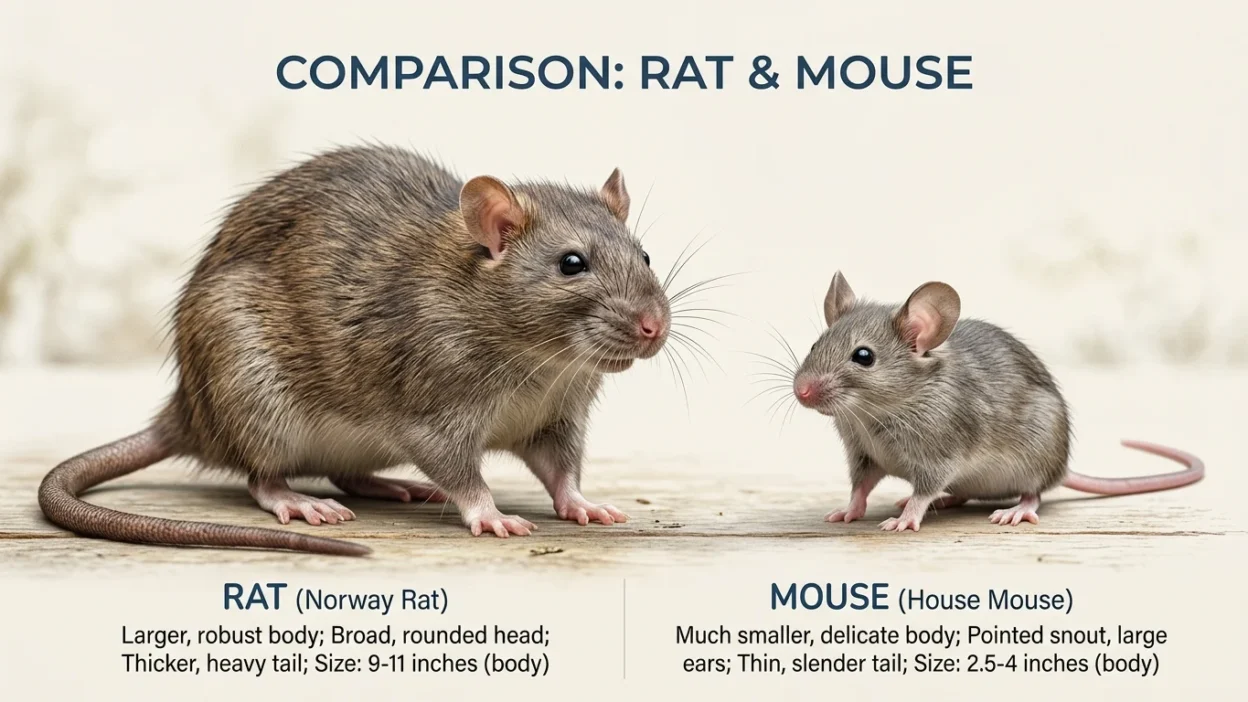
Many people confuse a rat with a mouse because both are small animals from the same rodent family. They have long tails, small ears, and sharp teeth. They also live near humans in homes, farms, gardens, and cities.
In everyday conversation, people often use the words “rat” and “mouse” as if they mean the same thing. Movies, cartoons, and stories also mix them up sometimes. Because of this, students, English learners, and beginners may not know which word to use.
The good news is that the difference is actually simple once you understand a few basic points.
Quick Answer
- A mouse is usually smaller and lighter.
- A rat is usually larger and stronger.
- Mice have small feet and thin bodies.
- Rats have bigger heads, thicker bodies, and larger tails.
- Mice are often curious and quiet.
- Rats are usually more careful and smarter in dangerous situations.
- Both are rodents, but they are different animals.
Simple Origin and Background
Rats and mice belong to the rodent group. Rodents are animals with teeth that continue growing throughout their lives. They must keep chewing things to wear their teeth down.
Humans have known rats and mice for thousands of years. They have lived near people because they can easily find food and shelter.
Mice in History
Mice were often seen in:
- homes
- farms
- grain storage areas
Because they are tiny, they can enter very small spaces.
Rats in History
Rats became famous in history because they were linked to dirty cities and sickness in the past. They are larger and can survive in difficult places such as:
- sewers
- ships
- garbage areas
Today, both animals can still be found around humans all over the world.
Clear Explanation of the Difference
The easiest way to understand the difference is to compare their size, body shape, and behavior.
Size
The biggest difference is size.
- A mouse is small enough to fit in your hand.
- A rat is much larger and heavier.
A rat may grow several times bigger than a mouse.
Tail
A mouse usually has:
- a thin tail
- a tail almost as long as its body
A rat often has:
- a thicker tail
- a heavier looking tail
Head and Face
Mice have:
- small heads
- pointed noses
- softer facial features
Rats have:
- larger heads
- stronger jaws
- thicker faces
Ears
Mouse ears are often:
- larger compared to their head
- round and soft looking
Rat ears are usually:
- smaller compared to body size
- thicker looking
Behavior
Mice are usually:
- curious
- fast moving
- active around new objects
Rats are often:
- more careful
- smarter at avoiding danger
- better at surviving difficult conditions
Living Areas
Mice often live:
- inside walls
- kitchens
- small holes
Rats usually prefer:
- basements
- sewers
- outdoor garbage areas
- larger spaces
Comparison
| Feature | Mouse | Rat |
| Size | Small | Larger |
| Body Shape | Thin and light | Thick and heavy |
| Tail | Thin | Thicker |
| Head | Small | Bigger |
| Nose | Pointed | Wider |
| Ears | Large compared to head | Smaller compared to body |
| Behavior | Curious | Careful |
| Common Place | Homes and walls | Sewers and garbage areas |
| Weight | Very light | Much heavier |
| Speed | Quick and tiny movements | Slower but stronger |
Which One to Use and When
Knowing which word to use becomes easier when you think about the animal’s size and appearance.
Use “Mouse” When:
- the animal is very small
- it has a thin body
- it looks tiny and light
- you are talking about a common house mouse
Example:
- “There is a mouse in the kitchen.”
Use “Rat” When:
- the animal is much larger
- it has a thick body and tail
- it looks stronger or heavier
Example:
- “A rat was seen near the garbage bins.”
In Computer Language
The word “mouse” also means a computer device used to move a cursor on a screen.
Example:
- “My computer mouse is not working.”
The word “rat” is sometimes used informally for a person who secretly tells information to others. This meaning is negative.
Example:
- “He acted like a rat and shared everyone’s secrets.”
Common Mistakes People Make
Thinking Every Small Rodent Is a Mouse
Some people call every small rodent a mouse. This is incorrect because young rats can also look small.
Thinking Rats and Mice Are the Same Animal
They belong to the same family, but they are different animals with different behaviors and body shapes.
Using the Wrong Word in Writing
Students sometimes write:
- “I saw a mouse near the sewer.”
A sewer animal is more likely to be a rat.
Confusing Baby Rats with Adult Mice
This is very common because baby rats are small. Looking at the feet, tail, and head shape can help.
Forgetting Other Meanings
Remember:
- a “mouse” can mean a computer tool
- a “rat” can describe a dishonest person
Context matters.
Everyday Real Life Examples
Emails
A landlord might write:
- “A rat problem was reported near the trash area.”
A homeowner might write:
- “We found a mouse in the pantry.”
News
News reports often say:
- “City workers are trying to control rats.”
This is because rats are more common in streets and sewer systems.
Social Media
People may post:
- “A tiny mouse ran across my floor!”
- “Huge rat spotted behind the restaurant!”
Daily Conversations
Examples:
- “I heard scratching sounds from a mouse in the wall.”
- “The rat near the garbage can looked very large.”
Schools and Science Classes
Teachers may explain:
- mice are often used in laboratory studies because they are small
- rats are also used because they are intelligent animals
Short Learning Section for Students and Beginners
Here is a simple trick to remember the difference.
Easy Memory Tip
Think of this:
- Mouse = mini
- Rat = bigger
A mouse is the tiny one.
A rat is the larger one.
Quick Practice
Which word fits better?
- “A small animal ran under the fridge.”
- Possible answer: mouse
- “The large rodent was near the sewer.”
- Possible answer: rat
- “My computer ___ stopped working.”
- Answer: mouse
Simple Sentence Practice
- “The mouse ate some cheese.”
- “The rat climbed out of the drain.”
- “I bought a new computer mouse.”
Practicing short sentences helps learners remember the words naturally.
FAQ
Is a rat bigger than a mouse?
Yes. Rats are usually much larger and heavier than mice.
Can a mouse become a rat?
No. A mouse and a rat are different animals.
Are rats more dangerous than mice?
Rats are usually stronger and may cause more damage because of their size.
Do rats and mice bite?
Both can bite if they feel trapped or afraid.
Which one is smarter?
Rats are generally considered more intelligent and careful.
Can mice and rats live together?
Usually not. Rats may attack mice because rats are larger and stronger.
Why are mice common inside houses?
Mice can fit through very tiny holes and easily enter homes for food and warmth.
Is a computer mouse related to the animal?
The name comes from the animal because the device has a small shape and a tail like wire.
Conclusion
The difference between a rat and a mouse becomes easy once you focus on size, shape, and behavior.
A mouse is smaller, lighter, and more delicate looking. A rat is larger, stronger, and heavier. Both are rodents, but they are not the same animal.
Understanding this difference helps students, English learners, and general readers use the correct word in conversations, writing, schoolwork, and daily life.
The next time you see one of these animals, you can look at its body size, tail, and face to quickly decide whether it is a rat or a mouse.

Daniel Matthew is a language enthusiast, writer, and contributor at Meanefy.com, where he explores the meanings, origins, and nuances of words and phrases. With a deep passion for language, Daniel aims to make complex concepts simple, engaging, and easy to understand for readers of all ages.