Many people feel confused about “shrank” and “shrunk.” They look similar, they come from the same verb, and both seem correct in different situations. This can make learners stop and think: Which one should I use?
The good news is that the difference is simple once you understand how English verb forms work. This guide will explain everything in very easy English, so you can understand it quickly and use both words with confidence.
Quick Answer
Here is the short and clear answer:
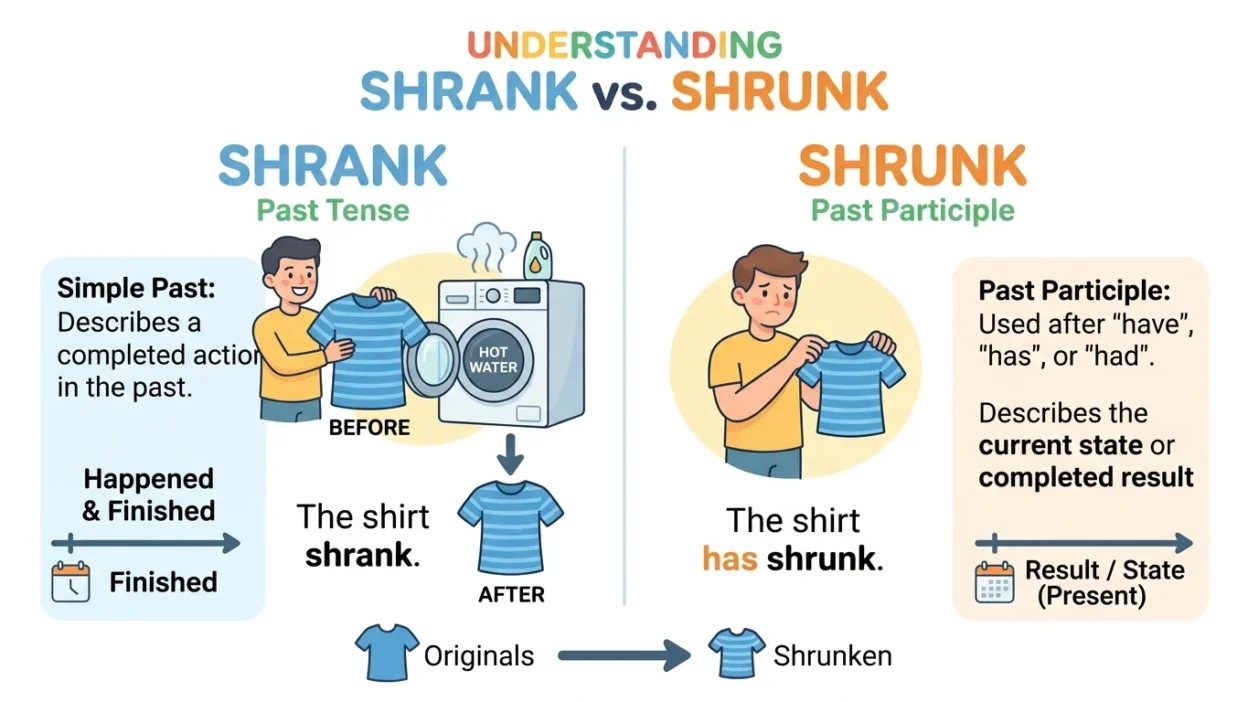
- “Shrank” = simple past (used alone)
- “Shrunk” = past participle (used with helping verbs like has, have, had)
Examples:
- Yesterday, my shirt shrank in the wash. ✅
- My shirt has shrunk after many washes. ✅
Simple Background
The words “shrank” and “shrunk” come from the verb “shrink.”
Shrink means:
- to become smaller
- to reduce in size
Basic verb forms:
- Present: shrink
- Past: shrank
- Past participle: shrunk
English has many verbs like this. They change form depending on time and grammar.
Clear Explanation of the Difference
Let’s make it very simple.
Shrank (Past Simple)
Use “shrank” when you talk about something that happened in the past.
- It does not need any helping verb.
- It tells us when something happened.
Examples:
- The sweater shrank after I washed it.
- The company shrank last year.
- My phone battery shrank quickly during the trip.
Think: Shrank = happened in the past (finished action)
Shrunk (Past Participle)
Use “shrunk” with helping verbs like:
- has
- have
- had
It is often used to talk about:
- results
- experiences
- changes over time
Examples:
- My sweater has shrunk.
- The population has shrunk over the years.
- His confidence had shrunk before the exam.
Think: Shrunk = used with has/have/had
Comparison
| Form | Word | How to Use | Example |
| Base form | shrink | Present tense | I don’t want my clothes to shrink. |
| Past simple | shrank | Action in the past | My jeans shrank yesterday. |
| Past participle | shrunk | With has/have/had | My jeans have shrunk. |
Which One to Use and When
Here is an easy way to decide:
Use “shrank” when:
- You talk about the past
- You do NOT use has/have/had
Examples:
- The shirt shrank in hot water.
- The business shrank during the crisis.
Use “shrunk” when:
- You use has, have, or had
- You talk about results or changes
Examples:
- The shirt has shrunk.
- The market has shrunk this year.
Quick Tip
If you see:
- has / have / had → use “shrunk”
- no helping verb → use “shrank”
Common Mistakes People Make
Many learners mix these two forms. Here are some common mistakes:
Mistake 1: Using “shrunk” without a helping verb
❌ My shirt shrunk yesterday.
✅ My shirt shrank yesterday.
Mistake 2: Using “shrank” with “has/have”
❌ My shirt has shrank.
✅ My shirt has shrunk.
Mistake 3: Mixing both in one sentence
❌ The clothes have shrank and shrunk.
✅ The clothes have shrunk.
Mistake 4: Forgetting the verb pattern
Some people try to treat it like regular verbs (like walked), but it is irregular.
Everyday Real Life Examples
Let’s see how people use these words in daily life.
In Emails
- The file size shrank after I compressed it.
- The document has shrunk after editing.
In News
- The economy shrank last quarter.
- The country’s population has shrunk over the past decade.
On Social Media
- My favorite shirt shrank in the wash 😢
- Why have my jeans shrunk again? 😂
In Daily Conversations
- My sweater shrank, so I can’t wear it now.
- My sweater has shrunk, and now it’s too small.
Learning Section for Students and Beginners
Here are some easy ways to remember the difference:
Memory Trick
- Shrank = past (no helper)
- Shrunk = has/have/had
Practice Sentences
Fill in the blanks:
- My jacket ______ after washing.
- My jacket has ______.
Answers:
- shrank
- shrunk
Speak and Repeat
Say these aloud:
- It shrank yesterday.
- It has shrunk already.
This helps your brain remember faster.
Simple Rule
If you are unsure, ask yourself:
- Do I see “has/have/had”?
→ Yes → use shrunk
→ No → use shrank
FAQ Section
What is the main difference between shrank and shrunk?
Shrank is past tense.
Shrunk is past participle used with helping verbs.
Can I say “has shrank”?
No. It is incorrect.
Correct form: has shrunk
Is “shrunk” ever used alone?
Usually no. It is mostly used with has/have/had.
Is “shrank” used with helping verbs?
No. It is used alone as past tense.
Which one is more common in daily use?
Both are common, but used in different situations.
Why is this confusing?
Because both come from the same verb and look similar.
Can “shrunk” be used in spoken English?
Yes, very often:
- My clothes have shrunk.
What is the base form of both words?
The base form is shrink.
Conclusion
The difference between “shrank” and “shrunk” is simple once you understand it.
- Shrank = past tense (used alone)
- Shrunk = used with has/have/had
Just remember this small rule, and you will avoid mistakes easily.
Learning small grammar differences like this can make your English clearer and more natural. Keep practicing with simple sentences, and soon you will use both words without thinking.
If you ever feel unsure, go back to the rule:
- No helper → shrank
- With helper → shrunk