
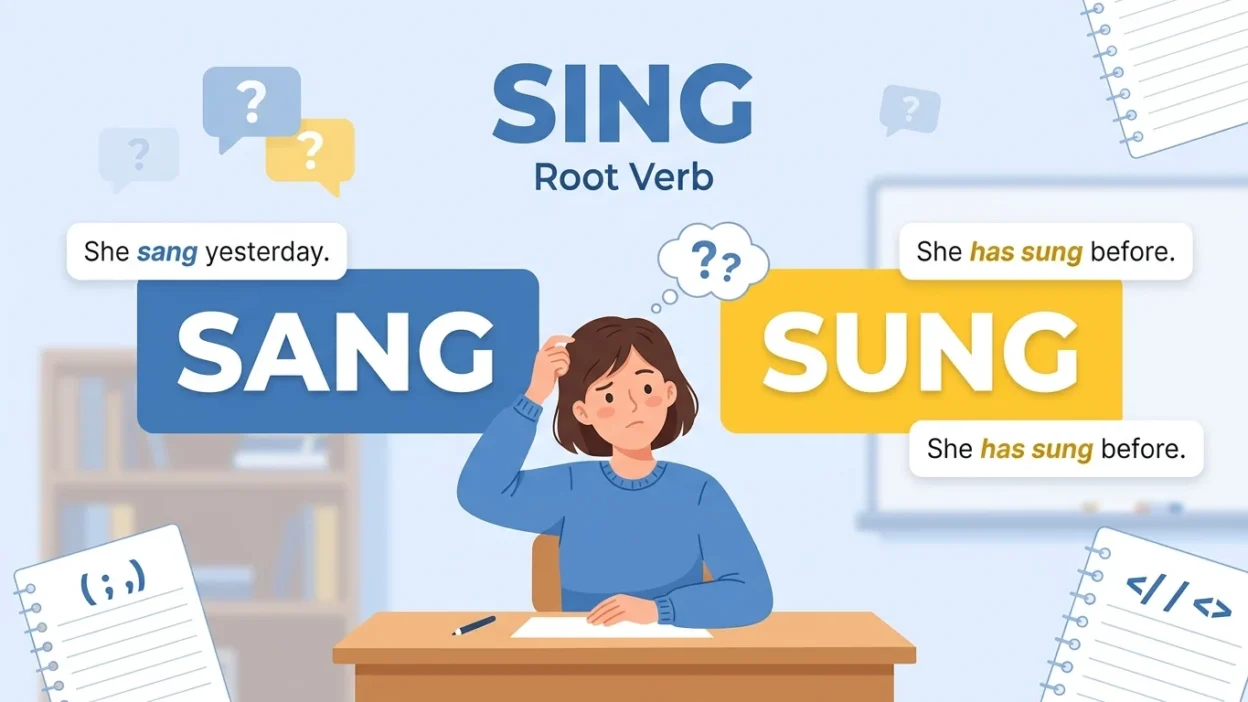
People often get confused between “sung” and “sang” because both words come from the verb “sing.” They look similar, sound similar, and are both connected to music and singing. But they are used in different grammar situations.
This guide explains the difference in very simple English so students, beginners, and English learners can understand it easily.
Quick Answer
- Sang = simple past tense of “sing”
- Sung = past participle of “sing”
- Use sang without a helping verb
- Use sung with helping verbs like:
- have
- has
- had
- was
- were
Examples
- She sang yesterday. ✅
- She has sung before. ✅
Simple Background of “Sing”
The word “sing” is an irregular verb. That means it does not follow the normal “-ed” pattern like:
- walk → walked
- play → played
Instead, it changes form completely.
| Verb Form | Word |
| Base Verb | sing |
| Simple Past | sang |
| Past Participle | sung |
These forms have existed in English for a very long time.
What Does “Sang” Mean?
“Sang” is the simple past tense of “sing.”
Use it when talking about something that already happened and finished in the past.
Structure
- Subject + sang
Examples
- I sang at school.
- They sang together.
- She sang beautifully.
- We sang all night.
The action is complete.
What Does “Sung” Mean?
“Sung” is the past participle form of “sing.”
It is usually used with a helping verb.
Common Helping Verbs
- have
- has
- had
- was
- were
Examples
- She has sung that song before.
- They had sung already.
- The anthem was sung loudly.
- He has never sung in public.
“Sung” normally does not stand alone.
Main Difference Between Sung and Sang
The main difference is grammar tense.
Use “Sang” for Simple Past
Use “sang” when no helping verb is in the sentence.
Example
- Maria sang yesterday.
Use “Sung” with Helping Verbs
Use “sung” when there is a helping verb.
Example
- Maria has sung before.
Without the helping verb, the sentence becomes incorrect.
❌ Maria sung yesterday.
✅ Maria sang yesterday.
Sung vs Sang Comparison
| Feature | Sang | Sung |
| Verb Type | Simple past | Past participle |
| Needs Helping Verb | No | Yes |
| Common Use | Finished past action | Perfect tenses/passive voice |
| Example | He sang yesterday. | He has sung before. |
Which One Should You Use?
Use “Sang” When:
- Talking about a finished action
- No helping verb is used
- Writing in simple past tense
Examples
- We sang at the party.
- The children sang loudly.
- She sang my favorite song.
Use “Sung” When:
- A helping verb is present
- Using perfect tenses
- Using passive voice
Examples
- They have sung together before.
- He had sung many songs.
- The song was sung beautifully.
Easy Trick to Remember
A simple trick can help you remember forever.
No Helping Verb → Use “Sang”
- I sang yesterday.
Helping Verb Present → Use “Sung”
- I have sung before.
This rule works in most situations.
Common Mistakes People Make
Many learners mix these words because they sound alike.
Mistake 1: Using “Sung” Alone
❌ She sung well.
✅ She sang well.
Why?
Because there is no helping verb.
Mistake 2: Using “Sang” After “Has” or “Have”
❌ He has sang before.
✅ He has sung before.
Helping verbs need the past participle form.
Mistake 3: Mixing Past Tenses
❌ They had sang at the event.
✅ They had sung at the event.
“Had” always uses the past participle.
Everyday Real Life Examples
Real examples make learning easier.
Daily Conversation
- We sang happy birthday.
- She has sung this song many times.
School Use
- The students sang during assembly.
- The school song was sung proudly.
Emails
- Our team sang at the event yesterday.
- The anthem has been sung every year.
Social Media
- Everyone sang together at the concert!
- This song has been sung by many singers.
News Reports
- Fans sang before the match.
- The national anthem was sung before kickoff.
Simple Learning Section for Students
Learning becomes easier when you follow steps.
Step 1: Look for a Helping Verb
Check for words like:
- have
- has
- had
- was
- were
If you see one, use sung.
Example
- She has sung before.
Step 2: No Helping Verb?
Then use sang.
Example
- She sang yesterday.
Step 3: Practice Short Sentences
- I sang.
- We sang.
- They have sung.
- He had sung.
Small practice helps you remember faster.
Practice Questions
Choose the correct word.
- She has ___ this song before.
→ sung - They ___ at the wedding yesterday.
→ sang - The anthem was ___ before the game.
→ sung - We ___ together last night.
→ sang
FAQ About Sung and Sang
Is it “I sang” or “I sung”?
Correct: I sang
✅ I sang yesterday.
✅ I have sung before.
Can “sung” be used alone?
Usually no.
“Sung” normally needs a helping verb.
Why is “has sang” incorrect?
Because “has” needs the past participle form.
✅ has sung
❌ has sang
Is “sang” present tense?
No.
“Sang” is simple past tense.
What is the past participle of “sing”?
The past participle is sung.
Do native speakers make this mistake?
Yes, sometimes in informal speech.
But standard grammar still follows the correct rule.
Is “sung” used in passive voice?
Yes.
Example:
- The song was sung beautifully.
What is the easiest way to remember the difference?
- No helping verb → sang
- Helping verb → sung
Conclusion
“Sang” and “sung” both come from the verb “sing,” but they are used differently.
- Sang is the simple past tense
- Sung is the past participle
Use sang when there is no helping verb:
- She sang yesterday.
Use sung with helping verbs:
- She has sung before.
Once you practice a few examples, the difference becomes easy and natural.

Daniel Matthew is a language enthusiast, writer, and contributor at Meanefy.com, where he explores the meanings, origins, and nuances of words and phrases. With a deep passion for language, Daniel aims to make complex concepts simple, engaging, and easy to understand for readers of all ages.