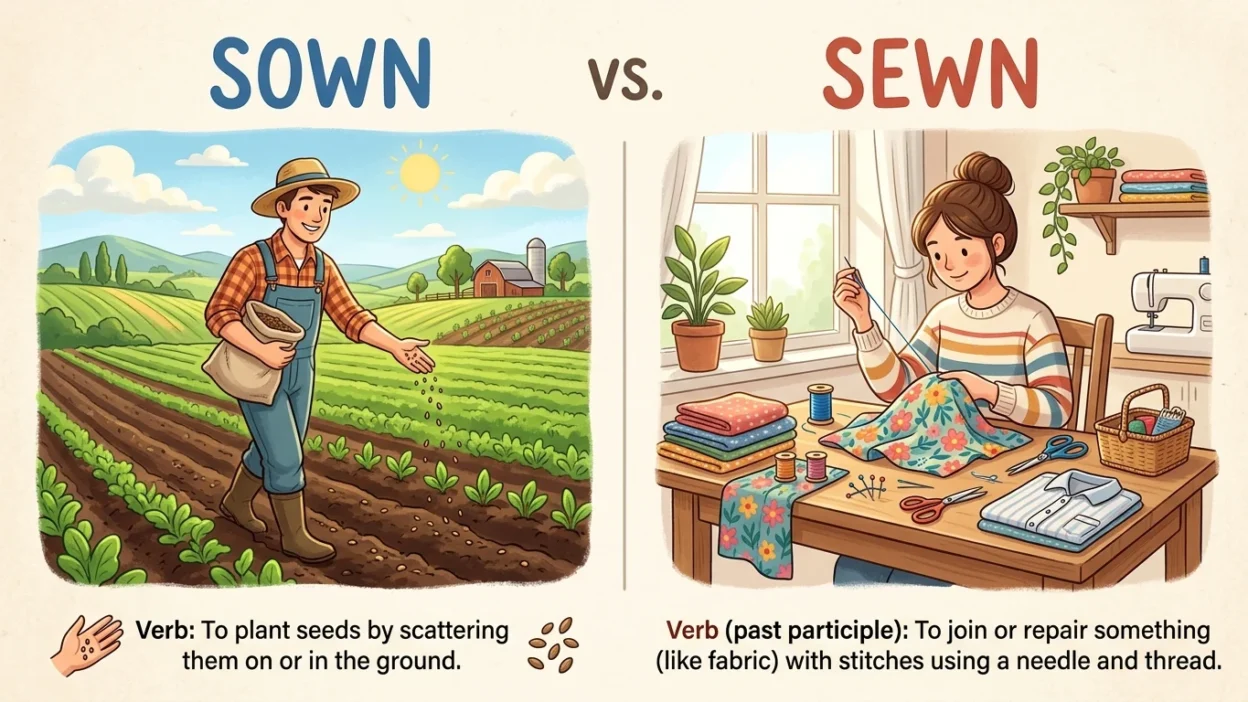
People often confuse “sown” and “sewn” because the words look almost the same. Their pronunciation is also very close, which makes the confusion even bigger for students, ESL learners, and beginners.
But the real difference is simple.
One word is connected to planting seeds, while the other is connected to stitching clothes or fabric.
Once you understand that idea, it becomes much easier to use the correct word in writing and speaking.
Quick Answer: Sown or Sewn?
Here is the easiest way to understand the difference:
- Sown = planted seeds
- Sewn = stitched cloth or fabric
Simple Examples
- The farmer had sown wheat in the field.
- My grandmother had sewn a beautiful dress.
Easy Memory Trick
- Sown → Seeds
- Sewn → Shirts
This quick trick helps many learners remember the difference instantly.
What Does “Sown” Mean?
The word sown comes from the verb sow.
“Sow” means:
- to plant seeds in the ground
Farmers and gardeners sow seeds so plants can grow.
Verb Forms of Sow
| Verb Form | Word |
| Base Verb | sow |
| Past Tense | sowed |
| Past Participle | sown |
Examples of “Sown”
- The seeds were sown before the rain started.
- Farmers have sown rice across the fields.
- The garden was carefully sown with flowers.
Common Words Used With “Sown”
- seeds
- crops
- wheat
- rice
- flowers
- fields
- soil
If the sentence is about farming, gardening, or planting, “sown” is usually the correct word.
What Does “Sewn” Mean?
The word sewn comes from the verb sew.
“Sew” means:
- to join fabric using a needle and thread
People sew clothes, bags, curtains, and other cloth items.
Verb Forms of Sew
| Verb Form | Word |
| Base Verb | sew |
| Past Tense | sewed |
| Past Participle | sewn |
Examples of “Sewn”
- The button was sewn onto the jacket.
- She had sewn the curtains herself.
- The dress was beautifully sewn by hand.
Common Words Used With “Sewn”
- clothes
- fabric
- shirt
- dress
- thread
- needle
- jacket
If the sentence is about stitching or fabric, “sewn” is the correct choice.
Main Difference Between Sown and Sewn
The difference becomes easy when you focus on the topic of the sentence.
| Word | Meaning | Used For |
| Sown | planted seeds | farming and gardening |
| Sewn | stitched fabric | clothes and sewing |
One Line Difference
- Sown is about plants.
- Sewn is about fabric.
That is the main difference.
Sown vs Sewn Comparison
Here is a quick table you can scan anytime.
| Feature | Sown | Sewn |
| Comes From | sow | sew |
| Main Meaning | plant seeds | stitch fabric |
| Related To | farming | clothing |
| Used With | seeds, crops | clothes, thread |
| Connected to Gardening? | Yes | No |
| Connected to Sewing? | No | Yes |
| Example | Seeds were sown. | The shirt was sewn. |
When Should You Use “Sown”?
Use sown when talking about:
- planting
- farming
- agriculture
- seeds
- gardens
- crops
Correct Examples
- Corn had been sown before winter.
- The farmer has sown wheat this year.
- Flower seeds were sown in spring.
Incorrect Example
❌ The farmer had sewn seeds.
✅ The farmer had sown seeds.
Why?
Because seeds are planted, not stitched.
When Should You Use “Sewn”?
Use sewn when talking about:
- clothes
- stitching
- repairing fabric
- sewing machines
- handmade items
Correct Examples
- The torn pocket was sewn shut.
- She has sewn many dresses.
- The logo was sewn onto the uniform.
Incorrect Example
❌ She had sown a new dress.
✅ She had sewn a new dress.
Why?
Because dresses are stitched, not planted.
Common Mistakes People Make
Many English learners make the same mistakes with these two words.
Learning these mistakes can help you avoid them.
Mistake 1: Mixing Up Farming and Sewing
Some people use “sewn” when talking about farming.
❌ The fields were sewn with rice.
✅ The fields were sown with rice.
Remember:
- Farming → sown
- Stitching → sewn
Mistake 2: Using “Sown” for Clothes
❌ My mother has sown a shirt.
✅ My mother has sewn a shirt.
Clothes are sewn because they are stitched together.
Mistake 3: Forgetting the Original Verb
Many learners forget:
| Base Verb | Correct Past Participle |
| sow | sown |
| sew | sewn |
This small spelling difference changes the meaning completely.
Mistake 4: Confusing “Sowed” and “Sewn”
Some people also confuse the past tense and past participle forms.
Correct Usage
- The farmer sowed seeds yesterday.
- The seeds have been sown.
- She sewed the dress yesterday.
- The dress has been sewn.
Both forms can be correct depending on the sentence structure.
Everyday Examples of Sown and Sewn
Real-life examples help learners remember words faster.
In Daily Conversation
Using “Sown”
- Have the seeds been sown yet?
- The farmer has already sown the field.
Using “Sewn”
- Who sewn this patch onto your bag?
- These curtains were sewn by hand.
In Emails
Farming Example
- The land was fully sown before the rainy season.
Clothing Example
- The company confirmed that the badges were sewn onto the jackets.
On Social Media
Gardening Post
- Finally sown tomato seeds in my backyard today!
Sewing Post
- I just finished a hand-sewn handbag.
In News Reports
Farming News
- Thousands of acres were sown with wheat this month.
Fashion News
- The costumes were sewn by local designers.
Simple Learning Section for Students and Beginners
If you still feel confused, follow these easy learning steps.
Step 1: Think About the Topic
Ask yourself:
- Is the sentence about plants or seeds?
- Use sown
- Is the sentence about fabric or stitching?
- Use sewn
Step 2: Remember This Simple Rule
Seeds are sown.
Shirts are sewn.
This sentence is easy to remember and works very well for beginners.
Step 3: Practice Small Sentences
Practice With “Sown”
- Wheat was sown last week.
- The seeds have been sown.
- Rice was sown early this year.
Practice With “Sewn”
- The jacket was sewn by hand.
- A button has been sewn onto the coat.
- The dress was sewn yesterday.
Regular practice helps the difference stay in your memory.
Frequently Asked Questions (FAQ)
Is “sown” used for clothes?
No.
“Sown” is only used for planting seeds.
Example:
- The farmer had sown corn.
Is “sewn” related to farming?
No.
“Sewn” is connected to stitching fabric or clothing.
Example:
- The bag was sewn by hand.
Why are “sown” and “sewn” confusing?
They look and sound similar, but they come from different verbs with different meanings.
Can I use “sowed” instead of “sown”?
Yes, sometimes.
Example:
- The farmer sowed seeds yesterday.
But “sown” is very common in perfect tense sentences.
Example:
- The seeds have been sown.
Can I use “sewed” instead of “sewn”?
Yes.
However, “sewn” sounds more natural in many formal and everyday sentences.
Example:
- The patch has been sewn onto the shirt.
Which word is connected to seeds?
“Sown.”
Example:
- Grass seeds were sown in spring.
Which word is connected to stitching?
“Sewn.”
Example:
- The curtains were sewn by my aunt.
How can I remember the difference easily?
Use this memory trick:
- Sown = Seeds
- Sewn = Shirts
This is one of the easiest ways to remember the correct word.
Conclusion
The difference between sown and sewn is simple once you connect each word to its meaning.
- Sown comes from sow and is used for planting seeds.
- Sewn comes from sew and is used for stitching fabric or clothes.
Whenever you feel confused, remember this:
Seeds are sown.
Shirts are sewn.
With a little practice, you will start using both words naturally and correctly in everyday English.

Anthony Charles is the founder and lead content creator at Meanefy.com, a platform dedicated to exploring word meanings, language nuances, and everyday curiosities. With a passion for language and a keen eye for detail, Anthony aims to make complex words and concepts simple and accessible for readers around the world.