Many learners feel confused when they see the words “showed” and “shown.” Both come from the verb “show,” and both talk about something in the past. So, why are there two forms?
The confusion usually happens because English verbs can change in different ways depending on how they are used in a sentence.
If you are not sure when to use “showed” or “shown,” don’t worry. This guide will explain everything in very simple English so you can understand it easily and use it with confidence.
Quick Answer
Here is the simple difference:
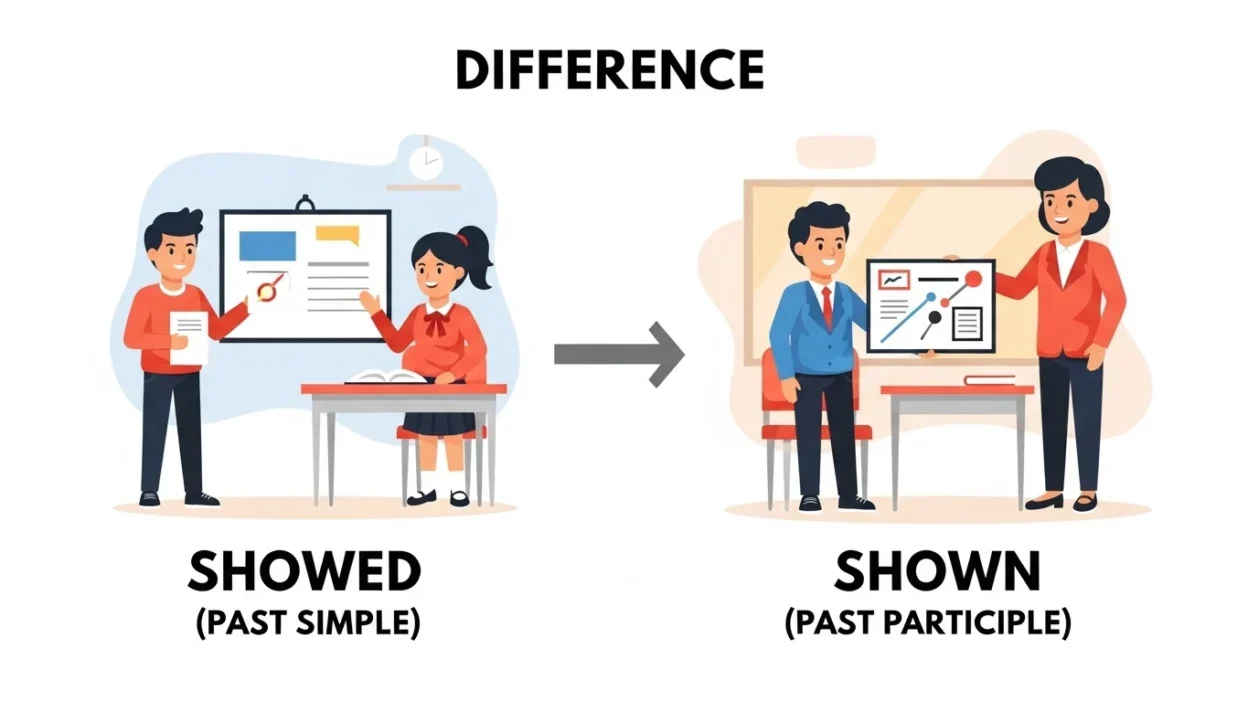
- Showed = simple past form
→ Used alone in past sentences
→ Example: I showed him my new phone. - Shown = past participle
→ Used with helping verbs like has, have, had, was, were
→ Example: I have shown him my new phone.
Easy tip:
- If there is no helping verb, use showed
- If there is a helping verb, use shown
Simple Background
The verb “show” is an irregular verb in English. This means it does not follow a simple rule like adding “ ed” in every form.
Here are its main forms:
- Base form: show
- Past simple: showed
- Past participle: shown
In English, many verbs have three forms:
- Present (show)
- Past (showed)
- Past participle (shown)
The past participle is usually used with helping verbs.
Clear Explanation of the Difference
Let’s understand both words step by step.
What is “showed”?
“Showed” is the past simple form. It talks about something that already happened and is finished.
You use “showed” when:
- You are talking about a completed action in the past
- There is no helping verb
Examples:
- She showed me her homework.
- They showed us the way.
- I showed my teacher the answer.
In all these sentences, the action is complete and simple.
What is “shown”?
“Shown” is the past participle. It is not used alone. It needs a helping verb like:
- has
- have
- had
- was
- were
- been
Examples:
- She has shown me her homework.
- They have shown us the way.
- The results were shown on the screen.
Here, “shown” works with another verb to form a complete idea.
Comparison
| Feature | Showed | Shown |
| Type | Past simple | Past participle |
| Used alone? | Yes | No |
| Needs helping verb? | No | Yes |
| Example | I showed him the photo. | I have shown him the photo. |
| Common verbs used | — | has, have, had, was, were |
| Sentence meaning | Simple past action | Connected or completed action |
Which One to Use and When
Choosing between “showed” and “shown” becomes easy if you follow these simple rules.
Use “showed” when:
- You talk about a finished action
- There is no helping verb
- The sentence is in simple past
Examples:
- I showed my friend my new shoes.
- She showed her parents her report card.
- We showed them our house.
Use “shown” when:
- You use a helping verb
- The sentence is in perfect tense or passive voice
Examples:
- I have shown my friend my new shoes.
- She had shown her parents her report card.
- The video was shown to the class.
Quick check tip:
Ask yourself:
- Is there a helping verb? → use shown
- No helping verb? → use showed
Common Mistakes People Make
Here are some mistakes learners often make:
Using “shown” without a helping verb
❌ Wrong: I shown him the answer.
✅ Correct: I showed him the answer.
Using “showed” with a helping verb
❌ Wrong: I have showed him the answer.
✅ Correct: I have shown him the answer.
Mixing both forms in one sentence
❌ Wrong: She has showed and shown her work.
✅ Correct: She has shown her work.
Forgetting helping verbs with “shown”
❌ Wrong: They shown us the way.
✅ Correct: They have shown us the way.
Everyday Real Life Examples
Let’s see how these words are used in daily life.
In emails
- I showed the report to my manager yesterday.
- I have shown the updated version to the team.
In school
- The teacher showed us how to solve the problem.
- The method has been shown in the textbook.
In news
- The report showed a rise in prices.
- The results have been shown on TV.
On social media
- I showed my followers my new outfit.
- I have shown you all my travel photos!
In daily conversation
- He showed me his new bike.
- He has shown me his new bike already.
Learning Section for Students and Beginners
If you are learning English, here are some easy ways to remember:
Simple rule
- Showed = past simple
- Shown = with has/have/had
Practice method
Try making your own sentences:
- I showed ______ yesterday.
- I have shown ______ already.
Fill the blank with:
- my homework
- my friend
- the teacher
Memory trick
Think like this:
- “Showed” stands alone
- “Shown” needs help
Small exercise
Choose the correct word:
- I have ______ him the photo.
- She ______ me her new bag yesterday.
- They have ______ us their plan.
Answers:
- shown
- showed
- shown
FAQ Section
What is the main difference between showed and shown?
“Showed” is used alone in past sentences. “Shown” is used with helping verbs.
Can I use “shown” without “has” or “have”?
No. “Shown” always needs a helping verb.
Is “showed” correct English?
Yes, it is correct. It is the past form of “show.”
Which is more common: showed or shown?
Both are common, but they are used in different situations.
Can I say “I have showed”?
No, that is incorrect. You should say “I have shown.”
Why is “shown” used with helping verbs?
Because it is a past participle, and past participles need helping verbs.
Is “shown” used in passive voice?
Yes. Example: The movie was shown yesterday.
Can both words be used in the same sentence?
Usually no. Each has its own role in grammar.
Conclusion
Understanding the difference between “showed” and “shown” is easier than it looks. The key is to remember how each one is used.
- Use showed for simple past actions
- Use shown with helping verbs like has, have, had, was, were
With a little practice, you will start using both forms correctly without thinking too much. Keep making simple sentences, and soon it will feel natural.

Daniel Matthew is a language enthusiast, writer, and contributor at Meanefy.com, where he explores the meanings, origins, and nuances of words and phrases. With a deep passion for language, Daniel aims to make complex concepts simple, engaging, and easy to understand for readers of all ages.