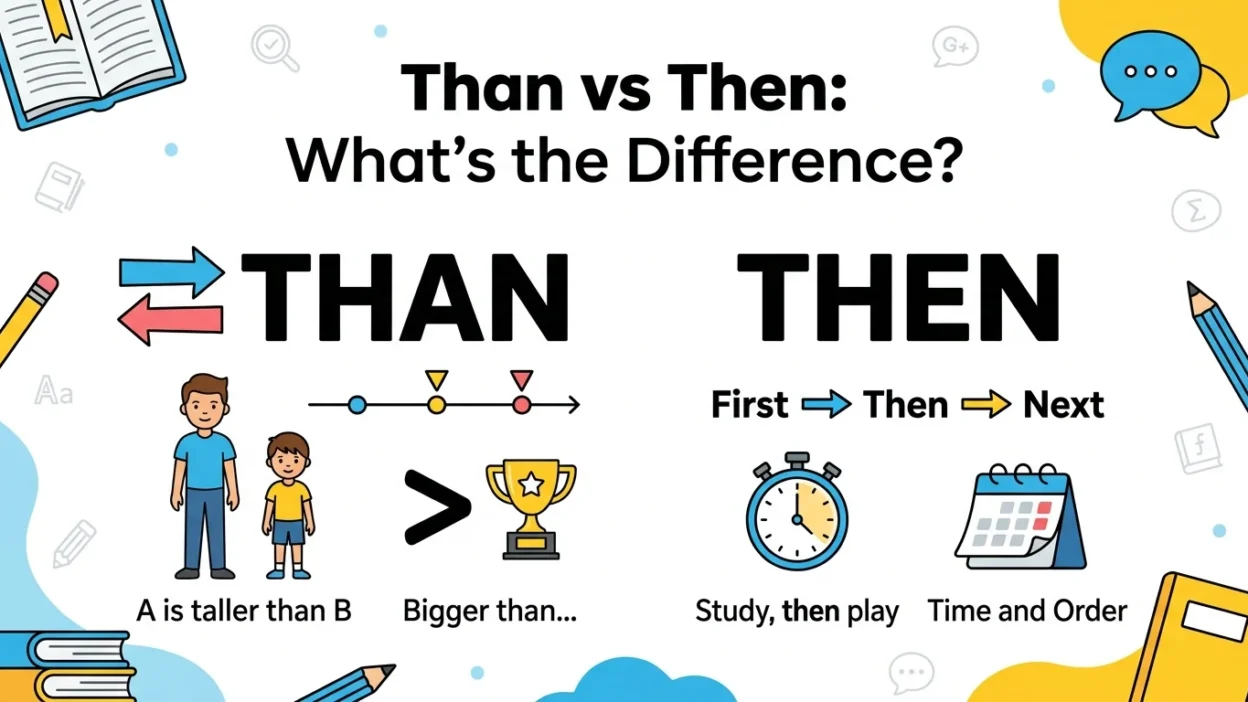
Many people mix up than and then because the two words look very similar. They differ by only one letter, and when speaking quickly, they can sound alike.
Students, English learners, and even native speakers sometimes use the wrong one in writing. The good news is that the difference is actually very simple once you understand what each word does.
A quick way to remember:
- Than is usually used for comparison.
- Then is usually used for time or order.
Once you learn this basic rule, choosing the correct word becomes much easier.
Quick Answer
Here is the simplest explanation:
Use than when comparing things.
Examples:
- My car is faster than yours.
- She is taller than her brother.
- I would rather read than watch TV.
Use then when talking about time or what happens next.
Examples:
- We ate dinner and then watched a movie.
- Finish your homework, then go outside.
- Back then, life was different.
Easy memory trick:
- Than = Comparison
- Then = Time or Next Step
Simple Origin or Background Explanation
Both words come from very old forms of English and have been used for hundreds of years.
In earlier English, the meanings were closer together than they are today. Over time, the language changed and each word developed a more specific job.
Today:
- Than mainly helps compare things.
- Then mainly shows time, order, or sequence.
Even though their histories are connected, modern English treats them as two different words with different uses.
Clear Explanation of the Difference
The easiest way to understand the difference is to look at each word separately.
What Does “Than” Mean?
Than is used when comparing two or more people, things, ideas, or actions.
Think of it as a comparison word.
Examples:
- Cats are quieter than dogs.
- This book is more interesting than that one.
- He works harder than I do.
- Summer is hotter than winter.
In each sentence, two things are being compared.
What Does “Then” Mean?
Then is used when talking about time or the order of events.
Think of it as a time word.
Examples:
- I woke up and then took a shower.
- We finished lunch and then returned to work.
- First mix the ingredients, then bake the cake.
- Back then, smartphones did not exist.
In each sentence, then shows when something happened or what happened next.
Comparison
| Feature | Than | Then |
| Main purpose | Comparison | Time or sequence |
| Helps compare? | Yes | No |
| Shows what happens next? | No | Yes |
| Used with words like “more” and “less”? | Yes | No |
| Related to time? | No | Yes |
| Example | She is taller than me. | She called me, then left. |
Quick Reminder
| If you are talking about… | Use |
| Comparing two things | Than |
| What happens next | Then |
| More, less, better, worse | Than |
| Time, order, sequence | Then |
Which One to Use and When
Use “Than” for Comparisons
You need than whenever one thing is compared with another.
Examples:
- Better than
- Bigger than
- Smaller than
- More than
- Less than
- Rather than
Sentences:
- This phone is better than my old phone.
- She has more experience than I do.
- He would rather walk than drive.
Use “Then” for Time and Order
Use then when one event follows another.
Examples:
- First, second, then
- Now and then
- Back then
- Until then
Sentences:
- Complete the form and then submit it.
- I met her in 2020. Then we became friends.
- Life was different back then.
A Simple Test
Ask yourself:
Am I comparing something?
- Yes → Use than
- No → Go to the next question.
Am I talking about time or what happens next?
- Yes → Use then
Common Mistakes People Make
Mistake 1: Using “Then” in Comparisons
❌ She is taller then her sister.
✅ She is taller than her sister.
Why?
Because a comparison is being made.
Mistake 2: Using “Than” for Time
❌ We ate dinner and than watched TV.
✅ We ate dinner and then watched TV.
Why?
Because the sentence describes the next action.
Mistake 3: Confusing Them in Writing
People often type quickly and choose the wrong word without noticing.
❌ First study, than take the test.
✅ First study, then take the test.
Mistake 4: Forgetting the Comparison Rule
❌ This bag is cheaper then that one.
✅ This bag is cheaper than that one.
Whenever you see words like:
- better
- worse
- bigger
- smaller
- more
- less
you will usually need than.
Everyday Real Life Examples
Emails
- Please review the document and then send your feedback.
- This option is better than the previous one.
News
- Temperatures were higher than expected.
- The storm weakened and then moved north.
Social Media
- This movie was better than I thought.
- I posted the photo and then went offline.
School and Homework
- Math is harder than history for some students.
- Finish question one and then move to question two.
Daily Conversations
- My house is closer than yours.
- We went shopping and then had lunch.
Short Learning Section for Students and Beginners
Here is a simple learning trick.
Remember the Letter “A” in Than
The word than contains the letter A.
Think:
A = Compare
Examples:
- Faster than
- Smarter than
- Better than
Remember the Letter “E” in Then
The word then contains the letter E.
Think:
E = Events
Examples:
- Wake up, then eat breakfast.
- Study, then relax.
Practice Exercise
Choose the correct word.
- She is younger ___ her brother.
- Finish your work and ___ go home.
- This road is longer ___ that road.
- We arrived and ___ checked into the hotel.
Answers:
- than
- then
- than
- then
If the sentence compares things, use than.
If it shows time or order, use then.
FAQ
Is “than” used only for comparisons?
Almost always. Its main job is to compare people, things, actions, or ideas.
Is “then” always about time?
Most of the time, yes. It usually shows when something happens or what happens next.
Which is correct: “better than” or “better then”?
Better than is correct because it is a comparison.
Which is correct: “and then” or “and than”?
And then is correct because it shows the next event.
How can I remember the difference quickly?
Remember:
- Than = Compare
- Then = Time
Can native English speakers confuse them?
Yes. Many native speakers accidentally type the wrong one, especially when writing quickly.
Is “rather than” correct?
Yes. Rather than is a very common phrase used for comparison or preference.
Example:
- I would rather read than watch television.
Is “back then” correct?
Yes. Back then refers to a time in the past.
Example:
- Back then, people wrote more letters.
Conclusion
The difference between than and then is much simpler than many people think.
Use than when you compare things:
- bigger than
- better than
- more than
Use then when you talk about time or the next step:
- first this, then that
- back then
- and then
A good final rule to remember is:
If you are comparing, use “than.” If you are talking about time or sequence, use “then.”
Once you keep that rule in mind, you will be able to choose the correct word confidently in everyday writing, school assignments, emails, and conversations.