
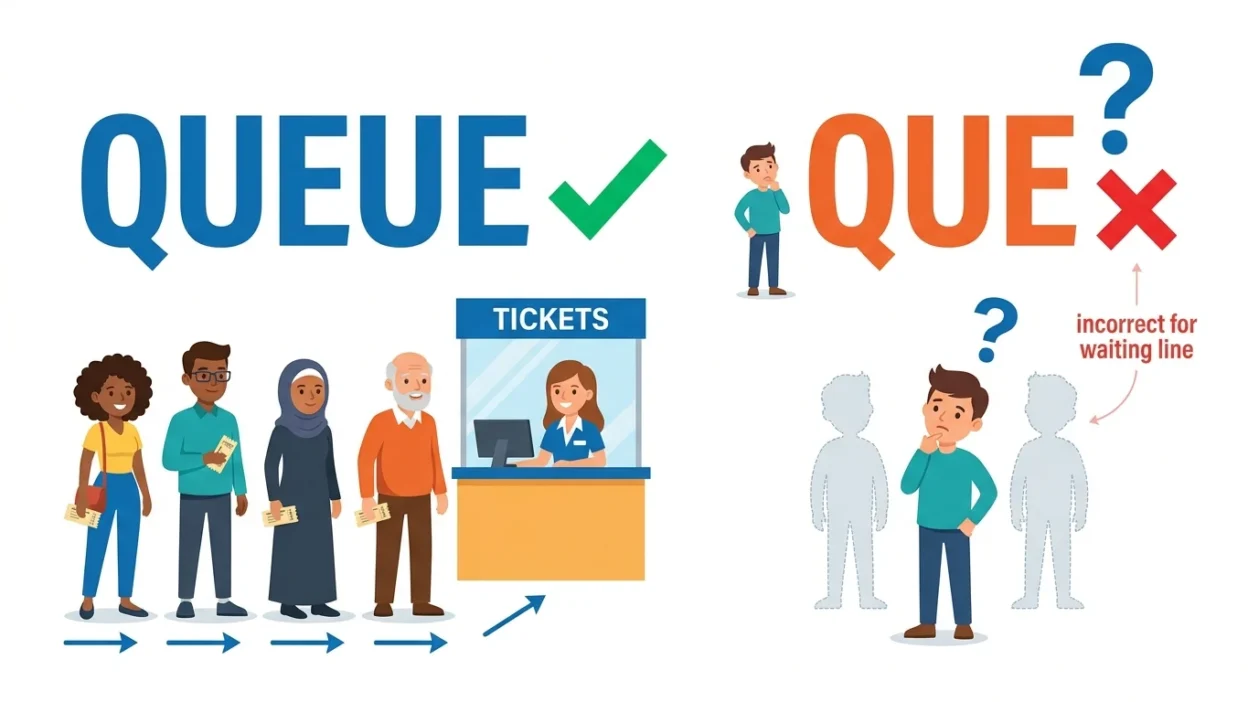
Many English learners and even native speakers get confused between queue and que because the words look very similar.
The confusion becomes even greater because queue has five letters but sounds almost the same as the letter Q. On the other hand, que appears in some languages and names, so people sometimes think it is another English spelling of the same word.
The good news is that the difference is very simple:
- Queue is an English word.
- Que is usually not an English word used in the same way.
Once you understand what each word means, it becomes easy to choose the correct one.
Quick Answer
- ✅ Queue = a line of people, vehicles, or items waiting for something.
- ✅ Queue can also mean placing something in a waiting list.
- ❌ Que is not the correct spelling when you mean a line or waiting list.
- ✅ Que is mainly found in Spanish, Portuguese, French expressions, names, and some informal uses.
- ✅ If you are talking about waiting in line, always use queue.
Example:
- Correct: We stood in a queue for tickets.
- Incorrect: We stood in a que for tickets.
Simple Origin or Background Explanation
The word queue came into English from French many years ago.
In French, it originally meant tail. Because a line of people looks a bit like a tail stretching behind something, the word later came to mean a line of people waiting.
Over time, English speakers started using queue for:
- People waiting in line
- Cars waiting in traffic
- Tasks waiting to be completed
- Computer processes waiting their turn
The word que has a different background.
In Spanish, que often means that, what, or which, depending on the sentence.
Because many people see the word in other languages, they sometimes accidentally use it instead of queue.
Clear Explanation of the Difference
The easiest way to remember the difference is to look at their meanings.
What Does “Queue” Mean?
Queue means a line of people or things waiting for their turn.
Examples:
- There was a long queue at the bank.
- We joined the queue for the bus.
- The customers waited in a queue.
It can also be used as a verb.
Examples:
- People queued outside the store.
- We queued for two hours.
- The system queued the requests.
What Does “Que” Mean?
Que is generally not used in standard English to mean a line.
You may see it:
- In Spanish sentences
- In French expressions
- In names and titles
- In informal online writing
Examples:
- ¿Que pasa? (Spanish phrase)
- Personal names containing “Que”
When discussing waiting lines, que is not the correct English word.
Comparison
| Feature | Queue | Que |
| Is it an English word? | Yes | Usually no |
| Meaning | A line or waiting list | Different meanings in other languages |
| Used for waiting in line? | Yes | No |
| Can be a verb? | Yes | No |
| Common in everyday English? | Yes | Mostly in foreign language contexts |
| Correct example | Join the queue. | Not correct for waiting lines |
Which One to Use and When
Choosing the correct word is simple once you know the situation.
Use “Queue” When
You are talking about:
- Waiting in line
- A list of tasks waiting to be completed
- Traffic waiting to move
- Computer jobs waiting their turn
Examples:
- The queue moved slowly.
- We joined the queue outside the stadium.
- My printer queue is full.
- Cars formed a queue on the highway.
Use “Que” When
You are:
- Writing in Spanish
- Quoting another language
- Referring to a name, title, or phrase that contains the word
Examples:
- The phrase contains the word “que.”
- It appears in a Spanish sentence.
For normal English writing about waiting lines, use queue.
Common Mistakes People Make
Many learners make the same mistakes when writing these words.
Mistake 1: Dropping the Extra Letters
Incorrect:
- I waited in a que.
Correct:
- I waited in a queue.
Many people hear the word and think it should be spelled que because the pronunciation is similar.
Mistake 2: Using “Que” in Business Writing
Incorrect:
- Your request has been added to the que.
Correct:
- Your request has been added to the queue.
Mistake 3: Forgetting That Queue Can Be a Verb
Correct examples:
- We queued for tickets.
- Hundreds of people queued outside.
Mistake 4: Mixing Languages
Sometimes people see que in another language and assume it works the same way in English.
Remember:
- English waiting line = queue
- Foreign language word = often que
Everyday Real Life Examples
Emails
Correct:
- Your application has been placed in the queue.
- We will review your request once it reaches the front of the queue.
Incorrect:
- Your application has been placed in the que.
News
Correct:
- Passengers waited in a long queue at the airport.
- Vehicles formed a queue after the accident.
Social Media
Correct:
- I’ve been in this queue for an hour!
- The queue is finally moving.
Incorrect:
- This que is taking forever.
Daily Use
Correct:
- Join the queue, please.
- The queue starts over there.
- We queued outside the restaurant.
- A queue formed quickly after the doors opened.
Short Learning Section for Students and Beginners
A helpful trick is to remember that queue has several extra letters waiting behind the first letter Q.
Think of it this way:
Q + ueue
The extra letters are standing in line behind the Q, just like people stand in a queue.
Easy Memory Tip
- Queue = waiting line
- Que = not the English word for waiting line
Practice Sentences
Choose the correct word:
- We stood in a _____ for tickets.
- The cars formed a long _____.
- My print _____ is full.
- She waited in a _____ at the bank.
Answers:
- queue
- queue
- queue
- queue
FAQ
Is “que” a correct English word?
Usually no. It is mainly found in other languages or specific names and expressions.
Is “queue” the same as a line?
Yes. A queue is a line of people or things waiting for their turn.
Why is “queue” spelled with so many letters?
The spelling comes from its historical development and French origins. Even though it looks long, it is pronounced like the letter Q.
Can “queue” be a verb?
Yes.
Examples:
- We queued outside.
- People queued for tickets.
Is “que” short for “queue”?
Not in standard English writing. You should write the full word queue.
What does a printer queue mean?
It is a list of print jobs waiting to be printed.
Which spelling should I use in formal writing?
Use queue whenever you mean a waiting line or waiting list.
How can I remember the correct spelling?
Think of the extra letters standing behind the Q in a line. That visual image can help you remember queue.
Conclusion
The difference between queue and que is actually very simple. Queue is the correct English word for a line of people, vehicles, tasks, or items waiting for their turn. It can also be used as a verb meaning to wait in line.
Que, on the other hand, is generally not the English word for a waiting line. It is most often seen in other languages, names, or special expressions.
Whenever you are talking about waiting in line, joining a waiting list, traffic backed up on a road, or tasks waiting to be completed, choose queue. Remembering this one rule will help you avoid the mistake every time.

Daniel Matthew is a language enthusiast, writer, and contributor at Meanefy.com, where he explores the meanings, origins, and nuances of words and phrases. With a deep passion for language, Daniel aims to make complex concepts simple, engaging, and easy to understand for readers of all ages.