
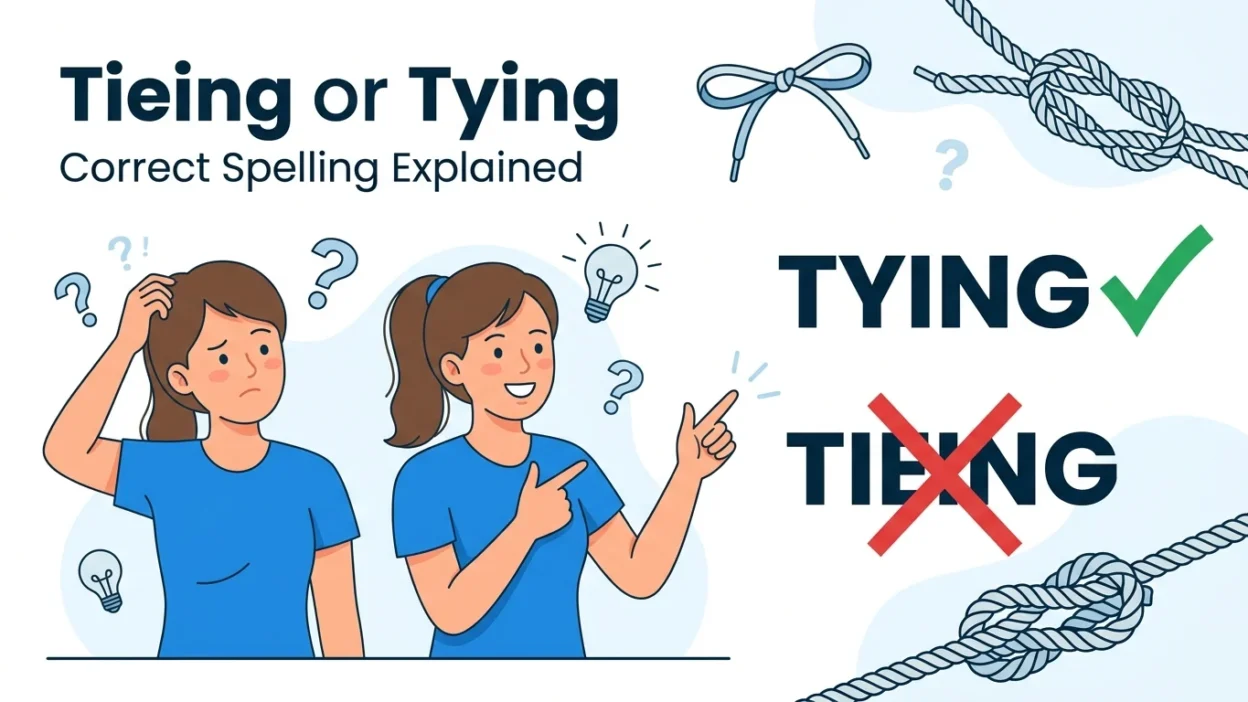
Many people are unsure whether they should write tieing or tying. The confusion happens because English spelling rules are not always simple. Usually, when a word ends with e, we remove the e before adding -ing. For example:
- make → making
- write → writing
- dance → dancing
So, some people naturally think that tie → tieing should be correct.
However, English has a special spelling rule for the word tie, which makes things a little different. That is why many students, writers, and English learners stop and wonder which form is right.
The good news is that the answer is actually very simple.
Quick Answer
- ✅ Tying is the correct spelling in modern English.
- ❌ Tieing is generally considered incorrect for the verb tie.
- Use tying when talking about fastening, connecting, or making a knot.
- Most dictionaries, schools, teachers, and style guides accept tying.
- If you want to be safe, always choose tying.
Examples:
- She is tying her shoes.
- I am tying the rope to the fence.
- They are tying the packages together.
Origin and Background
The word tie has been part of English for hundreds of years. It means to fasten something, connect things together, or make a knot.
When English speakers began adding -ing to the verb tie, they faced a small problem.
If they wrote tieing, it looked awkward and could be harder to read quickly. Over time, English settled on tying instead.
This spelling follows a pattern used by a few other English words that end with -ie.
For example:
- die → dying
- lie → lying
- tie → tying
Instead of simply adding -ing, the ie changes to y before -ing is added.
This became the accepted standard spelling.
The Difference Between Tieing and Tying
The difference is very straightforward.
Tying
Tying is the correct present participle and gerund form of the verb tie.
It means:
- Making a knot
- Fastening something
- Connecting things together
- Securing an object
Examples:
- He is tying a knot.
- We are tying the balloons together.
- She spends time tying ribbons on gifts.
Tieing
Tieing is usually considered a spelling mistake when used as the -ing form of tie.
Most modern English dictionaries and grammar guides do not recommend it.
Incorrect examples:
- ❌ She is tieing her shoes.
- ❌ We are tieing the rope.
Correct versions:
- ✅ She is tying her shoes.
- ✅ We are tying the rope.
Comparison Table
| Feature | Tying | Tieing |
| Correct modern spelling | Yes | No |
| Accepted in schools | Yes | Usually no |
| Found in dictionaries | Yes | Rarely as a standard form |
| Used in everyday writing | Yes | No |
| Recommended for students | Yes | No |
| Safe to use in emails and reports | Yes | No |
Which One to Use and When
Always use tying when you need the -ing form of tie.
Use “tying” when talking about knots
Examples:
- I am tying my shoelaces.
- She is tying a ribbon around the box.
Use “tying” when fastening objects
Examples:
- They are tying the boat to the dock.
- We are tying the bags shut.
Use “tying” in figurative meanings
Sometimes tie does not refer to a real knot.
Examples:
- The company is tying its success to customer service.
- The story is tying all the ideas together.
Avoid “tieing”
In modern writing, there is almost never a reason to choose tieing instead of tying.
Common Mistakes People Make
Many learners make similar mistakes when writing tying.
Following the wrong spelling rule
Some people think:
- tie + ing = tieing
This seems logical, but English treats tie differently.
- tie → tying
Copying incorrect online writing
Sometimes spelling mistakes appear on social media, forums, or comments.
Seeing a word many times does not make it correct.
Mixing up similar words
People sometimes confuse these patterns:
| Base Word | Correct -ing Form |
| tie | tying |
| die | dying |
| lie | lying |
| make | making |
| write | writing |
Notice that words ending in ie often change ie to y before adding -ing.
Not proofreading
Many spelling errors happen simply because people type quickly and do not check their work before sending it.
Everyday Real Life Examples
Emails
Correct:
- I am tying up a few loose ends before the meeting.
- We are tying the final details together.
Incorrect:
- ❌ I am tieing up a few loose ends.
News Writing
Correct:
- Workers were tying safety ropes around the equipment.
- Volunteers spent the day tying packages for delivery.
Social Media
Correct:
- Just finished tying my hiking boots.
- My daughter is learning how to start tying her own shoes.
Daily Conversations
Correct:
- He is tying the dog to a post.
- She is tying a scarf around her neck.
- We are tying the decorations together.
Learning Section for Students and Beginners
A simple trick can help you remember the correct spelling.
Remember the “ie to y” rule
For some words ending in ie, change ie to y before adding -ing.
| Word | -ing Form |
| tie | tying |
| die | dying |
| lie | lying |
Memory Tip
Think:
Tie → Tying
The letters ie become y.
This small change makes the word easier to read and follows standard English spelling.
Practice Sentences
Fill in the blank:
- She is _____ her shoes.
- We are _____ the rope securely.
- They are _____ balloons to the fence.
Answers:
- tying
- tying
- tying
FAQ
Is tying the correct spelling?
Yes. Tying is the correct spelling of the -ing form of tie.
Is tieing a real word?
It occasionally appears in writing, but it is generally considered incorrect for the verb tie in modern English.
Why does tie become tying?
Words ending in ie often change ie to y before adding -ing.
Is tying used in British English?
Yes. Tying is correct in both British and American English.
Is tying used in American English?
Yes. American English uses tying as the standard spelling.
How do I remember the spelling?
Remember this pattern:
- die → dying
- lie → lying
- tie → tying
Can I use tieing in school assignments?
No. Teachers generally expect the standard spelling tying.
Which spelling should English learners use?
English learners should always use tying because it is the accepted and recommended form.
Conclusion
The confusion between tieing and tying is common, especially for students and English learners. Even though tieing may seem logical at first, tying is the correct modern spelling.
A simple rule makes it easy to remember: when tie takes -ing, the ie changes to y, creating tying.
So whenever you are talking about fastening, connecting, or making a knot, use tying with confidence. It is the spelling accepted in everyday English, schools, professional writing, and formal communication.

Anthony Charles is the founder and lead content creator at Meanefy.com, a platform dedicated to exploring word meanings, language nuances, and everyday curiosities. With a passion for language and a keen eye for detail, Anthony aims to make complex words and concepts simple and accessible for readers around the world.