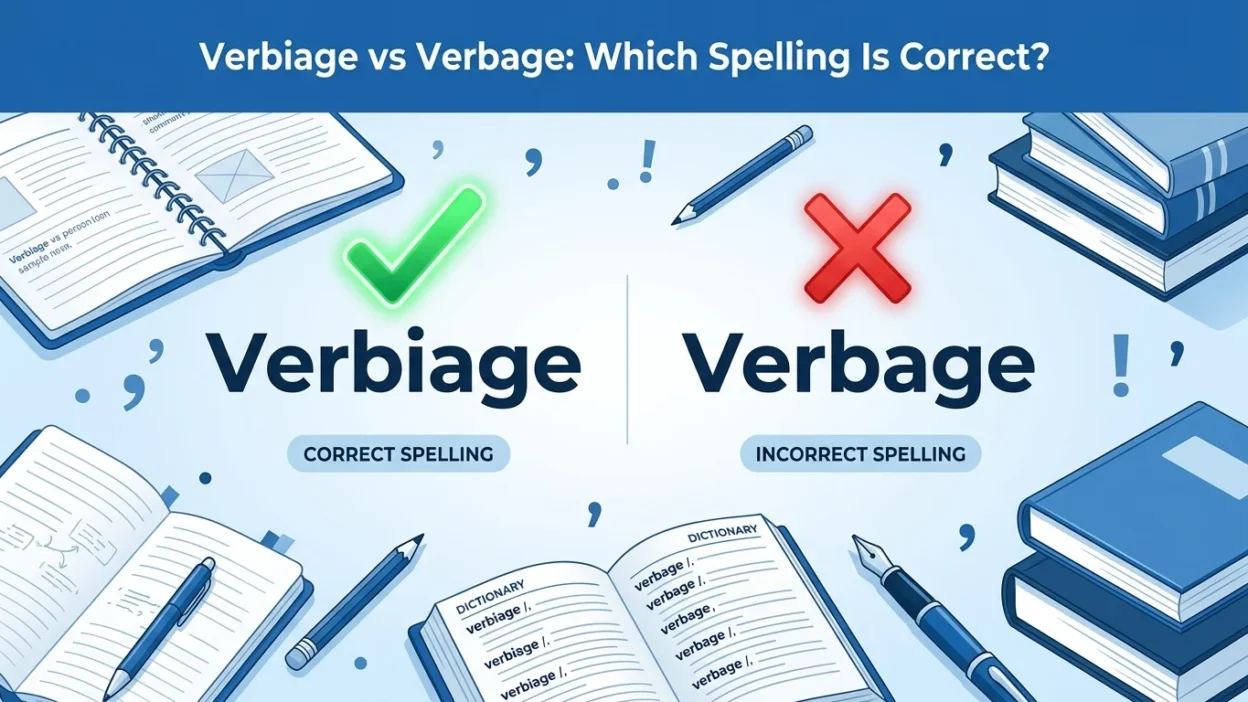
Many English learners and even native speakers get confused between verbiage and verbage because both words look very similar. You may see both spellings online, in social media posts, emails, and even in some published writing.
The confusion happens because people often assume that verbage is a shorter or simpler spelling of verbiage. However, the two forms are not treated equally in standard English.
If you have ever wondered which one is correct, this guide will explain everything in very simple language.
Quick Answer
- Verbiage is the standard and widely accepted spelling.
- Verbage is usually considered a misspelling or nonstandard spelling.
- In formal writing, always use verbiage.
- Most dictionaries recognize verbiage as the correct form.
- If you want to avoid mistakes, choose verbiage every time.
Simple Example
✅ The contract contains too much verbiage.
❌ The contract contains too much verbage.
Origin and Background
The word verbiage has been part of English for a long time.
It comes from a word that is related to the idea of words and language. Over time, English speakers began using verbiage to describe a large amount of words, especially when more words are used than necessary.
Originally, the word often had a negative meaning. It described writing or speech that was too long, wordy, or difficult because of unnecessary words.
Today, many people still use it in this way.
The spelling verbage likely appeared because people heard the word spoken and then wrote it the way it sounded. Since the ending sounds similar to many English words ending in “-age,” some writers dropped the letter “i.
However, standard English kept the spelling verbiage.
Difference Between Verbiage and Verbage
The biggest difference is simple:
Verbiage
This is the accepted dictionary spelling.
It is the spelling used in:
- Schools
- Books
- Newspapers
- Business writing
- Academic writing
- Professional communication
Verbage
This spelling is usually considered incorrect or nonstandard.
Some people use it accidentally because it sounds similar to verbiage when spoken aloud.
Many teachers, editors, and employers may view it as a spelling mistake.
Easy Rule to Remember
If you are writing anything important, use verbiage.
Avoid verbage.
Comparison Table
| Feature | Verbiage | Verbage |
| Standard English spelling | Yes | No |
| Found in major dictionaries | Yes | Rarely or as a variant |
| Suitable for formal writing | Yes | No |
| Commonly accepted | Yes | No |
| Recommended for students | Yes | No |
| Safe to use in professional writing | Yes | No |
Which One to Use and When
The answer is simple: use verbiage in all situations.
In School Assignments
Use verbiage.
Example:
“The article contains unnecessary verbiage.”
In Business Emails
Use verbiage.
Example:
“Please reduce the verbiage and make the message shorter.”
In Reports
Use verbiage.
Example:
“The report has too much verbiage and needs editing.”
In Everyday Writing
Use verbiage.
Example:
“I like simple language without extra verbiage.”
Should You Ever Use Verbage?
In most cases, no.
Because many readers see it as a spelling mistake, it is safer to avoid it completely.
Common Mistakes People Make
Thinking Both Spellings Are Equal
Many people believe verbiage and verbage are interchangeable.
This is not true in standard English.
Using Verbage in Professional Writing
A resume, cover letter, report, or business email should not contain verbage.
Using the standard spelling looks more professional.
Assuming Verbiage Always Means “Words”
The word often suggests too many words, not just words in general.
Example:
“The speech was full of verbiage.”
This suggests the speech used more words than necessary.
Misspelling Because of Pronunciation
People often hear the word spoken and write:
- verbage
instead of:
- verbiage
This is one of the most common spelling errors.
Everyday Real Life Examples
Emails
✅ Your email contains unnecessary verbiage.
✅ Please remove some of the verbiage and make the message clearer.
❌ Your email contains unnecessary verbage.
News Writing
✅ Reporters try to avoid excessive verbiage.
✅ Good news articles use clear language rather than unnecessary verbiage.
Social Media
✅ Too much verbiage can make posts difficult to read.
✅ Short posts often perform better than posts filled with verbiage.
Daily Conversations
✅ His explanation included a lot of verbiage.
✅ The teacher asked students to remove unnecessary verbiage from their essays.
Workplace Communication
✅ The manager requested less verbiage in future reports.
✅ Clear communication is better than excessive verbiage.
Learning Section for Students and Beginners
Here is an easy way to remember the correct spelling.
Memory Trick
Think of the word:
verb + iage = verbiage
Notice the letter i in the middle.
That i belongs there.
Quick Practice
Which sentence is correct?
A. The document contains too much verbage.
B. The document contains too much verbiage.
Answer:
✅ B. The document contains too much verbiage.
Fill in the Blank
“The lawyer reduced the unnecessary ________ in the contract.”
Answer:
✅ verbiage
One Minute Rule
Whenever you are unsure:
- Choose verbiage
- Avoid verbage
You will almost always be correct.
Frequently Asked Questions
Is verbage a real word?
Some people use it, and some dictionaries may mention it as a variant spelling. However, it is generally considered nonstandard. Most writers should avoid it.
Which spelling is correct: verbiage or verbage?
Verbiage is the correct and accepted spelling in standard English.
Can I use verbage in formal writing?
It is not recommended. Use verbiage instead.
What does verbiage mean?
It usually means an excessive amount of words or language, especially when some words are unnecessary.
Why do people spell it as verbage?
Many people write the word based on how it sounds when spoken, which leads to the incorrect spelling.
Do teachers consider verbage a mistake?
Many teachers and editors do consider it a spelling error and prefer verbiage.
Is verbiage always negative?
Not always, but it often suggests that too many words are being used.
How can I remember the correct spelling?
Remember that the standard spelling includes the letter i:
verbiage
Conclusion
The confusion between verbiage and verbage is very common, but the answer is straightforward. Verbiage is the standard, accepted spelling used in schools, workplaces, books, and professional writing. Verbage is generally viewed as a misspelling or nonstandard form.
If you want your writing to look correct and professional, always choose verbiage. A simple rule to remember is: when in doubt, keep the “i” and write verbiage. This choice will help you avoid mistakes and communicate more clearly in every situation.

Steven Mark is a writer, researcher, and contributor at Meanefy.com, a platform dedicated to exploring word meanings, language nuances, and everyday linguistic curiosities. With a passion for words and clear communication, Steven focuses on making language simple, engaging, and accessible to all readers.