Many learners feel confused about “wore” and “worn.” Both words come from the same verb, and both talk about the past. Because of this, they look very similar and are easy to mix up.
But don’t worry. This guide will explain everything in very simple English. After reading this, you will clearly understand when to use wore and when to use worn, and you will feel more confident using them in real life.
Quick Answer
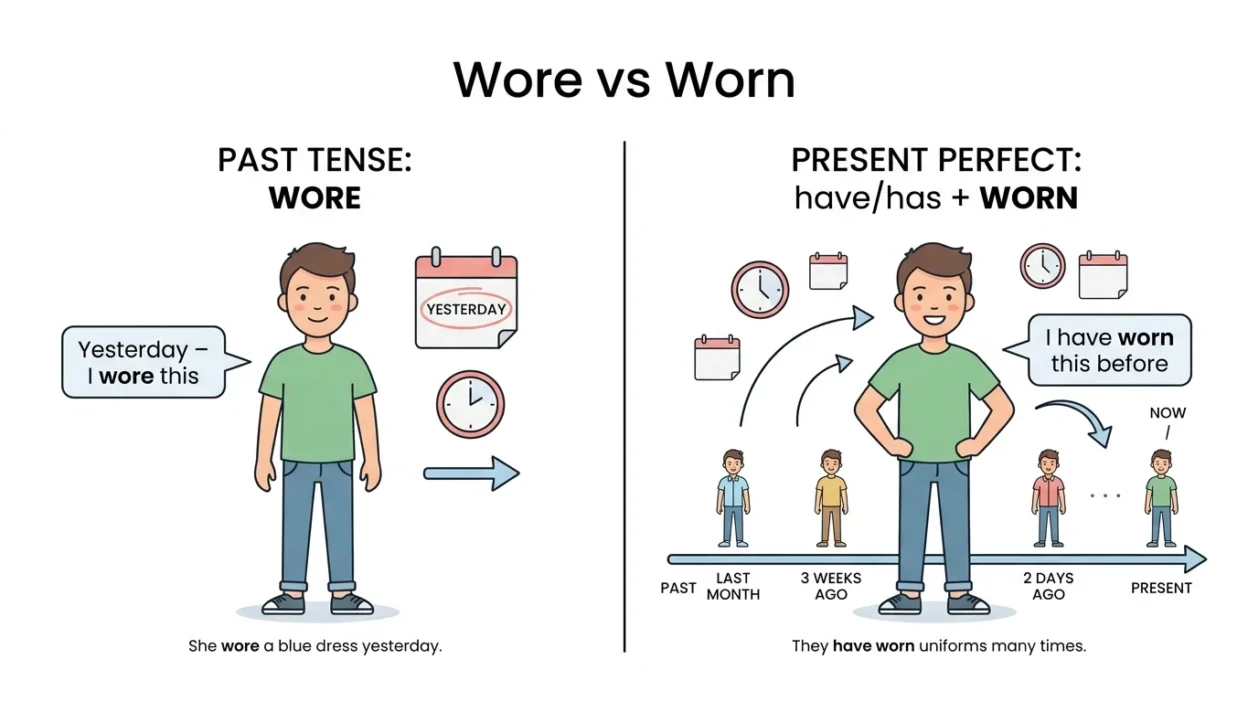
- Wore = simple past (used alone)
- Example: I wore a blue shirt yesterday.
- Worn = past participle (used with helping verbs)
- Example: I have worn that shirt before.
- Use wore when talking about a finished action in the past.
- Use worn with words like has, have, had, was, were.
Simple Background
The base verb is wear, which means to have clothes, shoes, or accessories on your body.
Here are its main forms:
- Present: wear
- Past: wore
- Past participle: worn
English verbs often change form when talking about the past. Some verbs are regular (they end in ed), but wear is an irregular verb. That’s why it changes to wore and worn instead of something like weared.
The Difference Between Wore and Worn
Let’s make it very clear.
What is “Wore”?
Wore is the simple past form of wear.
It is used when the action happened in the past and is finished.
- It does not need a helping verb.
- It usually comes with a time word like yesterday, last week, or this morning.
Examples:
- I wore a jacket yesterday.
- She wore red shoes at the party.
- They wore uniforms at school.
What is “Worn”?
Worn is the past participle form.
It cannot be used alone. It must be used with a helping verb.
Common helping verbs:
- has
- have
- had
- was
- were
Examples:
- I have worn this dress before.
- He had worn that coat many times.
- The shoes were worn by the actor.
Comparison
| Feature | Wore | Worn |
| Verb form | Simple past | Past participle |
| Needs helper | No | Yes |
| Time focus | Finished past action | Connected to another verb |
| Example | I wore a hat yesterday | I have worn that hat before |
| Sentence type | Simple sentence | Perfect or passive sentence |
Which One to Use and When
Here is a simple way to decide:
Use “Wore” when:
- You talk about a completed action in the past
- There is no helping verb
- You mention a specific time
Examples:
- I wore black shoes yesterday.
- She wore a beautiful dress last night.
- We wore masks during the event.
Use “Worn” when:
- You use has, have, or had
- You are making a perfect tense sentence
- You are using a passive voice sentence
Examples:
- I have worn this shirt many times.
- He has worn glasses since childhood.
- The costume was worn by the actor.
Common Mistakes People Make
Learning from mistakes is very helpful. Here are some common errors:
Using “worn” without a helper
❌ I worn a jacket yesterday.
✔ I wore a jacket yesterday.
Using “wore” with “has/have”
❌ I have wore this before.
✔ I have worn this before.
Mixing both forms in one sentence
❌ She has wore and worn many styles.
✔ She has worn many styles.
Forgetting the helping verb
❌ He worn a suit at the party.
✔ He wore a suit at the party.
✔ He has worn a suit before.
Everyday Real Life Examples
In Emails
- I wore formal clothes to the meeting yesterday.
- I have worn this outfit in previous events.
In Social Media
- She wore a stunning dress last night!
- I have worn this hoodie for years.
In Daily Conversations
- What did you wear?
→ I wore a white shirt. - Have you worn this before?
→ Yes, I have worn it twice.
In News or Reports
- The singer wore a unique costume during the show.
- The uniform has been worn by players for decades.
Learning Tips for Students and Beginners
Here are some easy tips to remember:
Think of time
- Wore = past time (yesterday, last week)
- Worn = used with “has/have/had”
Look for helping verbs
If you see:
- has
- have
- had
Then use worn, not wore
Practice simple sentences
Try making your own:
- I wore…
- She has worn…
- They had worn…
Practice helps your brain remember the correct form.
Speak out loud
Say sentences like:
- I wore a jacket.
- I have worn a jacket.
Hearing yourself helps you learn faster.
FAQ
What is the main difference between wore and worn?
Wore is used alone for past actions. Worn is used with helping verbs like has or have.
Can I use “worn” without “has” or “have”?
No. You need a helping verb with worn.
Is this correct: “I have wore a hat”?
No. The correct sentence is: I have worn a hat.
Is “wore” present or past?
Wore is past tense.
Is “worn” past or present?
Worn is a past participle. It works with helping verbs.
Can both be used in the same sentence?
Yes, but carefully:
- I wore a jacket, and I have worn it many times.
Which one is easier to use?
Wore is easier because it does not need a helper.
How can I remember the difference?
Think:
- Wore = yesterday
- Worn = has/have/had
Conclusion
Understanding wore and worn is easier than it seems. The key is to remember their roles:
- Wore is used for simple past actions.
- Worn is used with helping verbs like has, have, and had.
With a little practice, you will start using them correctly without even thinking. Keep making simple sentences, speak them out loud, and notice how they are used in real life.
Soon, this confusion will disappear completely.

Anthony Charles is the founder and lead content creator at Meanefy.com, a platform dedicated to exploring word meanings, language nuances, and everyday curiosities. With a passion for language and a keen eye for detail, Anthony aims to make complex words and concepts simple and accessible for readers around the world.