Many learners feel confused about lose and lost because they look similar and come from the same word.
The only difference is a small change in spelling, but the meaning and use are not the same. This small change can cause big mistakes in speaking and writing.
The good news is that once you understand one simple idea, the confusion will disappear.
Quick Answer
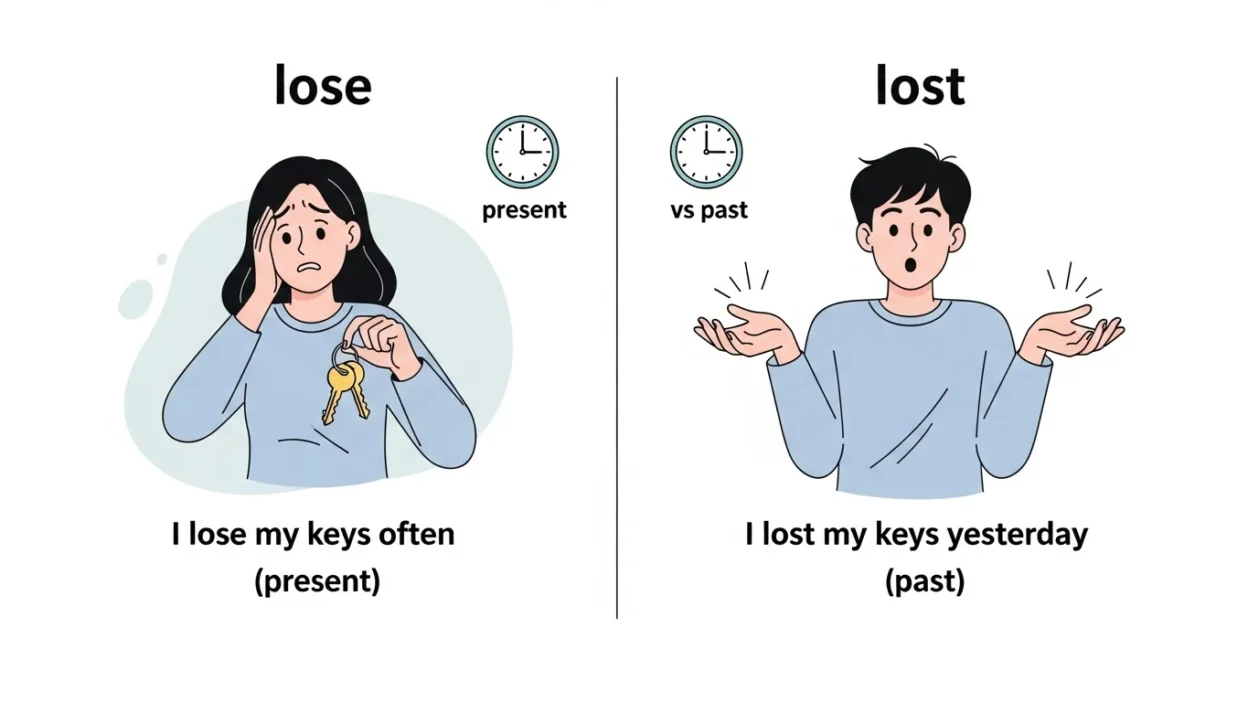
- Lose = present tense (happening now or regularly)
- Lost = past tense (already happened)
Example:
- I lose my keys often. (present habit)
- I lost my keys yesterday. (past action)
Simple Background
Both lose and lost come from the same base verb: lose.
In English, many verbs change form when we talk about the past.
- Some verbs add -ed (like walk → walked)
- But lose is an irregular verb, so it changes differently:
- lose → lost
This is why the two words look different.
Clear Explanation of the Difference
The difference is mainly about time.
Lose (Present)
Use lose when:
- Talking about now
- Talking about habits or general facts
- Talking about future situations
Examples:
- I always lose my phone.
- Don’t lose your ticket.
- If you don’t study, you will lose marks.
Lost (Past)
Use lost when:
- Something already happened
- You are talking about the past
Examples:
- I lost my phone yesterday.
- She lost her bag at the market.
- They lost the game last night.
Comparison
| Word | Type | Time | Example Sentence |
| Lose | Verb | Present | I don’t want to lose this chance. |
| Lost | Verb (past) | Past | I lost my wallet yesterday. |
Which One to Use and When
Use lose if:
- The action is happening now
- The action happens regularly
- The action will happen in the future
Use lost if:
- The action already happened
- You are talking about yesterday, last week, or any past time
Simple Tip:
If your sentence has words like yesterday, last night, ago, use lost.
Common Mistakes People Make
Using “lose” for the past
❌ I lose my keys yesterday.
✔ I lost my keys yesterday.
Mixing spelling with “loose”
❌ I don’t want to loose this game.
✔ I don’t want to lose this game.
Note:
- Lose = not keep something
- Loose = not tight
Using “lost” for present habits
❌ I always lost my phone.
✔ I always lose my phone.
Forgetting verb tense
❌ She lose her bag last week.
✔ She lost her bag last week.
Everyday Real Life Examples
In Emails
- I’m sorry, I lost your message. Can you send it again?
- Please don’t lose this document.
In News
- The team lost the match last night.
- Many people lose jobs during economic problems.
On Social Media
- I always lose my charger 😅
- I just lost my wallet! So stressful!
In Daily Conversation
- Don’t lose your keys again.
- I lost my phone at the mall.
- If you rush, you might lose something.
Learning Section for Students and Beginners
Here is an easy way to remember:
👉 Lose = Now
👉 Lost = Before (Past)
Try this simple practice:
Fill in the blanks:
- I ______ my bag yesterday.
- Don’t ______ your phone.
- She ______ her keys last night.
- I always ______ my pen.
Answers:
- lost
- lose
- lost
- lose
Mini Practice Tip
Ask yourself:
“Did this already happen?”
- Yes → use lost
- No → use lose
FAQ Section
What is the main difference between lose and lost?
Lose is present tense. Lost is past tense.
Can I use “lose” for yesterday?
No. Use lost for yesterday or any past time.
Is “lost” always past tense?
Yes, lost is the past form of lose.
What is the difference between lose and loose?
- Lose = to not keep something
- Loose = not tight
Can “lose” be used in future sentences?
Yes.
Example: You might lose your chance.
Why is “lose” confusing?
Because its past form (lost) changes completely and does not follow the usual “-ed” rule.
Is “lost” only used for things?
No. It can be used for:
- Objects: I lost my phone
- Games: We lost the match
- Direction: I got lost
How can I remember the difference easily?
Think:
- Lose = present
- Lost = past
Conclusion
The difference between lose and lost is simple once you focus on time.
- Use lose for present or future situations
- Use lost for past situations
This small change helps your English sound clear and correct. With a little practice, you will stop making mistakes and use both words naturally in everyday life.