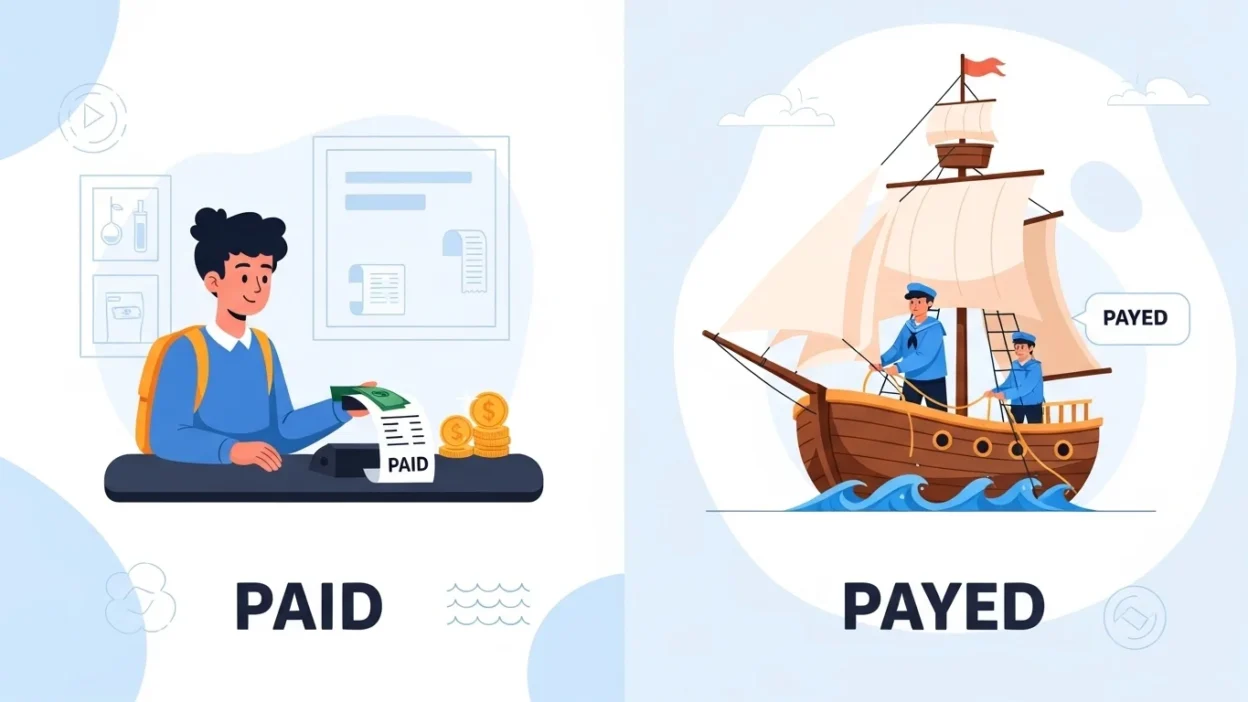
Many English learners get confused when they see the words “paid” and “payed.” They look almost the same, so people often think they are just different spellings of the same word. This confusion is very common, especially for students and learners.
The truth is simple: only one of them is correct in most situations. The other is very rare and used only in special cases. If you use the wrong one, your sentence may look incorrect to native speakers.
In this article, you will clearly understand the difference in very simple English. After reading, you will never mix them up again.
Quick Answer
Here is the simple truth in short points:
- Paid is the correct past tense of the verb pay in almost all situations.
- Paid is used when talking about money, bills, salaries, shopping, or services.
- Payed is rarely correct and is used only in very special situations related to boats or sealing something (old or technical use).
- In everyday English, always use “paid.”
- If you are unsure, choose paid—it is correct 99.9% of the time.
Simple Background of the Words
The word pay is a verb. It means to give money for something or to settle a cost.
In English, many verbs change in the past tense. Some follow normal rules like:
- play → played
- work → worked
But pay is irregular, which means it does not follow the normal rule.
Instead of becoming “payed,” it becomes:
- pay → paid
The form “payed” still exists in very old English and in a few special technical uses, but it is not used in daily life.
Clear Explanation of the Difference
Paid (Normal and Correct Use)
Paid is the standard past tense and past participle of “pay.”
You use it when talking about:
- Money you give for goods or services
- Bills or rent
- Salaries or wages
- Online purchases
- Fees or fines
Examples:
- I paid the electricity bill yesterday.
- She paid for the tickets online.
- They have paid their rent.
This is the word you will see everywhere in modern English.
Payed (Rare and Special Use)
Payed is NOT used in normal money situations.
It is used in very limited and old contexts, especially:
- Sailing or boats
- Sealing cracks in ships with special material
Examples (rare):
- The sailor payed the rope to prevent slipping.
- The crew payed the deck with tar.
Most English speakers never use this word in daily life. Many people go their entire lives without seeing it.
Easy Comparison
| Feature | Paid | Payed (Rare Use) |
| Meaning | Money or cost payment | Sealing or nautical action |
| Usage | Everyday English | Very old / technical English |
| Common in speaking | Yes | No |
| Common in writing | Yes | Very rare |
| Correct for bills | Yes | No |
| Example | I paid the bill | The sailor payed the rope |
When to Use Paid or Payed
To make things very simple:
Use “paid” when talking about:
- Shopping
- Restaurants
- School fees
- Rent or house payments
- Online orders
- Work salary
- Loans or debts
If money is involved, always use “paid.”
Use “payed” only when:
- You are reading old books about sailing
- You are talking about ships or boats
- You are discussing very technical maritime work
For almost everyone, this situation never appears in daily English.
Common Mistakes People Make
Many learners make small but important mistakes with these words. Here are the most common ones:
Using “payed” for money
❌ I payed the rent.
✔ I paid the rent.
Thinking both forms are equal
Some learners think both are correct. This is not true in modern English.
Overthinking spelling rules
Many people try to follow regular grammar rules:
- play → played
- stay → stayed
So they guess: - pay → payed (wrong in normal use)
But “pay” is irregular, so it becomes paid, not “payed.”
Using “payed” in emails or exams
This can make writing look incorrect or unnatural.
Everyday Real Life Examples
Let’s see how “paid” is used in daily life.
School Example
- I paid my school fee yesterday.
- She has already paid for the exam form.
Work Example
- The company paid the workers on time.
- He was paid weekly.
Shopping Example
- We paid for the clothes at the mall.
- They paid online using a card.
Social Media Example
- “Just paid my electricity bill 😩”
- “Finally paid off my phone!”
Email Example
- I have paid the invoice as requested.
- Please confirm that the fee has been paid.
In all of these situations, “paid” is the correct word.
Learning Section for Beginners
If you are learning English, here is a simple trick to remember:
Memory Trick
👉 Think: Money = Paid
Whenever you see money or payment, remember “paid.”
Simple Rule
- If you are unsure, always choose paid
- “Payed” is only for ships and old language
Practice Tip
Try making your own sentences:
- I paid for ___
- She paid for ___
- They paid for ___
Practice helps your brain remember faster.
Frequently Asked Questions
Is “payed” correct English?
Yes, but only in very rare and old nautical contexts. In normal English, it is not used.
Can I use “payed” for money?
No. For money, the correct word is always paid.
Why is “paid” irregular?
English has many irregular verbs that do not follow normal rules. “Pay” is one of them.
Which word is used in exams?
In almost all exams, paid is correct. “Payed” is usually considered wrong unless the question is about rare usage.
Do native speakers ever use “payed”?
Almost never in daily life. Most native speakers only use “paid.”
What is the easiest way to remember the difference?
Just remember:
Paid = everyday English
Payed = ships (rare and old)
Is it okay if I accidentally write “payed”?
Yes, it is a common mistake for learners, but it is better to correct it to “paid.”
Why do two spellings exist?
Because English has changed over time. “Payed” is an old form that stayed only in very specific uses.
Conclusion
The difference between paid and payed is actually very simple once you understand it.
- Paid is the correct and normal word used in almost all situations.
- Payed is very rare and only used in old or technical nautical language.
If you remember just one rule, remember this:
👉 Money situations always use “paid.”
Now you can confidently write emails, homework, messages, and daily English without confusion.

Daniel Matthew is a language enthusiast, writer, and contributor at Meanefy.com, where he explores the meanings, origins, and nuances of words and phrases. With a deep passion for language, Daniel aims to make complex concepts simple, engaging, and easy to understand for readers of all ages.