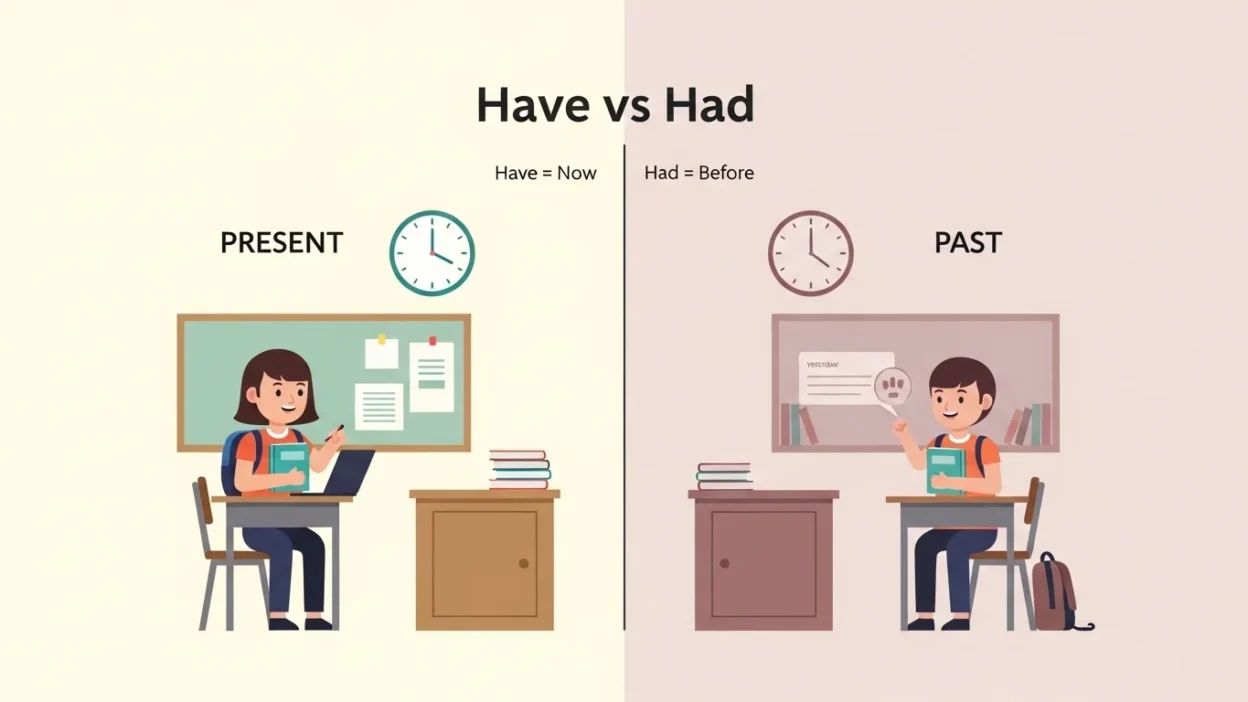
Many English learners feel confused when they see the words “have” and “had.” These two words look very similar, but they are used in different situations. Sometimes people mix them up and say the wrong one, especially when they are speaking quickly.
The good news is that the difference is actually very simple. Once you understand the basic idea of present time vs past time, you will never feel confused again.
This article will explain everything in very easy English with examples, so you can understand it on your first reading.
Quick Answer
Here is the simplest way to understand the difference:
- Have is used for the present time (now)
- Had is used for the past time (before now)
- Both words show possession or actions
- “Have” becomes “had” when we talk about the past
- “Had” is always connected to something that already happened
Example:
- I have a book (now)
- I had a book (before, in the past)
Simple Background
The words “have” and “had” come from basic English grammar rules about time.
English divides time into three main parts:
- Present (now)
- Past (before now)
- Future (later)
“Have” belongs mostly to the present time. It shows something you own, feel, or experience right now.
“Had” belongs to the past time. It shows something you owned, felt, or experienced before now.
This rule has been used in English for a very long time. It helps speakers clearly show when something happens.
Clear Explanation of the Difference
Let’s make it very simple:
Have (Present)
We use have when we talk about now.
It can show:
- Something you own now
- Something you do regularly
- Something you experience in the present
Examples:
- I have a phone.
- She has a car.
- We have homework today.
- They have time right now.
Remember:
- “Have” is alive in the present moment.
Had (Past)
We use had when we talk about the past.
It shows:
- Something you owned before
- Something you did before
- Something you experienced earlier
Examples:
- I had a phone last year.
- She had a bike when she was a child.
- We had homework yesterday.
- They had time before the meeting.
Remember:
- “Had” is a memory word. It talks about something finished.
Comparison
| Have | Had |
| Used for present time | Used for past time |
| Shows now | Shows before now |
| I have a pen | I had a pen |
| She has a house | She had a house |
| We have work today | We had work yesterday |
| Action is ongoing or current | Action is finished |
This table shows one very important idea:
- “Have” = now
- “Had” = before
Which One to Use and When
To choose the correct word, ask yourself one simple question:
Am I talking about now or the past?
Use “have” when:
- The situation is happening now
- You still own something
- The time is today or present
Examples:
- I have a headache now.
- They have exams this week.
- She has a new dress.
Use “had” when:
- The situation is finished
- You are talking about a memory
- The time is yesterday, last year, or before
Examples:
- I had a headache yesterday.
- They had exams last week.
- She had a new dress last year.
Common Mistakes People Make
Many learners make small mistakes with “have” and “had.” Here are the most common ones:
Mixing present and past
Wrong:
- I have a car yesterday.
Correct:
- I had a car yesterday.
Using “had” for present time
Wrong:
- She had a phone now.
Correct:
- She has a phone now.
Forgetting time words
Sometimes people forget to check time words like:
- now
- today
- yesterday
- last week
- last year
These words are very important because they help you choose correctly.
Using both words incorrectly together
Wrong:
- I have had a book yesterday.
Correct:
- I had a book yesterday.
(“Have had” is a special form, but beginners should not worry about it for now.)
Everyday Real Life Examples
Let’s see how native speakers use these words in daily life.
At school
- I have homework today.
- I had homework yesterday.
At home
- We have dinner now.
- We had dinner earlier.
Talking with friends
- I have a new game on my phone.
- I had that game last year.
Social media style
- I have a great day today!
- I had an amazing trip last weekend!
Emails or messages
- I have a meeting today at 3 PM.
- I had a meeting yesterday.
These examples show how simple the difference is in real life.
Learning Section for Beginners
If you are a beginner, follow this easy method:
Step one: Check time
Ask yourself:
- Is it now? → use have
- Is it before? → use had
Step two: Look for time words
- now, today → have
- yesterday, last week → had
Step three: Practice daily
Try making 5 sentences every day:
- 2 with “have”
- 2 with “had”
- 1 mixed sentence
Step four: Speak slowly
When speaking English, slow down and think:
- present or past?
This simple habit will improve your grammar very fast.
FAQ Section
What is the main difference between have and had?
“Have” is used for present time, and “had” is used for past time.
Can I use have and had in the same sentence?
Yes, but it is more advanced grammar. Beginners should first learn them separately.
Is “had” only used for possession?
No, “had” is used for possession, actions, and experiences in the past.
Why do people get confused with have and had?
Because they look similar and both are very common in English.
Can “have” change into “had”?
Yes, when you move from present to past, “have” becomes “had.”
Is “has” related to have and had?
Yes, “has” is another present form used with he, she, or it.
What is the easiest way to remember?
Remember this simple rule:
- have = now
- had = before
Conclusion
The difference between have and had is very simple once you understand time in English.
- “Have” is used for present situations.
- “Had” is used for past situations.
If you always think about “now” and “before,” you will never get confused again.
With practice, you will start using both words naturally in speaking and writing. Keep it simple, think about time, and your English will become much clearer every day.

Anthony Charles is the founder and lead content creator at Meanefy.com, a platform dedicated to exploring word meanings, language nuances, and everyday curiosities. With a passion for language and a keen eye for detail, Anthony aims to make complex words and concepts simple and accessible for readers around the world.