The topic of Blond vs Blonde is often confused because both words look almost identical in writing, speech, and pronunciation, but their meaning changes slightly based on gender and usage in American English and British English.
In traditional French grammar rules, the word comes from Old French blund, showing historical influence and linguistic evolution, where masculine and feminine endings were used differently. In modern style guides like the AP Stylebook and Chicago Manual of Style, this adjective gendering is still discussed, especially in context based writing, such as a novel, caption, or descriptive reference.
In simple terms, the Meaning of Blond/Blonde refers to light yellow color hair, often described as golden toned, light brown, or even platinum shades. A blond man, boy, or actor may have natural curls, or be a surfer, athlete, or student, while a blonde woman, girl, singer, model, or teacher is often shown in modern writing look as part of fashion, beauty, or pop culture personality.
Writers often face a mistake or incorrect usage issue, but correct grammar feature depends on context based guide, audience, and consistency in structure. I’ve personally noticed in editing dissertations, essays, and theses that even experienced writers mix blond/blonde usage, especially in English grammar variation where rules feel less strict due to modern simplification trends and increasing language neutrality.
Quick Answer: What Is the Difference?
Here is the simplest way to understand it:
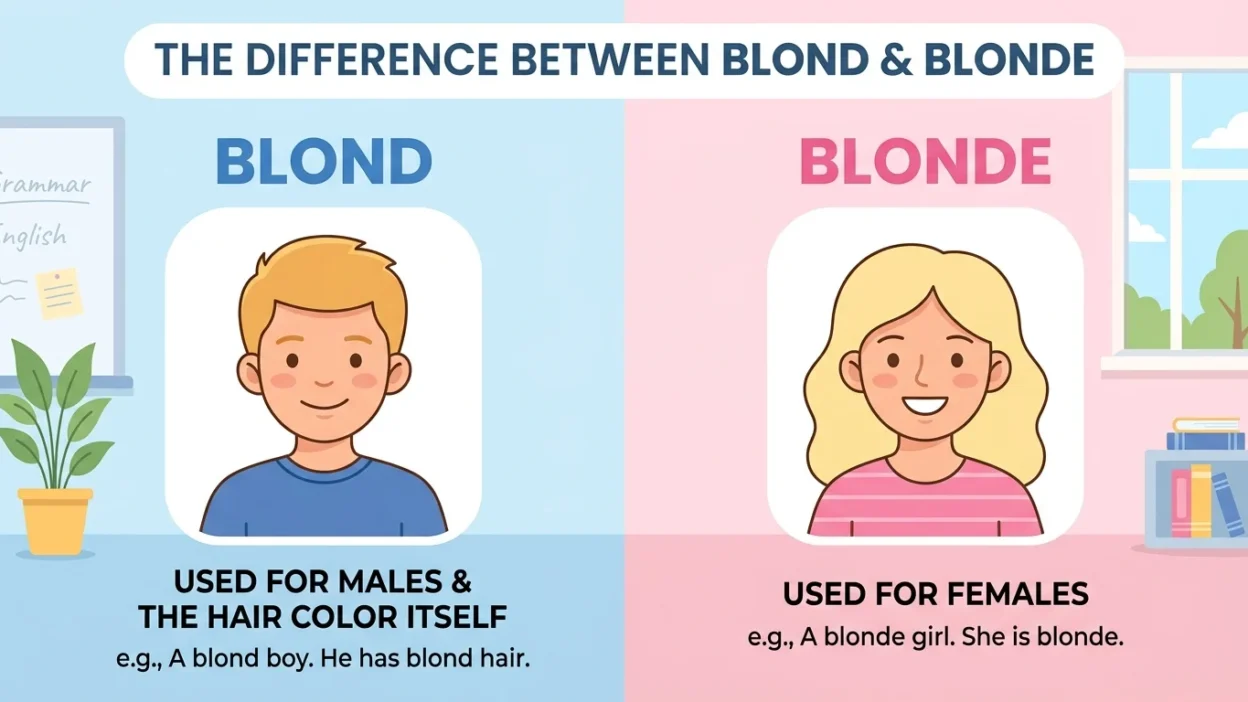
- Blond is often used for boys or men
- Blonde is often used for girls or women
- Both words mean light yellow or golden hair
- In modern English, especially in the US, “blond” is often used for everyone
- “Blonde” is still common in writing when talking about women
So, the difference is mostly about tradition and style, not meaning.
Origin and Background of the Words
The words “blond” and “blonde” come from the French language.
In French:
- “Blond” was used for masculine nouns (male form)
- “Blonde” was used for feminine nouns (female form)
English borrowed both words from French many years ago. At that time, English writers tried to keep the French style gender difference.
So:
- Men were called blond
- Women were called blonde
Over time, English became simpler. Many rules changed, and speakers started using both forms more freely. Today, the difference is less strict, but the old style is still seen in books, magazines, and formal writing.
Clear Explanation of the Difference
Even though both words mean the same hair color, there are small differences in usage.
Meaning
Both words describe:
- Light yellow hair
- Golden hair
- Pale or fair hair color
So meaning is NOT different.
Usage difference
The difference is mainly in how people use them:
- Blond
- Often used as an adjective (before a noun)
- Can describe men or boys
- Example: a blond boy, blond hair
- Blonde
- Often used as a noun for a woman
- Example: She is a blonde
- Also used as an adjective in some older or traditional writing
Modern English reality
Today, especially in American English:
- “Blond” is often used for people as an adjective
- “Blonde” is still used for women, especially in writing or storytelling
So, the difference is becoming smaller over time.
Comparison Table
| Feature | Blond | Blonde |
| Basic meaning | Light hair color | Light hair color |
| Gender use (traditional) | Male | Female |
| Used as noun | Rare | Common (for women) |
| Used as adjective | Common | Common (less strict today) |
| Modern English use | Often unisex | Mostly female reference |
| Example | a blond boy | a blonde girl |
This table shows that both words are very similar and only differ in style and tradition.
Which One to Use and When
If you are not sure which word to use, here is a simple guide:
Use “blond” when:
- You are writing generally about hair color
- You are describing a boy or man
- You want simple, modern English (especially in the US)
Examples:
- He has blond hair.
- The blond student is tall.
Use “blonde” when:
- You are talking about a woman as a noun
- You want traditional or descriptive style
- You are writing stories or older style English
Examples:
- She is a blonde.
- The blonde actress smiled.
Safe rule for beginners:
If you are unsure, you can use “blond” for everything in most modern writing. It is widely accepted.
Common Mistakes People Make
Many learners make small mistakes when using these words. Here are the most common ones:
- Thinking they have different meanings (they do not)
- Using “blonde” for everything without understanding context
- Believing “blond” is incorrect (it is not)
- Mixing spelling randomly without a pattern
- Thinking one is British and the other is American (not true)
The biggest mistake is thinking the difference is very strict. In reality, English is flexible here.
Everyday Real Life Examples
Let’s see how these words appear in daily life.
Social media posts
- “My friend is a blonde and she loves fashion.”
- “He is a blond guy from my class.”
News or articles
- “The blond athlete won the match.”
- “The blonde singer released a new song.”
Daily conversation
- “Do you know that blond boy from school?”
- “She is a natural blonde.”
Emails or informal writing
- “The blond student in your group is absent today.”
- “We met a blonde girl during the trip.”
These examples show that both words are used naturally in everyday English.
Short Learning Section for Students and Beginners
Here is a quick way to remember:
- Both words mean light colored hair
- “Blond” = more general and modern
- “Blonde” = often used for women
- The difference is about style, not meaning
Easy memory trick:
- Think “o = one style (general)” → blond
- Think “e = female ending” → blonde
This trick is not a grammar rule, but it helps beginners remember easily.
FAQ: Common Questions
Is blond and blonde the same thing?
Yes. Both words mean light or yellowish hair color. The difference is only in usage style.
Is blond only for men?
Traditionally, yes. But in modern English, it can be used for people.
Is blonde only for women?
Mostly yes in traditional usage, especially when used as a noun.
Which spelling is correct?
Both are correct. It depends on style and context.
Can I use blond for everything?
Yes. In modern writing, “blond” is often used for all genders, especially in American English.
Is one British and the other American?
No. Both are used in both British and American English.
Why are there two spellings?
The difference comes from French language rules that English borrowed long ago.
Do native speakers still follow this rule?
Some do, especially in formal writing. But many people do not strictly follow it anymore.
Conclusion
The difference between blond and blonde is very small and mostly traditional. Both words describe the same hair color: light, golden, or yellowish hair. The old rule said “blond” for men and “blonde” for women, but modern English is much more flexible.
Today, you can safely use “blond” in most situations, especially when writing simply. “Blonde” is still common when referring to women, especially in storytelling or descriptive writing.
The most important thing to remember is this: there is no difference in meaning—only in style and usage.

Anthony Charles is the founder and lead content creator at Meanefy.com, a platform dedicated to exploring word meanings, language nuances, and everyday curiosities. With a passion for language and a keen eye for detail, Anthony aims to make complex words and concepts simple and accessible for readers around the world.