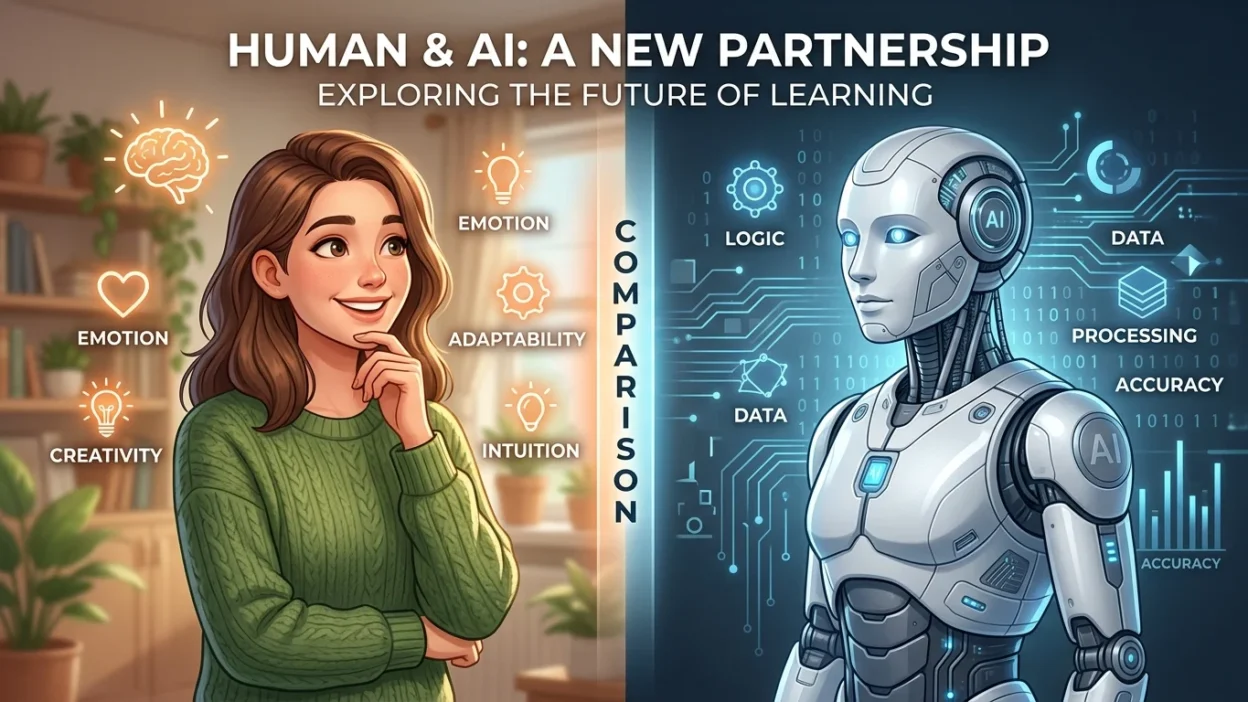
When I first interacted with a system that felt almost like a human, I noticed how easily we confuse ourselves between human and robot thinking. A robot is built as a programmable machine using metals, plastics, silicon chips, microprocessors, neural networks, and strict pre programmed code, while a human grows through biological tissue, cells, human brain, cognition, and biological consciousness.
The contrast becomes clearer when we compare emotions, empathy, creative intent, imagination, meaning, art, experience, and human effort with machine based task execution, user commands, tools, assist, emulate, efficiency, and automation.
In modern 2026 systems, a major technological leap is visible through physical AI, AI systems, multimodal foundation models, robotics, and intelligent machines working in homes, hospitals, factories, and unstructured environments. These systems depend on sensors, computer vision, Natural Language Processing (NLP), speech recognition (Whisper), LLMs, VLA models, object detection, and transformer models to achieve perception, reasoning, interaction, and environment awareness.
Even advanced humanoid robots like Figure AI, Tesla Optimus V3, and XPENG Iron use tactile sensors, artificial muscles, finger control, dexterity, and degrees of freedom to imitate natural movement and human like behavior, yet they still depend on electricity, lithium ion batteries, solid state batteries, and operating cycles, unlike humans powered by biochemical energy and survival instincts.
Quick Answer
Here is the simplest way to understand:
- A human is a living person who thinks, feels emotions, and makes decisions naturally.
- A robot is a machine or software that follows instructions and does not truly feel emotions.
- Humans can think freely, while robots follow patterns or programming.
- Humans make mistakes in natural ways, while robots often follow structured or repeatable behavior.
- Humans understand feelings deeply, while robots only simulate or copy emotional responses.
Simple Origin or Background
Humans have existed for thousands of years. We are biological beings made from nature. We learn from experience, emotions, and interaction with others.
Robots are much newer. They are created by humans using technology. Early robots were simple machines used in factories. They could do repeated tasks like lifting, moving, or assembling objects.
Now, robots are not only physical machines. Many are software based, like chatbots, virtual assistants, and AI systems. These systems can talk, write, and respond like humans, but they still follow code and data patterns.
So the key difference comes from origin:
- Humans come from nature.
- Robots come from human made technology.
Clear Explanation of the Difference
The main difference between humans and robots is how they think and respond.
Thinking ability
Humans think freely. They can imagine, create ideas, and change their mind at any time. Robots follow instructions based on data.
Emotions
Humans feel joy, sadness, anger, love, and fear. These emotions influence decisions. Robots do not truly feel emotions. They only copy emotional language when needed.
Learning style
Humans learn from real life experiences, mistakes, and feelings. Robots learn from data and training patterns.
Communication
Humans speak in flexible, natural ways. They can use slang, humor, or emotional expressions. Robots often use structured sentences and predictable responses.
Decision making
Humans can make unexpected decisions. Robots follow logic rules or programmed responses.
Comparison Table
| Feature | Human | Robot |
| Nature | Living being | Machine or software |
| Emotions | Real feelings | Simulated responses |
| Thinking | Creative and flexible | Based on data and rules |
| Learning | Experience based | Data and training based |
| Mistakes | Natural and random | Pattern or system errors |
| Communication | Emotional and flexible | Structured and predictable |
| Independence | High | Limited by programming |
Which One to Use and When
Humans and robots are not in competition. They are used for different purposes.
Use humans when:
- You need emotional understanding
- You need creative ideas
- You need personal care or advice
- You need deep judgment in complex situations
Use robots when:
- You need fast answers
- You need repetitive tasks done
- You need large amounts of data processed
- You need 24/7 support or automation
For example:
- A doctor (human) understands patient emotions and complex health issues.
- A chatbot (robot) answers simple health questions quickly.
Both are useful in their own ways.
Common Mistakes People Make
Many people get confused because of modern technology. Here are common mistakes:
- Thinking all fast answers are from robots
(Many humans also respond quickly) - Thinking robots are always correct
(Robots can give wrong or outdated information) - Thinking humans never sound robotic
(Humans can sound repetitive or scripted too) - Assuming emotional language means a human wrote it
(AI can copy emotional tone) - Believing robots understand meaning like humans
(They only process patterns, not real understanding)
Everyday Real Life Examples
Emails
Sometimes you get an email that says:
- “Thank you for contacting us. Your request is important to us.”
This may be written by a robot system or a human using a template.
News
In news writing:
- Humans research, analyze, and write stories.
- Robots may help generate summaries or alerts quickly.
Social Media
- Humans post opinions, jokes, and emotional thoughts.
- Robots may auto post updates or respond with fixed replies.
Daily Life
- Humans: teachers, friends, parents, doctors
- Robots: ATM machines, chatbots, automatic customer support
Even when robots help, humans are usually behind the system.
Short Learning Section for Students and Beginners
To remember easily:
- Human = Thinks + Feels + Chooses freely
- Robot = Follows rules + Processes data + No real feelings
Simple trick:
- If it “feels alive inside,” it is human.
- If it “follows instructions only,” it is a robot.
But be careful: modern AI can imitate humans very well, so you must look deeper than language style.
FAQ (Frequently Asked Questions)
Can robots think like humans?
No. Robots can process data and give answers, but they do not think or understand like humans.
Do robots have emotions?
No real emotions. They can only copy emotional language.
Can humans act like robots?
Yes. Humans can act very routine, repetitive, or emotionless, especially when tired or following strict rules.
Are chatbots robots?
Yes, they are software based robots. They are not physical machines but still follow programmed systems.
Can robots become human in the future?
They may become more advanced, but they will still be machines. Human life and machine systems are fundamentally different.
How can I tell if I am talking to a robot?
Look for:
- Very fast replies all the time
- Very structured or repetitive answers
- Lack of personal experience or real life feelings
But remember, advanced AI can still be hard to detect.
Why are robots used everywhere today?
Because they save time, reduce effort, and handle large tasks quickly.
Conclusion
Understanding the difference between humans and robots is important in today’s digital world. Humans are living beings with emotions, creativity, and free thinking. Robots are human made systems that follow instructions and process information.
While robots can imitate human language and behavior, they do not truly feel or understand like humans. Both humans and robots are useful, but in different ways.
If you remember one simple idea, let it be this:
Humans feel and think deeply, while robots follow patterns and rules.
This simple understanding will help you avoid confusion in daily life, online communication, and modern technology.

Daniel Matthew is a language enthusiast, writer, and contributor at Meanefy.com, where he explores the meanings, origins, and nuances of words and phrases. With a deep passion for language, Daniel aims to make complex concepts simple, engaging, and easy to understand for readers of all ages.